
Quick Conversion Table
| Brand | Equivalent | Match |
|---|---|---|
| Anchor | 887 | exact |
| Madeira | 2206 | close |
| Cosmo ⚠ | 771 | close |
| Sullivans | 45329 | close |
| J&P Coats | 2410 | close |
| Dimensions | 12410 | close |
| Bucilla | 3046 | close |
Nutmeg and Warm Spice: A Brown That Smells Like Autumn
Certain colors carry sensory associations so strong that looking at them is almost a multisensory experience. DMC 3046 is one of those threads. Medium Yellow Beige is the color of freshly grated nutmeg on a latte, of golden piecrust brushed with egg wash, of maple sugar candy still warm from the mold. It sits in that warm, approachable territory where brown meets gold and both agree to get along, creating a tone that's simultaneously comforting and sophisticated.
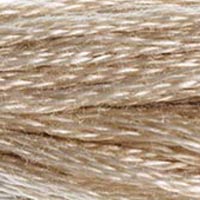
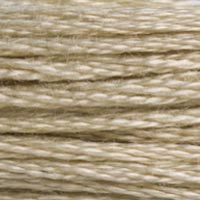
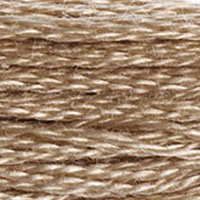
In the yellow beige family, 3046 occupies the comfortable middle ground between DMC 3045 (Dark Yellow Beige) and DMC 3047 (Light Yellow Beige), with DMC 167 (Very Dark Yellow Beige) anchoring the deepest end. At this middle value, the yellow-gold character is most apparent — 3046 is light enough for the warmth to read clearly but dark enough to register as a definite color rather than a pale neutral. On a color card, it catches your eye as something distinctly warm and appetizing.
Two strands of 3046 on 14-count white Aida produce a warm, honey-toned coverage that's immediately pleasing. The thread has good coverage characteristics — it fills the squares evenly without the thin spots that some lighter threads develop if your tension varies. On cream or ecru fabric, 3046 softens slightly, losing some of the contrast that makes it pop on white but gaining a naturalistic integration that works beautifully for landscape and nature pieces where you want the thread to feel like part of the earth rather than sitting on top of it.
Band Samplers and Decorative Borders
Band samplers — those horizontal compositions of repeated motifs separated by decorative borders — are one of cross-stitch's oldest and most enduring formats. Historically, they were stitched in whatever threads were available locally, which often meant naturally-dyed wools and linens in muted earth tones. Modern stitchers recreating these historical pieces reach for threads like 3046 constantly, because it captures the specific warmth of natural dyes — weld-dyed, onion-skin-dyed, or walnut-hull-dyed threads that produced exactly this kind of golden-brown-beige.
For a traditional band sampler, try 3046 as your primary decorative fill, paired with DMC 3045 for darker outline elements and DMC 3047 for the lightest fill sections. Add DMC 3721 (Dark Shell Pink) for the faded-red accents that characterize so many period pieces, and DMC 3011 (Dark Khaki Green) for the muted green motifs. This five-thread palette is historically plausible and visually harmonious — the kind of restrained, warm color scheme that reproduction sampler designers build entire collections around.
For contemporary band samplers with a modern twist, 3046 pairs surprisingly well with dusty blues — DMC 932 (Light Antique Blue) or DMC 931 (Medium Antique Blue). The warm brown-gold against cool, muted blue creates a complementary contrast that feels both classic and fresh. It's a combination that shows up in farmhouse-style home decor for a reason: it's warm without being cloying, traditional without being stuffy.
Straw, Thatch, and Woven Textures
When a design calls for straw — a thatched roof, a woven basket, a scarecrow's body, hay bales in a harvest scene — 3046 is the go-to mid-tone. It captures the sun-bleached, golden quality of dried grass without being as bright as a true gold or as dark as a proper brown. Real straw is a range of tones, and 3046 sits right where the eye expects the average to land.
For a thatched cottage roof, layer three values: DMC 3045 for the shadow areas under the eaves and in the thatch valleys, 3046 for the main body of the thatch, and 3047 for the sun-bleached ridgeline and any areas catching direct light. Use the English method (completing each cross before moving on) rather than the Danish method for straw textures — the slightly more irregular surface that English method produces mimics the uneven texture of actual thatch, where individual stalks catch light at different angles.
Basket weaving in cross-stitch benefits from the same three-value approach. Use 3045 for the under-weave (the parts that pass behind), 3046 for the main visible weave, and 3047 for the top surfaces catching light. The warm yellow-beige family reads as natural materials — reed, willow, rattan — in a way that neutral or cool browns simply cannot achieve.
The Middle of a Warm Gradient
Substituting the middle thread in a gradient family is trickier than substituting the endpoints, because the middle value has to relate correctly to the threads both above and below it. With DMC 3046, your substitute needs to sit precisely between 3045's darker warmth and 3047's lighter cream — too dark and it crowds 3045, too light and it disappears into 3047.
Anchor 887 is an exact match and integrates smoothly into the yellow beige family. It's the substitute I'd recommend without hesitation for any application, including gradient work where family coherence matters. Madeira 2206 is close and captures the golden warmth, though you may notice a very slight difference in the specific yellow-brown balance. For standalone use, it's perfectly fine. For gradient work, stitch a test next to your other values before committing.
Cosmo 771 covers similar territory and is worth trying, particularly if you're using Cosmo threads for other parts of the project. Cross-brand consistency within the yellow-beige range tends to be decent because the basic warm-gold-brown combination doesn't leave much room for interpretation.
Within DMC, the closest alternative is DMC 3782 (Light Mocha Brown), which matches closely in value but comes from the mocha family rather than the yellow beige family. The mocha sub-tone is slightly grayer, slightly less golden. In a mixed-palette design this difference is cosmetic at most. But in a yellow beige gradient where 3046 sits between 3045 and 3047, swapping in 3782 introduces a gray note that the adjacent threads don't share, and the eye picks up on it. Better to adjust your gradient by using 3045 and 3047 alone, skipping the middle step, than to insert a mismatched middle value.
Reference quality
How We Validate This Color Record
Use this page as a reference card for DMC 3046: the structured data, quick conversions, and long-form copy are all tied back to the same stored color record.
- Methodology
- This page renders DMC 3046, its hex value, and every brand equivalent from the site's source-of-truth color record, then checks long-form body copy against those same stored fields.
- Verification status
- Source-field checked. The page content is audited against the stored DMC number, brand equivalents, and match-quality labels before publishing.
- Last reviewed
- 2026-04-20
- Approximation warning
- Screen hex values, thread photos, and cross-brand conversions are reference aids. Dye lots, thread sheen, and fabric color can still shift the result in hand.
Decision guide
When to use the DMC 3046 reference page
This page should help you decide faster between palette planning, brand substitution, and shade comparison without turning the color record into a thin lookup page.
Best for
- + Palette planning when you want the stored DMC 3046 Medium Yellow Beige record, hex value #D8BC9A, and linked brand equivalents in one place.
- + Checking the quickest cross-brand shortlist before you buy floss, compare stash substitutes, or route into a more specific conversion page.
- + Finding nearby shades in the browns family before you commit to accents, shading, or background blends.
Watch for
- ! Screen previews are only reference aids. Medium Yellow Beige can shift on real fabric because thread sheen, stitch coverage, and room lighting change how the color reads.
- ! A stored equivalent is still a shortlist, not a guarantee that two brands will disappear into each other in the same stitched motif.
- ! Older charts, discontinued kit floss, and dye-lot variation can all introduce small but visible differences that the page cannot detect for you.
Before you commit
- Confirm the role of DMC 3046 Medium Yellow Beige: decide whether you need an exact hero shade, a forgiving background, or a rough stash substitute.
- Compare on project fabric: view the skein or stitched sample on the same fabric count and color you will actually use.
- Use the linked conversion pages next: open the brand-specific pages when you need match-quality caveats before substituting away from the DMC reference.
DMC 3046 FAQ
These questions appear on the page so the FAQ schema stays aligned with what visitors can actually read.
What is the Anchor equivalent of DMC 3046?+
The closest Anchor equivalent to DMC 3046 (Medium Yellow Beige) is Anchor 887. This is an exact match.
What color is DMC 3046?+
DMC 3046 is called "Medium Yellow Beige" and has a hex color value of #D8BC9A. It belongs to the browns color family.
What is the Madeira equivalent of DMC 3046?+
The closest Madeira equivalent to DMC 3046 (Medium Yellow Beige) is Madeira 2206. This is a close match.
How DMC 3046 Looks on Fabric
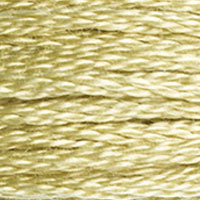
The same thread appears different depending on your fabric. Always test on your project fabric.
White Aida
Cream / Ecru
Black Aida
Pairs Well With
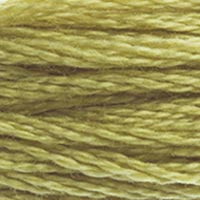
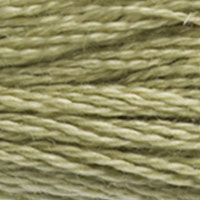
DMC colors commonly used alongside 3046 Medium Yellow Beige.
Suggested Palette
Shading Companions
Detailed Conversions
Where to Buy DMC 3046
This section contains affiliate links. We may earn a small commission at no cost to you.
Related Guides
Free Printable Thread Conversion Chart
Pick a brand, enter your email, and we'll send you a printable chart mapping all 552 DMC colors to that brand's equivalents. Zero spam, one chart.
Thanks! Here's your free chart:
Download Your ChartOpens in a new tab. Use your browser's Print → Save as PDF.
No spam. Your email is stored securely and never shared.