
Quick Conversion Table
| Brand | Equivalent | Match |
|---|---|---|
| Anchor | 831 | exact |
| Madeira | 1902 | close |
| Cosmo ⚠ | 366 | close |
| Sullivans | 45146 | close |
| J&P Coats | 5387 | close |
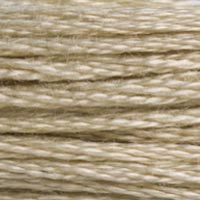
Fabric interaction is the defining characteristic of DMC 613 Very Light Drab Brown — arguably more than any other thread in the brown family. On crisp white 14-count Aida, it reads as a warm sandy tone with just enough brown to anchor it. On natural linen or antique-white evenweave, something interesting happens: the thread almost disappears into the ground fabric, pulling out only when surrounded by darker values. This chameleon quality makes 613 one of the most fabric-sensitive colors in your stash, and understanding it changes how you use it.
The "Drab" Family Explained
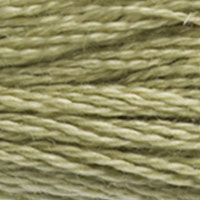
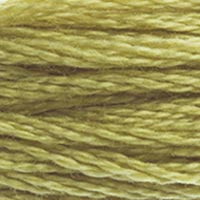
The word "drab" in embroidery thread naming doesn't mean boring — it's a traditional textile term for an undyed or barely-dyed earth cloth. DMC's drab brown family runs from the very dark 610 (which reads almost like military khaki) through 611, 612, and finally 613 at the lightest end. Each step is surprisingly distinct. DMC 612 Medium Drab Brown has a more assertive gray-brown presence, while 613 sits in territory so pale it sometimes gets mistaken for a warm cream. The distinction matters enormously when you're building naturalistic shading — 613 is where the highlights live in bark, driftwood, and aged linen textures.
Where 613 Earns Its Keep
Ask any stitcher who works nature-themed pieces and they'll have 613 in their kit. It's the thread that gives weathered wood its sun-bleached highlights, that brightens the tips of owl feathers, that reads as dry grass catching afternoon light. In full-coverage pieces, it often appears alongside DMC 610, DMC 611, and DMC 612 to build a complete bark or wood texture from dark base to light highlight. The transition from 610's deep khaki through to 613's sandy lightness creates shading that holds up even in large-scale pieces worked over-two on evenweave.
Needlepainters in particular reach for 613 when they need that specific warm highlight that's lighter than tan but not as yellow as DMC 676. It occupies a gap in the palette that no other color fills quite right. In portraits — human or animal — it works in skin highlights where you want warmth without the redness of a peach tone.
Parkng and Technique Notes
When parking multiple strands while working a complex shading sequence, 613 is easy to misplace at a glance because it reads so pale. A few stitchers mark their parked needles with small clips or needle minders when working this family. Because 613 sits at the extreme light end of the drab range, it requires careful railroading when laid alongside adjacent shades — the pale strands can twist in ways that make them read even lighter than they are, potentially blowing out your highlight effect. Running your finger along the thread before the stitch locks it down keeps the strands flat and maximizes coverage.
For backstitching detail lines over areas worked in 613, many designers specify DMC 610 or DMC 611 rather than jumping all the way to black. The result is a sketch-like quality that suits botanical and natural-history illustrations beautifully. If the backstitch needs to read stronger, DMC 898 Very Dark Coffee Brown provides more contrast without the harshness of black against such a light ground.
On darker fabrics — say, 28-count antique brown linen — 613 essentially becomes a near-white highlight, useful for eye reflections, snow highlights, or the gleam on smooth surfaces. This unexpected versatility across fabric colors is part of what makes building out the full drab family such a worthwhile investment for your stash.
Finding a truly close match for DMC 613 is easier than average because both Anchor 831 and Madeira 1902 rate as exact matches — genuinely rare across the brown family where brand interpretations tend to drift warm or cool. If you're working from an Anchor palette, 831 is a safe direct swap without color-checking.
The Cosmo 366 and Sullivans 45146 substitutions land in "close" territory. Cosmo 366 runs very slightly warmer and a touch more golden — acceptable in most contexts but worth comparing against your specific fabric before committing to a full skein purchase. Sullivans 45146 tends to have a marginally cooler cast. In a large fill area where 613 is the only highlight color, these differences might be noticeable. In a complex shading sequence with three or four browns, they'll blend in without issue.
Within the DMC range itself, if you find yourself mid-WIP with 613 run out and no replacement available, DMC 3864 Light Mocha Beige is the closest emergency substitute — it's slightly pinker but close enough for most work. DMC 3033 Very Light Mocha Brown is another possibility if you need something a shade lighter. Avoid DMC 712 Cream as a substitute — despite similar value, its warmth reads yellow against 613's neutral sandy tone, and the mismatch will show clearly in anything except the smallest areas.
Reference quality
How We Validate This Color Record
Use this page as a reference card for DMC 613: the structured data, quick conversions, and long-form copy are all tied back to the same stored color record.
- Methodology
- This page renders DMC 613, its hex value, and every brand equivalent from the site's source-of-truth color record, then checks long-form body copy against those same stored fields.
- Verification status
- Source-field checked. The page content is audited against the stored DMC number, brand equivalents, and match-quality labels before publishing.
- Last reviewed
- 2026-04-20
- Approximation warning
- Screen hex values, thread photos, and cross-brand conversions are reference aids. Dye lots, thread sheen, and fabric color can still shift the result in hand.
Decision guide
When to use the DMC 613 reference page
This page should help you decide faster between palette planning, brand substitution, and shade comparison without turning the color record into a thin lookup page.
Best for
- + Palette planning when you want the stored DMC 613 Very Light Drab Brown record, hex value #DCC4AA, and linked brand equivalents in one place.
- + Checking the quickest cross-brand shortlist before you buy floss, compare stash substitutes, or route into a more specific conversion page.
- + Finding nearby shades in the browns family before you commit to accents, shading, or background blends.
Watch for
- ! Screen previews are only reference aids. Very Light Drab Brown can shift on real fabric because thread sheen, stitch coverage, and room lighting change how the color reads.
- ! A stored equivalent is still a shortlist, not a guarantee that two brands will disappear into each other in the same stitched motif.
- ! Older charts, discontinued kit floss, and dye-lot variation can all introduce small but visible differences that the page cannot detect for you.
Before you commit
- Confirm the role of DMC 613 Very Light Drab Brown: decide whether you need an exact hero shade, a forgiving background, or a rough stash substitute.
- Compare on project fabric: view the skein or stitched sample on the same fabric count and color you will actually use.
- Use the linked conversion pages next: open the brand-specific pages when you need match-quality caveats before substituting away from the DMC reference.
DMC 613 FAQ
These questions appear on the page so the FAQ schema stays aligned with what visitors can actually read.
What is the Anchor equivalent of DMC 613?+
The closest Anchor equivalent to DMC 613 (Very Light Drab Brown) is Anchor 831. This is an exact match.
What color is DMC 613?+
DMC 613 is called "Very Light Drab Brown" and has a hex color value of #DCC4AA. It belongs to the browns color family.
What is the Madeira equivalent of DMC 613?+
The closest Madeira equivalent to DMC 613 (Very Light Drab Brown) is Madeira 1902. This is a close match.
How DMC 613 Looks on Fabric
The same thread appears different depending on your fabric. Always test on your project fabric.
White Aida
Cream / Ecru
Black Aida
Pairs Well With
DMC colors commonly used alongside 613 Very Light Drab Brown.
Suggested Palette
Shading Companions
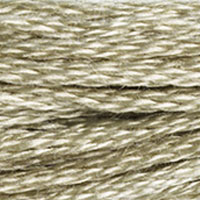
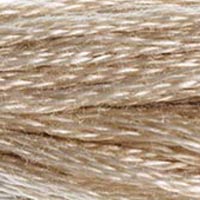
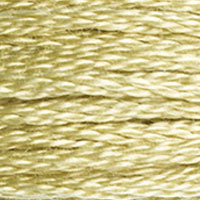
Detailed Conversions
Where to Buy DMC 613
This section contains affiliate links. We may earn a small commission at no cost to you.
Related Guides
Free Printable Thread Conversion Chart
Pick a brand, enter your email, and we'll send you a printable chart mapping all 552 DMC colors to that brand's equivalents. Zero spam, one chart.
Thanks! Here's your free chart:
Download Your ChartOpens in a new tab. Use your browser's Print → Save as PDF.
No spam. Your email is stored securely and never shared.