
Quick Conversion Table
| Brand | Equivalent | Match |
|---|---|---|
| Anchor | 98 | exact |
| Madeira | 0706 | close |
| Cosmo ⚠ | 282 | close |
| Sullivans | 45468 | close |
| J&P Coats | 4303 | close |
The Petal Blush That Solves a Stitcher's Problem
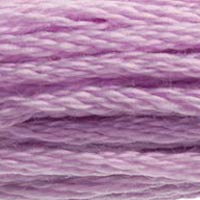
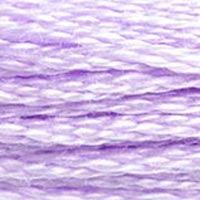
Here is a situation you have probably encountered: your pattern calls for a light purple, and you reach for DMC 211 (Light Lavender), but on white Aida it looks distinctly purple — too strong for the airy, barely-there quality you are trying to achieve. You need something lighter, something that reads as the memory of purple rather than purple itself. DMC 153 Very Light Violet is that thread. At #E6CCD9, it is a whisper of color — pink-leaning, warm, so pale it borders on blush but with just enough violet character to register as purple rather than pink.
This positioning makes 153 one of the most useful ultra-light purples in the DMC range. It is the lightest member of the solid violet family, and it serves the same role for purples that DMC 3713 (Very Light Salmon) serves for reds or DMC 3823 (Ultra Pale Yellow) serves for yellows — the final highlight step before you reach white. In any shading sequence that starts with DMC 550 (Very Dark Violet) and works through 552, 553, 554, and into the light values, 153 provides the last breath of color before the fabric shows through.
Nursery Designs and Delicate Palettes
Ultra-light colors tend to gravitate toward nursery and baby projects, and 153 is no exception. Birth samplers, baby milestone charts, first-birthday designs — these are the projects where 153 earns its keep. Paired with DMC 3747 (Very Light Blue Violet) for a cool accent and DMC 818 (Baby Pink) for a warmer companion, it creates the classic soft nursery palette that has been popular since Victorian christening samplers and shows no signs of falling out of favor.
But 153 is more versatile than the nursery pigeonhole suggests. It excels as a blush tone in portrait work — the subtle color that appears on cheekbones, earlobes, and the bridge of the nose where blood vessels sit close to the skin surface. Most stitchers think of pink for skin blush, but the lightest skin tones often carry a violet cast rather than a true pink one, and 153 captures that cooler blush accurately. Try it as a highlight color on fair skin alongside DMC 948 (Very Light Peach) and DMC 3770 (Very Light Tawny) for flesh tones that look genuinely luminous rather than flat.
Fabric Interaction and the Pale Color Challenge
Working with ultra-pale threads on white fabric demands attention to coverage. At this value level, any fabric showing through the stitches dilutes the already faint color further. Two strands on 14-count Aida is the minimum for 153 to read as a definite color rather than a suggestion of one. On 18-count, you may need to be especially careful about consistent tension and full stitch coverage — a loosely stitched area of 153 on white can virtually disappear.
Ironically, 153 becomes more visible and more useful on colored fabrics. On light blue Aida, it reads as a warm accent. On cream or ecru, the contrast between the warm fabric base and the cool violet shifts 153 into a clearly purple register that it loses on stark white. On black or dark navy fabric, 153 practically glows — the extreme contrast makes this whisper-pale thread look almost luminous, and it works beautifully for moonlight effects, ghostly imagery, or the pale inner petals of dark flowers.
One often-overlooked use: 153 makes an excellent blending partner in the needle. One strand of 153 combined with one strand of a more saturated purple — DMC 554 (Light Violet) or DMC 210 (Medium Lavender) — creates a lightened, softened version of the darker color. This is useful when your pattern's color sequence makes too large a jump between values. If the step from DMC 554 to white feels abrupt, a row or two of blended 554-plus-153 in between smooths the transition beautifully.
Matching the Faintest Violets
Anchor 98 is listed as an exact match, which is good news. Anchor's version captures the same warm, pink-leaning ultra-light violet character, and in side-by-side comparison the two are virtually indistinguishable. This is one of the cleaner cross-brand matches in the purple family, and if you need to substitute, Anchor 98 should serve without any visible difference in the finished piece.
Madeira 0706 is a close match. Madeira's slightly silkier finish can make ultra-light colors appear marginally more luminous, as the sheen catches and reflects more light than DMC's matte cotton. For highlight areas where you want maximum light-catching quality, this might actually be an improvement. For flat fill areas, the difference is negligible.
Cosmo 282 is rated close. Cosmo threads at this pale value tend to have excellent consistency, and the softer hand produces smooth, even coverage that helps maintain the delicate character of the color. Sullivans 45468 is also close, though Sullivans' coverage at ultra-light values can sometimes appear slightly thinner than DMC, so test on your project fabric.
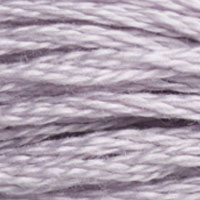
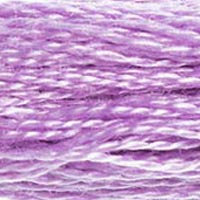
Within the DMC range, there is no direct substitute — 153 occupies a unique position as the lightest solid violet. DMC 3743 (Very Light Antique Violet) is close in value but shifts warmer and grayer, reading as dusty lavender rather than clean light violet. DMC 3747 (Very Light Blue Violet) is similar in lightness but cooler and bluer. If your design can tolerate a slight hue shift, either works. If the warm violet character of 153 specifically is what you need, stick with the cross-brand options rather than a DMC alternative.
Reference quality
How We Validate This Color Record
Use this page as a reference card for DMC 153: the structured data, quick conversions, and long-form copy are all tied back to the same stored color record.
- Methodology
- This page renders DMC 153, its hex value, and every brand equivalent from the site's source-of-truth color record, then checks long-form body copy against those same stored fields.
- Verification status
- Source-field checked. The page content is audited against the stored DMC number, brand equivalents, and match-quality labels before publishing.
- Last reviewed
- 2026-04-20
- Approximation warning
- Screen hex values, thread photos, and cross-brand conversions are reference aids. Dye lots, thread sheen, and fabric color can still shift the result in hand.
Decision guide
When to use the DMC 153 reference page
This page should help you decide faster between palette planning, brand substitution, and shade comparison without turning the color record into a thin lookup page.
Best for
- + Palette planning when you want the stored DMC 153 Very Light Violet record, hex value #E6CCD9, and linked brand equivalents in one place.
- + Checking the quickest cross-brand shortlist before you buy floss, compare stash substitutes, or route into a more specific conversion page.
- + Finding nearby shades in the purples family before you commit to accents, shading, or background blends.
Watch for
- ! Screen previews are only reference aids. Very Light Violet can shift on real fabric because thread sheen, stitch coverage, and room lighting change how the color reads.
- ! A stored equivalent is still a shortlist, not a guarantee that two brands will disappear into each other in the same stitched motif.
- ! Older charts, discontinued kit floss, and dye-lot variation can all introduce small but visible differences that the page cannot detect for you.
Before you commit
- Confirm the role of DMC 153 Very Light Violet: decide whether you need an exact hero shade, a forgiving background, or a rough stash substitute.
- Compare on project fabric: view the skein or stitched sample on the same fabric count and color you will actually use.
- Use the linked conversion pages next: open the brand-specific pages when you need match-quality caveats before substituting away from the DMC reference.
DMC 153 FAQ
These questions appear on the page so the FAQ schema stays aligned with what visitors can actually read.
What is the Anchor equivalent of DMC 153?+
The closest Anchor equivalent to DMC 153 (Very Light Violet) is Anchor 98. This is an exact match.
What color is DMC 153?+
DMC 153 is called "Very Light Violet" and has a hex color value of #E6CCD9. It belongs to the purples color family.
What is the Madeira equivalent of DMC 153?+
The closest Madeira equivalent to DMC 153 (Very Light Violet) is Madeira 0706. This is a close match.
How DMC 153 Looks on Fabric
The same thread appears different depending on your fabric. Always test on your project fabric.
White Aida
Cream / Ecru
Black Aida
Pairs Well With
DMC colors commonly used alongside 153 Very Light Violet.
Suggested Palette
Shading Companions
Detailed Conversions
Where to Buy DMC 153
This section contains affiliate links. We may earn a small commission at no cost to you.
Related Guides
Free Printable Thread Conversion Chart
Pick a brand, enter your email, and we'll send you a printable chart mapping all 552 DMC colors to that brand's equivalents. Zero spam, one chart.
Thanks! Here's your free chart:
Download Your ChartOpens in a new tab. Use your browser's Print → Save as PDF.
No spam. Your email is stored securely and never shared.