
Quick Conversion Table
| Brand | Equivalent | Match |
|---|---|---|
| Anchor | 328 | exact |
| Madeira | 0302 | close |
| Cosmo ⚠ | 441 | close |
| Sullivans | 45341 | close |
| J&P Coats | 2323 | close |
| Dimensions | 13332 | close |
| Bucilla | 13341 | close |
| Candamar | 6154 | close |
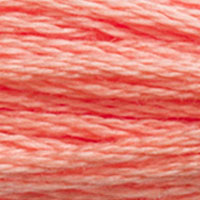
Color psychology has something interesting to say about apricot: it's one of those rare warm tones that tends to read as genuinely friendly and approachable across a wide range of viewers and contexts. Pure orange can feel aggressive; pale peach can feel insipid; apricot sits in the comfortable middle — warm, inviting, energetic without being demanding. DMC 3341 Apricot embodies this perfectly. It's a mid-value orange-peach that has enough warmth to be vivid but enough lightness to feel welcoming rather than intense.
The Classic Gradient Position
In the apricot family, DMC 3341 Apricot sits as the lighter, more peachy companion to DMC 3340 (Medium Apricot). Where 3340 is clearly orange, 3341 has moved noticeably toward the peach end — it's still decidedly warm-orange, but the lightening has softened the orange character and introduced more of a salmon-peach quality. This makes 3341 the more versatile thread in the family: it bridges orange and peach palettes naturally, whereas 3340 belongs firmly in the orange camp.
In sunset gradient designs, DMC 3341 typically handles the mid-sky territory — above the deepest orange-red at the horizon, below the yellowing upper sky. In floral designs, it represents the mid-tone of apricot-colored blooms — the main petal area that receives normal light without being in full highlight or deep shadow. In fruit illustrations, it's the sun-facing side of a ripe apricot before the skin takes on its deepest orange color.
Skin Tone Applications
The warm peachy-orange of DMC 3341 puts it squarely in the useful zone for lighter skin tone highlights. For fair and light complexions, the warm peach tones used in full-light areas of the face often fall in this range — the sun-touched warmth of a forehead or cheekbone in direct light, the warm blush of a lit nose tip. Pair it with DMC 353 (Peach) for the very lightest areas and DMC 3340 (Medium Apricot) for the slightly deeper lit areas to build a convincing warm-complexion highlight gradient.
Portrait cross-stitch using Japanese pattern booklets (which have produced some of the most technically sophisticated portrait designs in the stitching world) often calls for complex skin tone gradients in the peachy-orange range, and DMC 3341 regularly appears as a key mid-value in these palette specifications.
Seasonal and Thematic Context
Summer abundance and harvest themes are natural fits for apricot tones. DMC 3341 appears in designs depicting stone fruits, summer flowers (zinnias, marigolds, rudbeckia), warm afternoon light effects, and the generally warm visual richness of midsummer. Combined with DMC 743 (Medium Yellow) and DMC 3340 (Medium Apricot), it builds the warm-orange-to-yellow range of a sunflower palette — one of the most requested color combinations in cross-stitch design.
Autumn harvest designs use DMC 3341 for certain fruits (peaches, nectarines) and for general harvest warmth — it has a ripe, abundant quality that suits harvest themes without pushing into the deeper oranges and rusts of fully turned autumn foliage.
Anchor 328 and Madeira 0302 are both exact matches for DMC 3341, making substitution within these brands reliable and straightforward. The apricot range is consistently well-matched across these three brands. Cosmo 441 and Sullivans 45341 are listed as close; in the apricot-peach range where saturation can vary more noticeably, checking these in person before using in a prominent role is worthwhile.
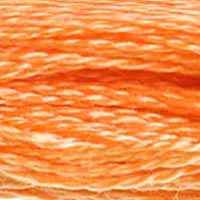
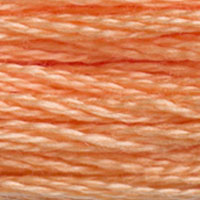
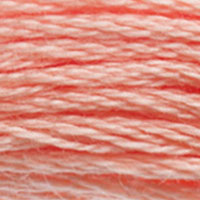
Within the DMC range, DMC 3340 (Medium Apricot) is darker and more orange — appropriate if you need a deeper apricot tone. DMC 3824 (Light Apricot) is lighter and more peachy, suitable if you need to step the color further toward pale peach. DMC 353 (Peach) is the thread that bridges apricot into the true peach family and can substitute for 3341 in contexts where a slightly lighter, more pink-peach result is acceptable.
For stash-based approximation when DMC 3341 is unavailable: a blended needle with one strand of DMC 3340 and one strand of DMC 353 creates a mid-apricot tone that sits close to 3341's value and character. The blend won't be perfectly uniform but will read correctly from a normal viewing distance in most designs. If you're buying multiple skeins for a large project, check that they're from the same dye lot — apricot-range threads can show noticeable variation between lots in some batches.
Reference quality
How We Validate This Color Record
Use this page as a reference card for DMC 3341: the structured data, quick conversions, and long-form copy are all tied back to the same stored color record.
- Methodology
- This page renders DMC 3341, its hex value, and every brand equivalent from the site's source-of-truth color record, then checks long-form body copy against those same stored fields.
- Verification status
- Source-field checked. The page content is audited against the stored DMC number, brand equivalents, and match-quality labels before publishing.
- Last reviewed
- 2026-04-20
- Approximation warning
- Screen hex values, thread photos, and cross-brand conversions are reference aids. Dye lots, thread sheen, and fabric color can still shift the result in hand.
Decision guide
When to use the DMC 3341 reference page
This page should help you decide faster between palette planning, brand substitution, and shade comparison without turning the color record into a thin lookup page.
Best for
- + Palette planning when you want the stored DMC 3341 Apricot record, hex value #FCAB98, and linked brand equivalents in one place.
- + Checking the quickest cross-brand shortlist before you buy floss, compare stash substitutes, or route into a more specific conversion page.
- + Finding nearby shades in the oranges family before you commit to accents, shading, or background blends.
Watch for
- ! Screen previews are only reference aids. Apricot can shift on real fabric because thread sheen, stitch coverage, and room lighting change how the color reads.
- ! A stored equivalent is still a shortlist, not a guarantee that two brands will disappear into each other in the same stitched motif.
- ! Older charts, discontinued kit floss, and dye-lot variation can all introduce small but visible differences that the page cannot detect for you.
Before you commit
- Confirm the role of DMC 3341 Apricot: decide whether you need an exact hero shade, a forgiving background, or a rough stash substitute.
- Compare on project fabric: view the skein or stitched sample on the same fabric count and color you will actually use.
- Use the linked conversion pages next: open the brand-specific pages when you need match-quality caveats before substituting away from the DMC reference.
DMC 3341 FAQ
These questions appear on the page so the FAQ schema stays aligned with what visitors can actually read.
What is the Anchor equivalent of DMC 3341?+
The closest Anchor equivalent to DMC 3341 (Apricot) is Anchor 328. This is an exact match.
What color is DMC 3341?+
DMC 3341 is called "Apricot" and has a hex color value of #FCAB98. It belongs to the oranges color family.
What is the Madeira equivalent of DMC 3341?+
The closest Madeira equivalent to DMC 3341 (Apricot) is Madeira 0302. This is a close match.
DMC 3341 Apricot earns its place in a surprisingly wide range of project categories. Summer florals are perhaps the strongest case: zinnias, marigolds, rudbeckia, California poppies, and the many cultivated flowers that come in apricot-orange shades all use 3341 as either a primary fill or a key mid-tone. The thread photographs warm and inviting — it performs well in the social media showcase photos that have become part of the cross-stitch community's culture, which contributes to its popularity in pattern designs aimed at contemporary stitchers.
Food illustration designs (citrus, stone fruits, tropical fruit arrangements) rely on the apricot family for the warm-orange tones that distinguish ripe, appetizing fruit from pale or overly brown renderings. Kitchen-themed and recipe-card-inspired cross-stitch pieces are a growing pattern category, and DMC 3341 appears frequently in these designs for both fruit and warm wooden or ceramic surface tones. Baby and nursery designs continue to be a core use case — the friendly warmth of apricot reads as welcoming and cheerful, and the thread works naturally alongside soft pinks, yellows, and mint greens in nursery color palettes. Birth samplers and baby milestone pieces frequently include this thread.
How DMC 3341 Looks on Fabric
The same thread appears different depending on your fabric. Always test on your project fabric.
White Aida
Cream / Ecru
Black Aida
Pairs Well With
DMC colors commonly used alongside 3341 Apricot.
Suggested Palette
Shading Companions
Detailed Conversions
Where to Buy DMC 3341
This section contains affiliate links. We may earn a small commission at no cost to you.
Related Guides
Free Printable Thread Conversion Chart
Pick a brand, enter your email, and we'll send you a printable chart mapping all 552 DMC colors to that brand's equivalents. Zero spam, one chart.
Thanks! Here's your free chart:
Download Your ChartOpens in a new tab. Use your browser's Print → Save as PDF.
No spam. Your email is stored securely and never shared.