
Quick Conversion Table
| Brand | Equivalent | Match |
|---|---|---|
| Anchor | 1047 | exact |
| Madeira | 2301 | close |
| Cosmo ⚠ | 127 | close |
| Sullivans | 45087 | close |
| J&P Coats | 5351 | close |
| Dimensions | 6402 | close |
| Bucilla | 3402 | close |
| Candamar | 6274 | close |
Where Brown Dissolves into Peach
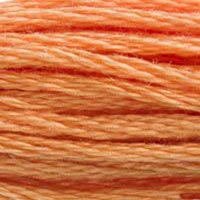
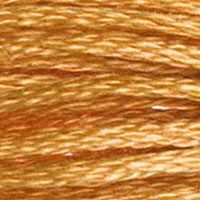
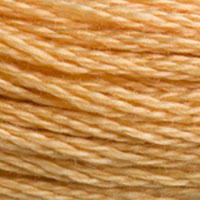
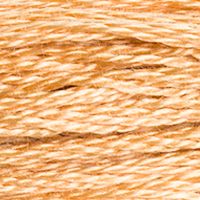
If you pulled a toffee until it turned translucent and held it up to a window, you'd see DMC 402. This is the lightest member of the mahogany family, and at this end of the gradient, "brown" barely applies. The thread is a warm, peachy apricot with just enough brown heritage to keep it grounded — think of the highlight on a caramel candy, the sunlit face of a terracotta pot, or the lightest stripe on a piece of tiger's-eye stone. It's one of those colors that people struggle to name when they see it stitched: not quite peach, not quite tan, not quite flesh tone, but somewhere in that warm, glowing territory.
What makes 402 indispensable is its role as a transition thread. Designs that use the full mahogany sequence — DMC 300 (Very Dark Mahogany) through 301, 400, and 401 — need somewhere to go at the top of the gradient, and 402 provides the exit ramp from brown into light. Without it, the mahogany family ends abruptly at mid-tone, leaving you with a shading sequence that runs out of room before it reaches the highlights. With 402, you can carry a warm brown surface all the way from deep shadow to sunlit highlight without ever leaving the red-warm color family.
Confection and Caramel Gradients
In the world of food-themed cross-stitch — and yes, that is a whole world — DMC 402 is the color of caramel at its lightest, butterscotch candy in a wrapper, golden toffee before it cools to darkness, the amber edge of a creme brulee. If you're stitching a dessert sampler or a kitchen-themed piece, 402 works alongside DMC 976 (Medium Golden Brown) for the deeper caramel tones and DMC 945 (Tawny) for the buttery highlights on golden baked goods. It's the kind of thread that makes cross-stitched food look appetizing rather than flat.
Bread and baking patterns use 402 extensively. The crust of a freshly baked baguette isn't a single color — it ranges from deep brown on the scoring lines to this exact peachy-golden tone on the thinnest, most blistered parts of the crust where the dough stretched taut in the oven. For a full bread palette, start with DMC 400 (Dark Mahogany) for the deep crust scoring, move through DMC 976 for the main crust body, bring in 402 for the lightest crust highlights, and use DMC 739 (Ultra Very Light Tan) for the flour-dusted areas. The result is a loaf that looks convincingly baked rather than uniformly brown.
Skin Tone Applications and Fabric Sensitivity
Because 402 sits in that peach-brown intersection, it occasionally appears in skin tone palettes — particularly for lighter skin with warm undertones, where it can serve as a highlight or blush area color. It pairs well with DMC 950 (Light Desert Sand) as a base and DMC 407 (Medium Cocoa) for shadows when building warm-toned complexions. However, the red undertone from the mahogany heritage means it reads slightly more apricot than a pure peach like DMC 353, so check your specific pattern's intention before swapping it into a flesh tone sequence that wasn't designed around the mahogany family.
Fabric choice has a dramatic effect on how 402 reads. On white Aida, the peachy warmth is fully visible and the thread looks distinctly orange-tinged. On cream fabric, it mellows and looks more genuinely tan. On natural linen, 402 can almost disappear into the fabric if the linen is a warm golden color — the thread and the fabric are close neighbors, which creates a soft, barely-there effect that's beautiful for subtle highlights but terrible for areas that need to read as a distinct color. Test before you commit, especially on hand-dyed linens that can vary significantly in warmth.
Two strands on 14-count provide good coverage, but because this is a very light thread, any tiny bit of dark fabric showing between stitches is more visible than it would be with a darker color. Make sure your crosses are complete and your tension is even. On 18-count, railroading helps — the smooth, flat surface maximizes the warm glow that is this thread's defining quality. Thread painting and long-stitch embroidery projects love 402 because the extended stitch length lets light play along the surface, enhancing the warm, luminous character.
The Peach-Brown Balance
At this light a value, small shifts in hue become very visible. A substitute that's even slightly too orange will look like a peach; slightly too yellow and it looks like a tan. You need that specific warm apricot quality — brown's last whisper before it becomes peach.
Anchor 1047 is rated exact, and it's a reliable swap that preserves the warm, peachy-brown character. Madeira 2301 also matches exactly and tends to carry the warmth gracefully — at this light a value, Madeira's sheen is noticeable and can add a subtle glow that works well for highlight applications. Both are safe choices for maintaining gradient integrity if you're using 402 alongside other mahogany family members.
Cosmo 127 is close and generally works, though some stitchers find the Cosmo version reads a hair more orange than the DMC. In a standalone application where 402 isn't part of a gradient, this slight difference is unlikely to matter. In a four- or five-step mahogany sequence, even a small hue shift at the highlight end can make the gradient feel like it drifts off course. Sullivans 45087 gets you into the right general area — verify in daylight, where warm artificial light won't mask an underlying coolness.
Within DMC, the nearest alternatives are DMC 945 (Tawny), which is similarly light and warm but slightly more yellow-golden, and DMC 951 (Light Tawny), which is lighter still and less peachy. DMC 3856 (Ultra Very Light Mahogany) is worth checking too — it's from the same color thinking and might be closer to what your specific pattern needs than a cross-brand substitute. Avoid substituting with DMC 353 (Peach), which looks similar in isolation but lacks the brown parentage that keeps 402 grounded in earthy warmth.
Reference quality
How We Validate This Color Record
Use this page as a reference card for DMC 402: the structured data, quick conversions, and long-form copy are all tied back to the same stored color record.
- Methodology
- This page renders DMC 402, its hex value, and every brand equivalent from the site's source-of-truth color record, then checks long-form body copy against those same stored fields.
- Verification status
- Source-field checked. The page content is audited against the stored DMC number, brand equivalents, and match-quality labels before publishing.
- Last reviewed
- 2026-04-20
- Approximation warning
- Screen hex values, thread photos, and cross-brand conversions are reference aids. Dye lots, thread sheen, and fabric color can still shift the result in hand.
Decision guide
When to use the DMC 402 reference page
This page should help you decide faster between palette planning, brand substitution, and shade comparison without turning the color record into a thin lookup page.
Best for
- + Palette planning when you want the stored DMC 402 Very Light Mahogany record, hex value #F7A777, and linked brand equivalents in one place.
- + Checking the quickest cross-brand shortlist before you buy floss, compare stash substitutes, or route into a more specific conversion page.
- + Finding nearby shades in the browns family before you commit to accents, shading, or background blends.
Watch for
- ! Screen previews are only reference aids. Very Light Mahogany can shift on real fabric because thread sheen, stitch coverage, and room lighting change how the color reads.
- ! A stored equivalent is still a shortlist, not a guarantee that two brands will disappear into each other in the same stitched motif.
- ! Older charts, discontinued kit floss, and dye-lot variation can all introduce small but visible differences that the page cannot detect for you.
Before you commit
- Confirm the role of DMC 402 Very Light Mahogany: decide whether you need an exact hero shade, a forgiving background, or a rough stash substitute.
- Compare on project fabric: view the skein or stitched sample on the same fabric count and color you will actually use.
- Use the linked conversion pages next: open the brand-specific pages when you need match-quality caveats before substituting away from the DMC reference.
DMC 402 FAQ
These questions appear on the page so the FAQ schema stays aligned with what visitors can actually read.
What is the Anchor equivalent of DMC 402?+
The closest Anchor equivalent to DMC 402 (Very Light Mahogany) is Anchor 1047. This is an exact match.
What color is DMC 402?+
DMC 402 is called "Very Light Mahogany" and has a hex color value of #F7A777. It belongs to the browns color family.
What is the Madeira equivalent of DMC 402?+
The closest Madeira equivalent to DMC 402 (Very Light Mahogany) is Madeira 2301. This is a close match.
How DMC 402 Looks on Fabric
The same thread appears different depending on your fabric. Always test on your project fabric.
White Aida
Cream / Ecru
Black Aida
Pairs Well With
DMC colors commonly used alongside 402 Very Light Mahogany.
Suggested Palette
Shading Companions
Detailed Conversions
Where to Buy DMC 402
This section contains affiliate links. We may earn a small commission at no cost to you.
Related Guides
Free Printable Thread Conversion Chart
Pick a brand, enter your email, and we'll send you a printable chart mapping all 552 DMC colors to that brand's equivalents. Zero spam, one chart.
Thanks! Here's your free chart:
Download Your ChartOpens in a new tab. Use your browser's Print → Save as PDF.
No spam. Your email is stored securely and never shared.