
Quick Conversion Table
| Brand | Equivalent | Match |
|---|---|---|
| Anchor | 860 | exact |
| Madeira | 1512 | close |
| Cosmo ⚠ | 924 | close |
| Sullivans | 45118 | close |
| J&P Coats | 6316 | close |
| Dimensions | 16316 | close |
| Bucilla | 522 | close |
The Herb Garden Workhorse
If you've ever grown sage in a garden — actual culinary sage, Salvia officinalis — you know that its leaves aren't the soft silver-sage of paint swatches. A mature sage plant in good health produces leaves that are distinctly green with a grey-green dustiness, somewhere between olive and celadon, with just enough yellow warmth to feel alive. DMC 522 is that sage leaf in thread form. It's the middle child of the fern green family (520/522/523/524), and like many middle children, it does the most work while getting the least attention.
Pattern designers lean on 522 for exactly this reason: it's a green that doesn't demand to be noticed. Use it for the bulk of a foliage background and it recedes, letting flowers and figures come forward. Use it for the main body of a leaf and it reads as convincingly botanical without competing with the design's focal point. It's the kind of thread you burn through three skeins of and never think to mention when someone asks what colors you used — but pull it out, and the whole piece loses its sense of living, breathing greenery.
Rosemary, Thyme, and the Kitchen Sampler
Kitchen herb samplers have seen a resurgence in pattern design, and DMC 522 appears in nearly all of them. Its particular value — not too dark to look dead, not too light to look washed out — makes it the default for the bushy, full-bodied herbs: rosemary sprigs, thyme clusters, oregano mounds. Where 520 gives you the darker shadows within those herb bundles and 523 catches the light on the top surfaces, 522 fills in the mass of the plant itself.
The grey-green quality matters for herb illustrations specifically because most kitchen herbs aren't pure green. They have that dusty, almost matte quality that comes from the fine hairs on their leaves (trichomes, if you want the botanical term). 522 captures this better than the parrot greens or the Christmas greens, which are too vivid and too blue for convincing herb work. Pair 522 with DMC 3012 (Medium Khaki Green) for thyme's warmer, more golden cast, and with DMC 3052 (Medium Green Grey) for the cool, almost blue-grey of lavender foliage.
Beyond herb samplers, 522 is a standout in woodland scene designs. It reads as lichen on stone, as the muted canopy of a forest in overcast light, as the green that appears on old wooden fences after years of weather. Nora Corbett's fairy designs and Mirabilia's garden scenes frequently call for this family, using 522 as the foundational foliage tone that other, brighter greens play against.
Managing Green Gradients Across a Large Project
One of the trickier aspects of the fern green family is maintaining visual consistency across a large piece. If your project involves hundreds or thousands of stitches in 522, tension variations and strand twist can create subtle patches of lighter and darker green within what should be a uniform area. This happens because the thread's grey-green character is sensitive to how light reflects off the stitches — a perfectly flat, railroaded stitch shows more yellow-green warmth, while a twisted stitch traps shadow and appears cooler and darker.
The solution is consistent technique, which sounds obvious but requires real discipline over a multi-month project. Railroad every stitch. Maintain even tension. If you're using a scroll frame, check periodically that your fabric tension hasn't changed as you've stitched — sagging fabric creates looser stitches that catch light differently. On 14-count Aida with two strands, 522 gives excellent coverage with good color fidelity. On 28-count linen over two, the fabric's natural texture adds to the organic quality of the color in a way that feels right for this particular shade.
Finding 522's Dusty Character in Other Brands
The key quality to preserve when substituting DMC 522 is that grey-green muting — the dustiness that makes it read as sage or lichen rather than vivid leaf. A substitute that's too clean and too green will pop forward in a design where 522 was meant to sit quietly in the background.
Anchor 860 nails it. The grey-green balance, the value, the coverage — all align well enough for seamless substitution even mid-skein. Madeira 1512 is equally reliable, though some stitchers notice Madeira's twist creates slightly rounder stitches on Aida, which can subtly affect how the color reads in large fill areas. Neither difference is likely to be visible in the finished piece unless you're stitching at very high count.
Cosmo 924 is where you'll want to be more careful. It captures the value but may not fully replicate the grey muting, leaning instead toward a cleaner, slightly more vivid green. For projects where 522 is one of many background greens, this is a perfectly acceptable trade-off. For projects where the fern green family is the dominant palette — a woodland scene, a tapestry reproduction — test Cosmo 924 against your 520 and 523 to confirm the family still reads as cohesive.
Don't reach for DMC 3363 (Medium Pine Green) as a DMC-internal swap. Despite occupying a similar value range, 3363 is cooler and bluer, lacking the warm yellow undertone that gives 522 its distinctly fern-like character. DMC 3052 (Medium Green Grey) is closer in mood but lighter in value, serving a different purpose in most palettes.
Reference quality
How We Validate This Color Record
Use this page as a reference card for DMC 522: the structured data, quick conversions, and long-form copy are all tied back to the same stored color record.
- Methodology
- This page renders DMC 522, its hex value, and every brand equivalent from the site's source-of-truth color record, then checks long-form body copy against those same stored fields.
- Verification status
- Source-field checked. The page content is audited against the stored DMC number, brand equivalents, and match-quality labels before publishing.
- Last reviewed
- 2026-04-20
- Approximation warning
- Screen hex values, thread photos, and cross-brand conversions are reference aids. Dye lots, thread sheen, and fabric color can still shift the result in hand.
Decision guide
When to use the DMC 522 reference page
This page should help you decide faster between palette planning, brand substitution, and shade comparison without turning the color record into a thin lookup page.
Best for
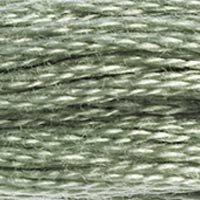
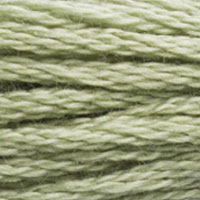
- + Palette planning when you want the stored DMC 522 Fern Green record, hex value #969E7E, and linked brand equivalents in one place.
- + Checking the quickest cross-brand shortlist before you buy floss, compare stash substitutes, or route into a more specific conversion page.
- + Finding nearby shades in the greens family before you commit to accents, shading, or background blends.
Watch for
- ! Screen previews are only reference aids. Fern Green can shift on real fabric because thread sheen, stitch coverage, and room lighting change how the color reads.
- ! A stored equivalent is still a shortlist, not a guarantee that two brands will disappear into each other in the same stitched motif.
- ! Older charts, discontinued kit floss, and dye-lot variation can all introduce small but visible differences that the page cannot detect for you.
Before you commit
- Confirm the role of DMC 522 Fern Green: decide whether you need an exact hero shade, a forgiving background, or a rough stash substitute.
- Compare on project fabric: view the skein or stitched sample on the same fabric count and color you will actually use.
- Use the linked conversion pages next: open the brand-specific pages when you need match-quality caveats before substituting away from the DMC reference.
DMC 522 FAQ
These questions appear on the page so the FAQ schema stays aligned with what visitors can actually read.
What is the Anchor equivalent of DMC 522?+
The closest Anchor equivalent to DMC 522 (Fern Green) is Anchor 860. This is an exact match.
What color is DMC 522?+
DMC 522 is called "Fern Green" and has a hex color value of #969E7E. It belongs to the greens color family.
What is the Madeira equivalent of DMC 522?+
The closest Madeira equivalent to DMC 522 (Fern Green) is Madeira 1512. This is a close match.
How DMC 522 Looks on Fabric
The same thread appears different depending on your fabric. Always test on your project fabric.
White Aida
Cream / Ecru
Black Aida
Pairs Well With
DMC colors commonly used alongside 522 Fern Green.
Suggested Palette
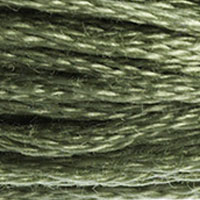
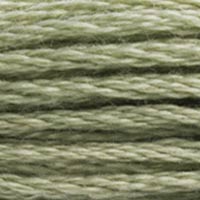
Shading Companions
Detailed Conversions
Where to Buy DMC 522
This section contains affiliate links. We may earn a small commission at no cost to you.
Related Guides
Free Printable Thread Conversion Chart
Pick a brand, enter your email, and we'll send you a printable chart mapping all 552 DMC colors to that brand's equivalents. Zero spam, one chart.
Thanks! Here's your free chart:
Download Your ChartOpens in a new tab. Use your browser's Print → Save as PDF.
No spam. Your email is stored securely and never shared.