
Quick Conversion Table
| Brand | Equivalent | Match |
|---|---|---|
| Anchor | 1038 | exact |
| Madeira | 1002 | close |
| Cosmo ⚠ | 252 | close |
| Sullivans | 45116 | close |
| J&P Coats | 7159 | close |
| Dimensions | 6009 | close |
| Bucilla | 6009 | close |
| Candamar | 6279 | close |
How This Blue Photographs Versus How It Actually Looks
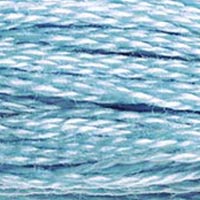
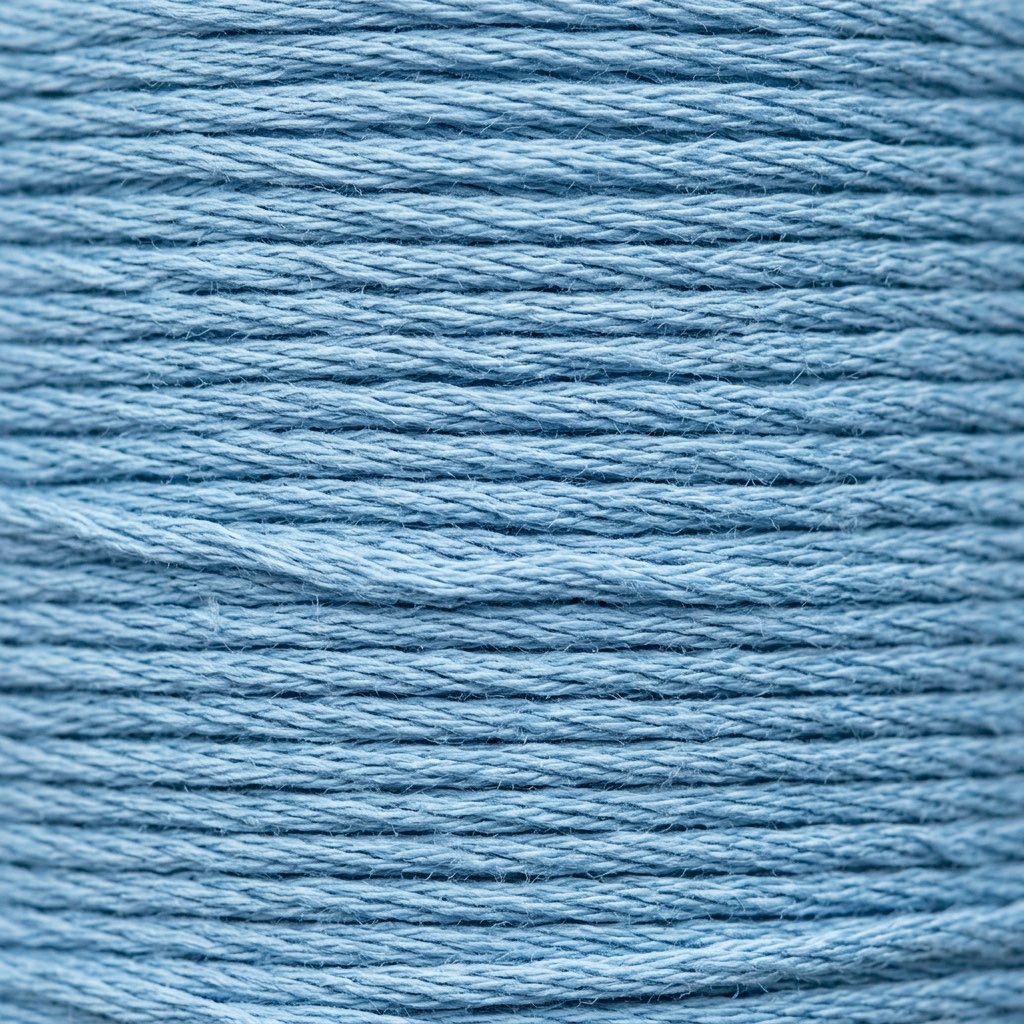
If you stitch with DMC 519 Sky Blue and then photograph your work for social media, you will meet two different threads. In your hands, under natural daylight, 519 is a soft, slightly dusty blue with the faintest cool-green whisper — the color of sky reflected in still lake water, not the sky itself but its quieter echo. In your phone camera, that subtlety often vanishes. Depending on your screen settings and white balance, 519 may photograph as more saturated than it is, leaning into a confident medium blue that loses the gentle, faded quality that makes this thread special in person.
This is worth knowing before you start a project where 519 carries significant visual weight. If you're stitching primarily for your own enjoyment or to hang on a wall, you'll experience the thread's true personality — understated, calming, the kind of blue that makes a room feel cooler just by being present. If you're stitching something you plan to sell on Etsy or showcase on Instagram, consider that the thread you photograph may look like a different color entirely. Some stitchers have found that photographing 519 in open shade rather than direct sunlight preserves more of its real-world softness.
Between Sky and Water
DMC 519 occupies a liminal space in the blue spectrum — not quite baby blue, not quite teal, not quite Wedgwood. It sits at the lighter end of the Wedgwood-adjacent range, sharing DNA with DMC 518 (Light Wedgwood) but stepping away from that family's grey influence toward something cleaner and more aerial. Where 518 is the color of blue china, 519 is the color of the sky on a spring morning when thin clouds diffuse the light and take the edge off the blue without muting it entirely.
This in-between quality makes 519 extraordinarily useful for portrait work, particularly for eye color. Not everyone has eyes that match the saturated blues in the 796-799 range or the grey-blues in the 930s. Many blue eyes are this exact shade — medium-light, slightly greyed, catching the light differently depending on angle. Pair 519 with DMC 518 for iris shadows and DMC 747 (Very Light Sky Blue) for the highlight near the pupil reflection, and you have a three-thread iris that reads as believably human rather than cartoonishly vivid.
Seasonal and Thematic Range
Spring and summer designs claim 519 most often, but it has unexpected range. In winter scenes, it serves as shadow color on snow — that blue-grey cast that snow picks up in the shade, particularly in the late afternoon when the sun sits low. For beach and tropical water themes, 519 works as the shallow-water zone where you can still see the sandy bottom, a step lighter than the deeper turquoises. In autumn designs, it provides sky contrast behind warm foliage — that clean cool blue that makes orange and gold leaves glow by opposition.
Stitchers working mandala or geometric patterns find 519 cooperative as a mid-value fill. It's light enough to provide breathing room between darker structural elements but carries enough presence to avoid looking washed out. In a colour-wheel mandala, position it between the turquoises (DMC 597, 598) and the true blues (DMC 826, 827) to create a smooth spectral transition that guides the eye around the design without jarring jumps.
For fabric choice, 519 on white Aida has a clean, poster-like clarity. On cream or natural linen, the thread warms very slightly and gains a vintage quality — think faded seaside postcards or well-loved linen tablecloths with blue embroidery that have been washed dozens of times. Both effects are beautiful; the question is whether your design wants crispness or nostalgia.
Navigating the Sky Blue Neighborhood
Anchor 1038 and Madeira 1002 are both exact matches, and both deliver the soft, slightly dusty quality that defines 519. If you're cross-referencing between brands for a kit conversion, these are among the more reliable exact-match pairings in the blue range — the kind where you can swap confidently without test-stitching first, though test-stitching is always a good habit.
Cosmo 252, a close match, may read fractionally warmer. In isolation you wouldn't notice, but alongside other threads in the 518-519 neighborhood, a warmer shift pulls the thread toward baby blue territory and away from the Wedgwood-adjacent coolness that gives 519 its particular character. If your project uses 519 as a standalone blue without adjacent family members, Cosmo 252 works fine. If you're building a gradient through the Wedgwood range, stick with the exact matches.
Within DMC itself, don't confuse 519 with DMC 827 (Very Light Blue) — they live at similar values but 827 is purer blue without the green-grey whisper that gives 519 its sky-reflected-in-water quality. Similarly, DMC 3761 (Light Sky Blue) is a cousin worth comparing in person, though it leans slightly greener. The differences are the kind that only matter when threads sit side by side in a gradient, but since that's exactly when substitution matters most, pull your candidates from the stash and compare before committing.
Reference quality
How We Validate This Color Record
Use this page as a reference card for DMC 519: the structured data, quick conversions, and long-form copy are all tied back to the same stored color record.
- Methodology
- This page renders DMC 519, its hex value, and every brand equivalent from the site's source-of-truth color record, then checks long-form body copy against those same stored fields.
- Verification status
- Source-field checked. The page content is audited against the stored DMC number, brand equivalents, and match-quality labels before publishing.
- Last reviewed
- 2026-04-20
- Approximation warning
- Screen hex values, thread photos, and cross-brand conversions are reference aids. Dye lots, thread sheen, and fabric color can still shift the result in hand.
Decision guide
When to use the DMC 519 reference page
This page should help you decide faster between palette planning, brand substitution, and shade comparison without turning the color record into a thin lookup page.
Best for
- + Palette planning when you want the stored DMC 519 Sky Blue record, hex value #7EB1C8, and linked brand equivalents in one place.
- + Checking the quickest cross-brand shortlist before you buy floss, compare stash substitutes, or route into a more specific conversion page.
- + Finding nearby shades in the blues family before you commit to accents, shading, or background blends.
Watch for
- ! Screen previews are only reference aids. Sky Blue can shift on real fabric because thread sheen, stitch coverage, and room lighting change how the color reads.
- ! A stored equivalent is still a shortlist, not a guarantee that two brands will disappear into each other in the same stitched motif.
- ! Older charts, discontinued kit floss, and dye-lot variation can all introduce small but visible differences that the page cannot detect for you.
Before you commit
- Confirm the role of DMC 519 Sky Blue: decide whether you need an exact hero shade, a forgiving background, or a rough stash substitute.
- Compare on project fabric: view the skein or stitched sample on the same fabric count and color you will actually use.
- Use the linked conversion pages next: open the brand-specific pages when you need match-quality caveats before substituting away from the DMC reference.
DMC 519 FAQ
These questions appear on the page so the FAQ schema stays aligned with what visitors can actually read.
What is the Anchor equivalent of DMC 519?+
The closest Anchor equivalent to DMC 519 (Sky Blue) is Anchor 1038. This is an exact match.
What color is DMC 519?+
DMC 519 is called "Sky Blue" and has a hex color value of #7EB1C8. It belongs to the blues color family.
What is the Madeira equivalent of DMC 519?+
The closest Madeira equivalent to DMC 519 (Sky Blue) is Madeira 1002. This is a close match.
How DMC 519 Looks on Fabric
The same thread appears different depending on your fabric. Always test on your project fabric.
White Aida
Cream / Ecru
Black Aida
Pairs Well With
DMC colors commonly used alongside 519 Sky Blue.
Suggested Palette
Shading Companions

Detailed Conversions
Where to Buy DMC 519
This section contains affiliate links. We may earn a small commission at no cost to you.
Related Guides
Free Printable Thread Conversion Chart
Pick a brand, enter your email, and we'll send you a printable chart mapping all 552 DMC colors to that brand's equivalents. Zero spam, one chart.
Thanks! Here's your free chart:
Download Your ChartOpens in a new tab. Use your browser's Print → Save as PDF.
No spam. Your email is stored securely and never shared.