
Quick Conversion Table
| Brand | Equivalent | Match |
|---|---|---|
| Anchor | 168 | close |
| Madeira | 1105 | close |
| Cosmo ⚠ | 374 | close |
| Sullivans | 45213 | close |
| J&P Coats | 7168 | close |
| Dimensions | 17168 | close |
| Bucilla | 2174 | close |
| Candamar | 6190 | close |
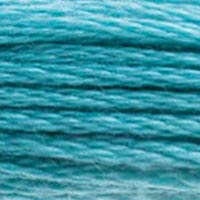
If DMC 806 (Dark Peacock Blue) is the deep, richly saturated version of the peacock color family, DMC 807 Peacock Blue is the full, clear expression of that color in its most immediately recognizable form. At this medium value and saturation, the blue-green reads unmistakably: this is the color people picture when they hear "peacock blue." Not dark enough to feel heavy, not pale enough to feel soft, but a vibrant, clear, tropical blue-green that has significant visual presence.
The Aquatic Color Space
DMC 807 occupies a particularly evocative position in the color spectrum — the zone that reads simultaneously as water, sky, and tropical. The blue component is strong enough that it registers as blue; the green component is strong enough that it reads as cool and aquatic rather than simply blue. This positions 807 in what designers sometimes call the "Caribbean" or "tropical" blue-green range: the color of shallow clear water over white sand in bright equatorial sunlight.
For aquatic cross-stitch — ocean scenes, reef designs, tropical fish patterns, mermaid pieces — 807 provides the mid-value water color that reads as the specific clear teal of tropical marine environments. Deeper water uses 806 (Dark Peacock Blue); shallower highlights might use DMC 3761 (Light Sky Blue) or DMC 747 (Very Light Sky Blue). 807 as the main body water color creates the visual impression of tropical clarity.
Peacock and Bird Design Work
The eponymous application of peacock blue in cross-stitch is, of course, peacock designs. In a peacock pattern, 807 typically serves as the primary or mid-value blue-green of the bird's body feathers and upper neck — the color that reads as the bird's characteristic hue before the deep shadows (806) and bright highlights (DMC 747, DMC 3761) are added. For simpler peacock motifs that use fewer colors, 807 alone can carry the peacock blue role without the full gradient.
For hummingbird designs, particularly the green-and-teal species common in cross-stitch patterns (ruby-throated, broad-tailed, Anna's), 807 provides the iridescent throat and back coloring that makes these birds so visually spectacular. The bright, saturated quality of 807 captures the way hummingbird feathers appear when light hits them directly — not quite the depth of the shadowed feather, but the characteristic vivid impression of these birds in flight.
Turquoise Jewelry and Southwest Themes
Turquoise jewelry — a significant motif in Southwestern American, Native American, and Middle Eastern cross-stitch designs — uses the peacock blue family extensively for the stone color. Authentic turquoise ranges from more green to more blue, and 807 captures the slightly blue-dominant turquoise that's characteristic of high-quality Persian and American Southwest specimens. Paired with DMC 300 (Very Dark Mahogany) or DMC 869 (Very Dark Hazelnut Brown) for silver-and-turquoise jewelry settings, 807 gives these designs the authentic mineral color they need.
Contemporary and Bohemian Design Palettes
The boho-chic and maximalist decorative aesthetics that have influenced cross-stitch design significantly in recent years often include peacock blue as a signature element. DMC 807 appears in mandalas, Moroccan-inspired geometric designs, bohemian floral arrangements, and colorful folk art patterns where the blue-green presence adds the tropical warmth that distinguishes these designs from cooler, more Nordic palettes.
Anchor 168 is close-rated rather than exact for DMC 807 — worth noting when Anchor is your preferred brand. Anchor 168 tends slightly more green-turquoise in some batches, which can shift the overall color impression in teal-sensitive designs. Madeira 1105 is exact-rated and is the most reliable brand substitution for 807.
Cosmo 374 and Sullivans 45213 are close-rated. Peacock blue is one of the more variable color families across brands because it sits at the intersection of blue and green — small formulation differences pull the color noticeably in one direction or the other. Testing close-rated substitutes against your palette in natural light is especially valuable for 807.
Within DMC, DMC 806 (Dark Peacock Blue) is the natural darker substitute for shadow areas. DMC 3766 (Light Peacock Blue) is one step lighter in the same family and substitutes gracefully in highlight areas. For designs where peacock blue appears as a standalone color without shading partners, DMC 3765 (Very Dark Peacock Blue) provides the full family range if needed. Outside the peacock family, DMC 959 (Medium Seagreen) and DMC 993 (Very Light Aquamarine) both share territory with 807 but read as distinctly different in character — more clearly green, less vivid, or lighter respectively.
Reference quality
How We Validate This Color Record
Use this page as a reference card for DMC 807: the structured data, quick conversions, and long-form copy are all tied back to the same stored color record.
- Methodology
- This page renders DMC 807, its hex value, and every brand equivalent from the site's source-of-truth color record, then checks long-form body copy against those same stored fields.
- Verification status
- Source-field checked. The page content is audited against the stored DMC number, brand equivalents, and match-quality labels before publishing.
- Last reviewed
- 2026-04-20
- Approximation warning
- Screen hex values, thread photos, and cross-brand conversions are reference aids. Dye lots, thread sheen, and fabric color can still shift the result in hand.
Decision guide
When to use the DMC 807 reference page
This page should help you decide faster between palette planning, brand substitution, and shade comparison without turning the color record into a thin lookup page.
Best for
- + Palette planning when you want the stored DMC 807 Peacock Blue record, hex value #64ABBA, and linked brand equivalents in one place.
- + Checking the quickest cross-brand shortlist before you buy floss, compare stash substitutes, or route into a more specific conversion page.
- + Finding nearby shades in the blues family before you commit to accents, shading, or background blends.
Watch for
- ! Screen previews are only reference aids. Peacock Blue can shift on real fabric because thread sheen, stitch coverage, and room lighting change how the color reads.
- ! A stored equivalent is still a shortlist, not a guarantee that two brands will disappear into each other in the same stitched motif.
- ! Older charts, discontinued kit floss, and dye-lot variation can all introduce small but visible differences that the page cannot detect for you.
Before you commit
- Confirm the role of DMC 807 Peacock Blue: decide whether you need an exact hero shade, a forgiving background, or a rough stash substitute.
- Compare on project fabric: view the skein or stitched sample on the same fabric count and color you will actually use.
- Use the linked conversion pages next: open the brand-specific pages when you need match-quality caveats before substituting away from the DMC reference.
DMC 807 FAQ
These questions appear on the page so the FAQ schema stays aligned with what visitors can actually read.
What is the Anchor equivalent of DMC 807?+
The closest Anchor equivalent to DMC 807 (Peacock Blue) is Anchor 168. This is a close match.
What color is DMC 807?+
DMC 807 is called "Peacock Blue" and has a hex color value of #64ABBA. It belongs to the blues color family.
What is the Madeira equivalent of DMC 807?+
The closest Madeira equivalent to DMC 807 (Peacock Blue) is Madeira 1105. This is a close match.
Peacock cross-stitch designs are an obvious home for 807, but mermaid patterns are equally significant — the sustained popularity of mermaid cross-stitch means 807 appears in enormous variety of piece styles, from small ornament-scale mermaid motifs to large wall-hanging-scale fantasy scenes. Ocean and reef designs for any tropical location use 807 extensively for water fill areas.
Jewelry and gemstone cross-stitch — a growing genre where detailed stitched reproductions of rings, bracelets, and necklaces are the subject matter — uses 807 for turquoise stones with impressive regularity. If you stitch jewelry-themed pieces, 807 is worth keeping well-stocked.
How DMC 807 Looks on Fabric
The same thread appears different depending on your fabric. Always test on your project fabric.
White Aida
Cream / Ecru
Black Aida
Pairs Well With
DMC colors commonly used alongside 807 Peacock Blue.
Suggested Palette
Shading Companions
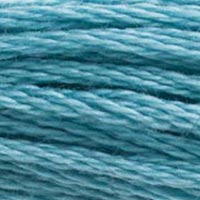
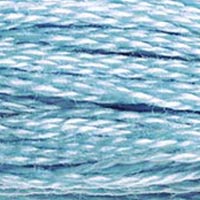
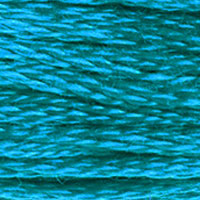
Detailed Conversions
Where to Buy DMC 807
This section contains affiliate links. We may earn a small commission at no cost to you.
Related Guides
Free Printable Thread Conversion Chart
Pick a brand, enter your email, and we'll send you a printable chart mapping all 552 DMC colors to that brand's equivalents. Zero spam, one chart.
Thanks! Here's your free chart:
Download Your ChartOpens in a new tab. Use your browser's Print → Save as PDF.
No spam. Your email is stored securely and never shared.