
Quick Conversion Table
| Brand | Equivalent | Match |
|---|---|---|
| Anchor | 878 | exact |
| Madeira | 1704 | close |
| Cosmo ⚠ | 536 | close |
| Sullivans | 45110 | close |
| J&P Coats | 6878 | close |
| Dimensions | 6195 | close |
| Bucilla | 6195 | close |
| Candamar | 6195 | close |
Seaweed, Depth, and the Green That Holds Its Breath
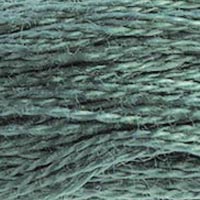
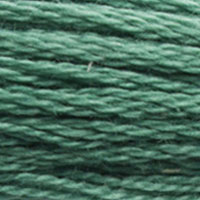
There is a particular green that lives where ocean kelp anchors itself to rock — not the bright lime of shallow water but the concentrated, almost inky pigment of plants that have adapted to low light and cold currents. DMC 501 captures that submerged intensity. It sits at the dark end of the 501/502/503 blue-green family, and it has a depth that photographs struggle with. On screen, 501 can look like a generic dark teal. In your hand, held against natural daylight, you'll notice something richer: a true blue-green where neither color dominates, but both contribute to a shade that feels genuinely deep rather than merely dark.
That photographic deception matters more than you might think. If you've ever ordered thread based on a screen swatch and been surprised by what arrived, 501 is a prime culprit. The hex value #396F52 gives monitors permission to render it as flat and lifeless, when in reality the thread has a subtle warmth that prevents it from reading as cold or clinical. Under tungsten lighting it shifts slightly warmer; under fluorescent it leans cooler. This chameleon quality is a feature, not a bug — it means 501 integrates with both warm and cool palettes without fighting for attention.
Building Depth in Foliage and Water
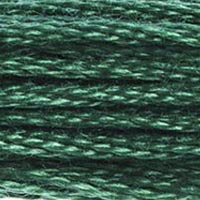
Where 501 earns its reputation is in shadow work. Any time a design calls for the darkest value in a blue-green gradient — the shadow beneath a lily pad, the deepest recess of a pine bough, the base of a wave — 501 is your anchor point. Its siblings 502 (Blue Green) and 503 (Medium Blue Green) step the value upward cleanly, giving you a three-shade progression that handles everything from underwater scenes to evergreen forests.
But don't limit this thread to nature designs. Historical sampler reproductions use 501 extensively, particularly reproductions of 18th-century European pieces where blue-green threads were achieved through a combination of indigo and woad dyes. The resulting shade was darker and more saturated than most modern greens, and 501 captures that pre-industrial character better than brighter, more synthetic-looking alternatives. If you're stitching a Teresa Wentzler or Chatelaine design, you've probably already encountered it.
On fabric choice, 501 performs very differently depending on your ground. Against white 14-count Aida, it reads as straightforwardly dark green-blue — clear, legible, no ambiguity. Against natural linen or a cream evenweave, the warmth of the fabric pulls out the thread's hidden warmth, and suddenly 501 looks less marine and more forest. Both are beautiful; they're just different moods. Over-one on 28-count or higher, 501 can almost disappear into dark fabrics, so save those combinations for pieces where you want the color to whisper rather than speak.
Companion Threads and Palette Building
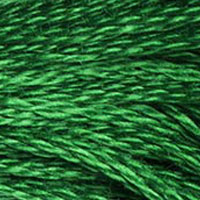
Beyond its immediate family (502 and 503), DMC 501 plays well with DMC 500 (Very Dark Blue Green) for those rare moments when you need to go even darker, and with DMC 924 (Very Dark Gray Green) when you want to shift the shadow tone toward a more muted, grey-tinged territory. For contrast, consider pairing 501 with DMC 758 (Very Light Terra Cotta) or DMC 3774 (Very Light Desert Sand) — the warm peachy tones complement the cool blue-green beautifully, creating the kind of color tension that makes a design feel alive rather than just pretty.
For blended needle work, combining one strand of 501 with one strand of DMC 319 (Very Dark Pistachio Green) gives you a transitional shade that bridges the blue-green and yellow-green families. This is particularly useful in large landscape pieces where you need a convincing shift from shadowed evergreens to deciduous trees without a jarring color boundary. The blended result is a green that doesn't quite exist anywhere in the DMC range on its own, which is precisely the point of blending.
The 501/502/503 family is popular enough that running out mid-project is a real possibility, especially on large-scale pieces. Anchor 878 is your safest bet — it's an exact match that nails the specific balance between blue and green, and it maintains that depth without drifting toward pure teal. Madeira 1704 is equally faithful, with Madeira's characteristic slight sheen adding a touch of luminosity that can actually enhance the color's depth on linen grounds.
Cosmo 536 will get you close, but test it carefully against your existing stitching. Some stitchers report that it skews marginally more blue than the DMC original, which in isolation is fine but can disrupt the gradient if you're using 501 alongside 502 and 503 in a shading sequence. If 501 is serving as your darkest shadow value, a slight blue shift may actually deepen the illusion of depth — but if it's the middle of your range, that shift will create an inconsistency the eye picks up on even if you can't immediately name it.
Within DMC's own range, resist the temptation to substitute DMC 561 (Very Dark Jade). Despite the similar hex neighborhood, 561 has a distinctly warmer, more saturated green character that lacks 501's cool blue undertone. DMC 500 (Very Dark Blue Green) is a value step too dark for most applications where 501 is specified, though it works if you're deliberately deepening the shadows in a design. Sullivans 45110 lands in the right territory but can feel fractionally lighter than the DMC original, so audit it against your darkest value needs before committing to a full substitution.
Reference quality
How We Validate This Color Record
Use this page as a reference card for DMC 501: the structured data, quick conversions, and long-form copy are all tied back to the same stored color record.
- Methodology
- This page renders DMC 501, its hex value, and every brand equivalent from the site's source-of-truth color record, then checks long-form body copy against those same stored fields.
- Verification status
- Source-field checked. The page content is audited against the stored DMC number, brand equivalents, and match-quality labels before publishing.
- Last reviewed
- 2026-04-20
- Approximation warning
- Screen hex values, thread photos, and cross-brand conversions are reference aids. Dye lots, thread sheen, and fabric color can still shift the result in hand.
Decision guide
When to use the DMC 501 reference page
This page should help you decide faster between palette planning, brand substitution, and shade comparison without turning the color record into a thin lookup page.
Best for
- + Palette planning when you want the stored DMC 501 Dark Blue Green record, hex value #396F52, and linked brand equivalents in one place.
- + Checking the quickest cross-brand shortlist before you buy floss, compare stash substitutes, or route into a more specific conversion page.
- + Finding nearby shades in the greens family before you commit to accents, shading, or background blends.
Watch for
- ! Screen previews are only reference aids. Dark Blue Green can shift on real fabric because thread sheen, stitch coverage, and room lighting change how the color reads.
- ! A stored equivalent is still a shortlist, not a guarantee that two brands will disappear into each other in the same stitched motif.
- ! Older charts, discontinued kit floss, and dye-lot variation can all introduce small but visible differences that the page cannot detect for you.
Before you commit
- Confirm the role of DMC 501 Dark Blue Green: decide whether you need an exact hero shade, a forgiving background, or a rough stash substitute.
- Compare on project fabric: view the skein or stitched sample on the same fabric count and color you will actually use.
- Use the linked conversion pages next: open the brand-specific pages when you need match-quality caveats before substituting away from the DMC reference.
DMC 501 FAQ
These questions appear on the page so the FAQ schema stays aligned with what visitors can actually read.
What is the Anchor equivalent of DMC 501?+
The closest Anchor equivalent to DMC 501 (Dark Blue Green) is Anchor 878. This is an exact match.
What color is DMC 501?+
DMC 501 is called "Dark Blue Green" and has a hex color value of #396F52. It belongs to the greens color family.
What is the Madeira equivalent of DMC 501?+
The closest Madeira equivalent to DMC 501 (Dark Blue Green) is Madeira 1704. This is a close match.
How DMC 501 Looks on Fabric
The same thread appears different depending on your fabric. Always test on your project fabric.
White Aida
Cream / Ecru
Black Aida
Pairs Well With
DMC colors commonly used alongside 501 Dark Blue Green.
Suggested Palette
Shading Companions
Detailed Conversions
Where to Buy DMC 501
This section contains affiliate links. We may earn a small commission at no cost to you.
Related Guides
Free Printable Thread Conversion Chart
Pick a brand, enter your email, and we'll send you a printable chart mapping all 552 DMC colors to that brand's equivalents. Zero spam, one chart.
Thanks! Here's your free chart:
Download Your ChartOpens in a new tab. Use your browser's Print → Save as PDF.
No spam. Your email is stored securely and never shared.