
Quick Conversion Table
| Brand | Equivalent | Match |
|---|---|---|
| Anchor | 288 | exact |
| Madeira | 0103 | close |
| Cosmo ⚠ | 299 | close |
| Sullivans | 45100 | close |
| J&P Coats | 2288 | close |
| Dimensions | 6132 | close |
| Bucilla | 6129 | close |
| Candamar | 6132 | close |
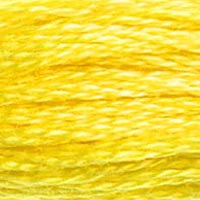
Near-white yellows are a specific technical challenge in cross-stitch, and DMC 445 Light Lemon is one of the best solutions to a very specific problem: how do you suggest the palest zone of a yellow object — the glare on a lemon surface, the center of a daffodil trumpet, the reflected sky in a golden field — without losing all color identity and tipping into plain white? Light Lemon answers this precisely. It holds just enough yellow to read as yellow while being pale enough to serve as a genuine highlight value.
The Technical Role of Pale Yellows
In gradient work, 445 typically occupies the second-to-lightest or lightest position in a yellow sequence. A complete lemon yellow gradient might run: DMC 444 (Dark Lemon) → DMC 3820 (Dark Straw) → DMC 3822 (Light Straw) → DMC 445 (this thread) → white. At each step the color becomes more translucent, more suggestion than statement, until 445 is the final assertion of yellow identity before color disappears entirely.
This position at the end of the value chain makes 445 particularly important in thread painting work. In realistic renderings of yellow flowers — sunflowers, daffodils, black-eyed Susans — the very center of the lightest petals, where direct sunlight blanches the color, needs 445 to avoid the flat, chalky appearance that results when a gradient terminates too abruptly at mid-yellow rather than easing gently to near-white.
Seasonal and Thematic Applications
Spring designs call for 445 constantly. Daffodil designs use it for the inner edge of the trumpet where the color bleaches in strong light, and for the outer petals viewed against a sky background. Easter imagery — baby chicks, decorated eggs, spring baskets — uses it as the primary chick color (with DMC 725 Topaz or DMC 3820 Dark Straw providing the darker accents). Bee and butterfly designs use it for the pale area near the wing edge where color fades.
In summer themes, Light Lemon appears in golden field backgrounds, sunflower compositions, and the lightest value in any citrus fruit design. Lemon slices, in particular, require 445 for the pale membrane sections between the seed pockets, with deeper yellows for the juice vesicles and a clean yellow-green for the peel highlights.
Fabric Behavior and Coverage
Like all very pale colors, 445 requires attention to coverage on light-colored fabric. On white Aida, it can read as near-invisible in small quantities or with minimal strand count. Most stitchers find that 3 strands on 14-count gives the best coverage and color presence. On 18-count or higher evenweave, the stitch density improves coverage naturally. Antique linen creates interesting results: the warmth of the linen can pull 445 toward a very pale gold, which is actually quite beautiful for designs where a sun-aged or antique quality is desirable.
Against dark backgrounds — particularly navy or black — 445 reads as a crisp, luminous pale yellow that can be stunning in high-contrast nighttime or moonlit scene compositions. A star pattern against navy with 445 as the star color produces a very different effect than white would, with a warmth that feels more like actual starlight.
The exact match ratings for Anchor 288 and Madeira 0103 are genuine goods news here — both brands hit 445 closely enough that substitution should be straightforward. Anchor 288 in particular is a well-known and widely available thread that stitchers who primarily use Anchor can rely on confidently for Light Lemon applications.
Madeira 0103 is equally trustworthy as an exact match. For projects requiring consistent pale yellow coverage across multiple skeins — a large field background, a sampler with extensive yellow elements — Madeira's dye lot consistency makes it a particularly sound choice. Order by the same lot code if possible.
Cosmo 299 is rated close rather than exact, which reflects a minor tonal shift compared to the DMC original. In practice, the difference is subtle enough that it's only detectable when threads are placed directly side by side. For standalone projects using Cosmo throughout, 571 is entirely suitable. The complication arises when mixing Cosmo and DMC in the same gradient sequence — a small tonal inconsistency can create a visible step in an otherwise smooth transition.
Sullivans 45100 performs adequately in non-critical applications. For practice samplers, casual projects, and any piece where 445 appears in small accent quantities, the Sullivans option is fine. The coverage of Sullivans' pale yellows can occasionally be slightly thinner than DMC's, which is worth noting if coverage is already a concern given the thread's very pale value.
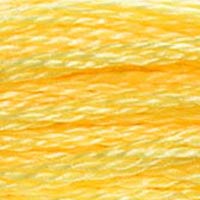
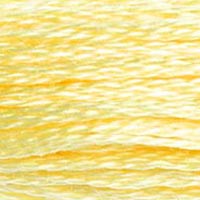
Within the DMC family, DMC 3823 (Ultra Pale Yellow) is one step lighter if you need something even more barely-there, while DMC 3855 (Light Autumn Gold) provides a slightly warmer emergency substitute from within the pale yellow zone.
Reference quality
How We Validate This Color Record
Use this page as a reference card for DMC 445: the structured data, quick conversions, and long-form copy are all tied back to the same stored color record.
- Methodology
- This page renders DMC 445, its hex value, and every brand equivalent from the site's source-of-truth color record, then checks long-form body copy against those same stored fields.
- Verification status
- Source-field checked. The page content is audited against the stored DMC number, brand equivalents, and match-quality labels before publishing.
- Last reviewed
- 2026-04-20
- Approximation warning
- Screen hex values, thread photos, and cross-brand conversions are reference aids. Dye lots, thread sheen, and fabric color can still shift the result in hand.
Decision guide
When to use the DMC 445 reference page
This page should help you decide faster between palette planning, brand substitution, and shade comparison without turning the color record into a thin lookup page.
Best for
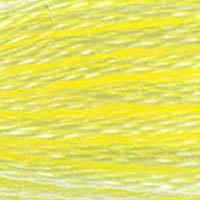
- + Palette planning when you want the stored DMC 445 Light Lemon record, hex value #FFFB8B, and linked brand equivalents in one place.
- + Checking the quickest cross-brand shortlist before you buy floss, compare stash substitutes, or route into a more specific conversion page.
- + Finding nearby shades in the yellows family before you commit to accents, shading, or background blends.
Watch for
- ! Screen previews are only reference aids. Light Lemon can shift on real fabric because thread sheen, stitch coverage, and room lighting change how the color reads.
- ! A stored equivalent is still a shortlist, not a guarantee that two brands will disappear into each other in the same stitched motif.
- ! Older charts, discontinued kit floss, and dye-lot variation can all introduce small but visible differences that the page cannot detect for you.
Before you commit
- Confirm the role of DMC 445 Light Lemon: decide whether you need an exact hero shade, a forgiving background, or a rough stash substitute.
- Compare on project fabric: view the skein or stitched sample on the same fabric count and color you will actually use.
- Use the linked conversion pages next: open the brand-specific pages when you need match-quality caveats before substituting away from the DMC reference.
DMC 445 FAQ
These questions appear on the page so the FAQ schema stays aligned with what visitors can actually read.
What is the Anchor equivalent of DMC 445?+
The closest Anchor equivalent to DMC 445 (Light Lemon) is Anchor 288. This is an exact match.
What color is DMC 445?+
DMC 445 is called "Light Lemon" and has a hex color value of #FFFB8B. It belongs to the yellows color family.
What is the Madeira equivalent of DMC 445?+
The closest Madeira equivalent to DMC 445 (Light Lemon) is Madeira 0103. This is a close match.
How DMC 445 Looks on Fabric
The same thread appears different depending on your fabric. Always test on your project fabric.
White Aida
Cream / Ecru
Black Aida
Pairs Well With
DMC colors commonly used alongside 445 Light Lemon.
Suggested Palette
Shading Companions
Detailed Conversions
Where to Buy DMC 445
This section contains affiliate links. We may earn a small commission at no cost to you.
Related Guides
Free Printable Thread Conversion Chart
Pick a brand, enter your email, and we'll send you a printable chart mapping all 552 DMC colors to that brand's equivalents. Zero spam, one chart.
Thanks! Here's your free chart:
Download Your ChartOpens in a new tab. Use your browser's Print → Save as PDF.
No spam. Your email is stored securely and never shared.