
Quick Conversion Table
| Brand | Equivalent | Match |
|---|---|---|
| Anchor | 1066 | close |
| Madeira | 2506 | close |
| Cosmo ⚠ | 375 | close |
| Sullivans | 45406 | close |
| J&P Coats | 7169 | close |
| Dimensions | 17169 | close |
| Bucilla | 3809 | close |
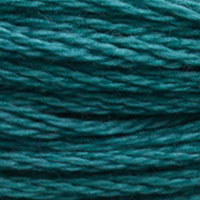
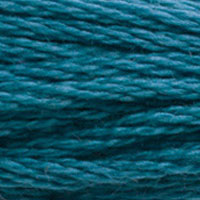
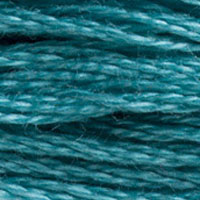
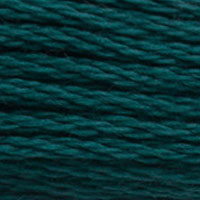
Between the ultra-dark anchor of DMC 3808 and the brighter mid-range of DMC 3810, Very Dark Turquoise occupies the gradient position that designers rely on most heavily: dark enough to read as substantial, light enough to show the color clearly. At hex #3F7C85, DMC 3809 is a saturated, medium-dark teal-blue — the color of a tropical lagoon in afternoon light where the water is a few meters deep, the turquoise vivid but with depth beneath it. It has more presence than a midtone but more transparency of color than a shadow value.
In practical terms, this is the turquoise thread that does most of the fill work in turquoise-heavy designs. The family's ultra-dark anchor (3808) appears in shadow positions; the very light (3811) appears in highlights; but 3809 — along with 3810 — covers the large middle ground where turquoise actually displays itself as turquoise. It's the thread that reads as 'this design is turquoise' from across the room.
Gradient Building in the Turquoise Family
The four-step turquoise family — 3808 through 3811 — is one of the more useful gradients in the DMC range for building smooth tonal progressions. The steps are well-spaced: each value is clearly distinct from its neighbors while belonging to the same clear color family. DMC 3809 in this sequence typically occupies either the second-darkest position in a four-step sequence, or the darkest position when you're only building a three-step gradient (3809, 3810, 3811).
For ombre and shaded backgrounds — popular in both traditional landscape work and modern geometric counted-thread designs — building the turquoise gradient correctly requires understanding which thread carries which value. 3809 is the one that sits in the lower third of the palette's brightness range: substantial, saturated, present, but still showing its color character rather than its shadow character.
Textile and Cultural Associations
Turquoise in this medium-dark range appears in Persian and Iznik tile work, in Moroccan zellige mosaic, and in traditional Southwest American beading and jewelry — all traditions that have inspired cross-stitch design. For tilework-inspired geometric patterns, 3809 provides the main tile color when the design calls for a strong, saturated turquoise that reads boldly.
In folk art-inspired pieces — Ukrainian embroidery, Bohemian patterns, or Southwestern American geometric designs — this value of turquoise often appears in the large fill areas of design elements. Paired with DMC 3776 (Light Mahogany) or DMC 3830 (Terra Cotta) for the classic warm-cool contrast, it creates the saturated, vibrant palette associated with these traditions.
A practical note for SAL participants stitching turquoise-heavy designs: when parking DMC 3808, 3809, and 3810 simultaneously, they can be confusingly similar under dim lighting or warm artificial light. Label your parking positions or use different knot styles for each. Frogging a section of 3809 thinking it was 3810 is the kind of mistake you only want to make once.
Coverage and thread behavior at this saturation level are both reliable. DMC 3809 covers 14-count Aida consistently with two strands, and on 28-count evenweave stitched over-two the result is a solid, clear teal-blue that reads well from viewing distance. This is a color that rewards consistently tensioned stitching — the saturation is enough that even tension differences (from varying hoop tightness across a long work session) can create subtle striping in large fill areas. Keeping your hoop tension consistent and working in a regular rhythm helps with this.
Like the rest of the turquoise family, DMC 3809 has no exact cross-brand matches — Anchor 1066, Madeira 2506, Cosmo 375, and Sullivans 45406 are all rated close. The turquoise family in general is one where the brand differences are noticeable enough to reward checking your specific substitute against the DMC before committing.
Anchor 1066 is the most commonly referenced substitute and reads very similarly in most cases. Some stitchers report it as slightly brighter than DMC 3809 — a touch more saturated and slightly less deep — which may or may not matter depending on the gradient role 3809 is playing in your design. If it's meant to be the dark anchor in a three-step sequence, a brighter Anchor equivalent can collapse the value contrast you need.
Madeira 2506 can run slightly lighter than the DMC in some lots, similar to the Anchor caveat. Cosmo 375 is generally one of the more accurate close matches in the turquoise range, according to many comparative reviews. Sullivans 45406 is acceptable with the usual note about checking dye lot consistency.
Within DMC, the turquoise family is self-contained: DMC 3808 (Ultra Very Dark) goes darker, DMC 3810 (Dark) goes lighter. For cross-family alternatives at a similar value, DMC 3765 (Very Dark Peacock Blue) is in adjacent deep teal territory. DMC 3760 (Medium Wedgwood) is a different color family but similar value, useful for understanding 3809's position on the value scale.
Reference quality
How We Validate This Color Record
Use this page as a reference card for DMC 3809: the structured data, quick conversions, and long-form copy are all tied back to the same stored color record.
- Methodology
- This page renders DMC 3809, its hex value, and every brand equivalent from the site's source-of-truth color record, then checks long-form body copy against those same stored fields.
- Verification status
- Source-field checked. The page content is audited against the stored DMC number, brand equivalents, and match-quality labels before publishing.
- Last reviewed
- 2026-04-20
- Approximation warning
- Screen hex values, thread photos, and cross-brand conversions are reference aids. Dye lots, thread sheen, and fabric color can still shift the result in hand.
Decision guide
When to use the DMC 3809 reference page
This page should help you decide faster between palette planning, brand substitution, and shade comparison without turning the color record into a thin lookup page.
Best for
- + Palette planning when you want the stored DMC 3809 Very Dark Turquoise record, hex value #3F7C85, and linked brand equivalents in one place.
- + Checking the quickest cross-brand shortlist before you buy floss, compare stash substitutes, or route into a more specific conversion page.
- + Finding nearby shades in the blues family before you commit to accents, shading, or background blends.
Watch for
- ! Screen previews are only reference aids. Very Dark Turquoise can shift on real fabric because thread sheen, stitch coverage, and room lighting change how the color reads.
- ! A stored equivalent is still a shortlist, not a guarantee that two brands will disappear into each other in the same stitched motif.
- ! Older charts, discontinued kit floss, and dye-lot variation can all introduce small but visible differences that the page cannot detect for you.
Before you commit
- Confirm the role of DMC 3809 Very Dark Turquoise: decide whether you need an exact hero shade, a forgiving background, or a rough stash substitute.
- Compare on project fabric: view the skein or stitched sample on the same fabric count and color you will actually use.
- Use the linked conversion pages next: open the brand-specific pages when you need match-quality caveats before substituting away from the DMC reference.
DMC 3809 FAQ
These questions appear on the page so the FAQ schema stays aligned with what visitors can actually read.
What is the Anchor equivalent of DMC 3809?+
The closest Anchor equivalent to DMC 3809 (Very Dark Turquoise) is Anchor 1066. This is a close match.
What color is DMC 3809?+
DMC 3809 is called "Very Dark Turquoise" and has a hex color value of #3F7C85. It belongs to the blues color family.
What is the Madeira equivalent of DMC 3809?+
The closest Madeira equivalent to DMC 3809 (Very Dark Turquoise) is Madeira 2506. This is a close match.
How DMC 3809 Looks on Fabric
The same thread appears different depending on your fabric. Always test on your project fabric.
White Aida
Cream / Ecru
Black Aida
Pairs Well With
DMC colors commonly used alongside 3809 Very Dark Turquoise.
Suggested Palette
Detailed Conversions
Where to Buy DMC 3809
This section contains affiliate links. We may earn a small commission at no cost to you.
Related Guides
Free Printable Thread Conversion Chart
Pick a brand, enter your email, and we'll send you a printable chart mapping all 552 DMC colors to that brand's equivalents. Zero spam, one chart.
Thanks! Here's your free chart:
Download Your ChartOpens in a new tab. Use your browser's Print → Save as PDF.
No spam. Your email is stored securely and never shared.