
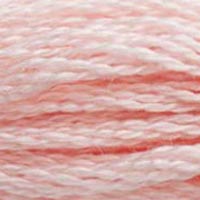
DMC 225 — Ultra Very Light Shell Pink
Pinks family · Hex #FFDFD7
Quick Conversion Table
| Brand | Equivalent | Match |
|---|---|---|
| Anchor | 1026 | exact |
| Madeira | 0814 | close |
| Cosmo ⚠ | 651 | close |
| Sullivans | 45047 | close |
| J&P Coats | 3066 | close |
| Dimensions | 13239 | close |
| Bucilla | 225 | close |
| Candamar | 6173 | close |
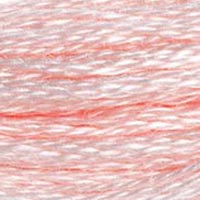
DMC 225 Ultra Very Light Shell Pink occupies the extreme pale end of the shell pink spectrum — the kind of color that looks like almost-white in the skein but transforms on the needle. On white Aida, it's barely there, a faint blush that reads more as texture than color. On linen or ecru fabric, it comes into its own, providing that delicate warm-pink highlight that makes petals look three-dimensional and skin tones look alive rather than flat. Knowing when and where to use it is the whole skill.
When Near-White Pink Is Exactly Right
The instinct when building a shading sequence is to stop one or two values before the lightest color in the range, on the theory that anything paler will "disappear." DMC 225 challenges that assumption. Used correctly — at the very brightest point of a curved surface, at the tip of a petal where light catches most directly, as a single row of stitches at the edge of a highlight zone — it adds a quality of luminosity that simply stopping at DMC 224 (Very Light Shell Pink) doesn't achieve.
The difference between a highlight that reads as "light" and one that reads as "glowing" often comes down to including that extreme pale step. Thread painters and needle painters know this instinctively. The same principle applies to counted cross-stitch when the design has enough detail to support it.
Skin Tone and Portrait Applications
DMC 225 is a valuable tool in portrait embroidery for fair to medium complexions. It represents the lightest catchlight areas — the shine on a forehead, the brightest point of a cheekbone, the highlight on a lip. In these contexts, it works alongside DMC 224 (Very Light Shell Pink), DMC 353 (Peach), and DMC 3713 (Very Light Salmon) to build a gradient from fairly lit to fully lit skin. The shell pink undertone of 225 keeps it from looking chalky or dead — it has just enough warmth to read as luminous skin rather than white paint.
Birth samplers and portraits of infants are a classic use case. Baby skin has almost no visible saturation in the lightest areas, and DMC 225 captures that perfectly — the warm-pale look of a lit cheek or the back of a tiny hand.
Botanical and Floral Context
For roses, peonies, and other full, layered flowers rendered in the shell pink family, DMC 225 belongs at the petal tips and along the upper edges of the outermost petals. These are the areas where the flower's color bleaches out toward the light source, and DMC 225's near-whiteness gives those spots the right weight. Combined with the rest of the shell pink sequence — DMC 221, 222, 223, 224, and 225 — the flower looks convincingly three-dimensional rather than decoratively flat.
Hydrangeas, cherry blossoms, and other flowers with inherently pale colorings also use DMC 225 as a primary rather than a highlight color. A full cherry blossom rendered almost entirely in DMC 225 with DMC 224 for shadow and DMC 223 for the deepest shading is an understated beauty — delicate and precise, perfect for Japanese-inspired designs or spring-themed wall hangings and ornaments.
Anchor 1026 is listed as an exact match. This is one of the pale colors where "exact" may still show minor variation depending on dye lot and viewing conditions — extremely light threads are sensitive to even small production differences. If you're using Anchor 1026 alongside other DMC shell pink shades, do a quick visual check under your working light before committing.
Madeira 0814 is listed as close rather than exact. The Madeira shade in this range may have a slightly different undertone — some stitchers report it reads as fractionally more peachy than the DMC equivalent. In a design where DMC 225 is a small highlight detail, this is unlikely to matter. In a design where pale shell pink is a primary large-area color, the difference may be visible.
Cosmo 651 and Sullivans 45047 are also close matches. For this thread specifically, if you're shopping substitutes, comparing under daylight (not incandescent or LED) gives the most accurate color read — pale pinks are notorious for shifting dramatically between light sources. If DMC 225 is completely unavailable, DMC 819 (Light Baby Pink) or DMC 3713 (Very Light Salmon) can approximate it in some contexts, though both have slightly different undertones that may shift a palette toward either cooler pink or warmer peach.
Reference quality
How We Validate This Color Record
Use this page as a reference card for DMC 225: the structured data, quick conversions, and long-form copy are all tied back to the same stored color record.
- Methodology
- This page renders DMC 225, its hex value, and every brand equivalent from the site's source-of-truth color record, then checks long-form body copy against those same stored fields.
- Verification status
- Source-field checked. The page content is audited against the stored DMC number, brand equivalents, and match-quality labels before publishing.
- Last reviewed
- 2026-04-20
- Approximation warning
- Screen hex values, thread photos, and cross-brand conversions are reference aids. Dye lots, thread sheen, and fabric color can still shift the result in hand.
Decision guide
When to use the DMC 225 reference page
This page should help you decide faster between palette planning, brand substitution, and shade comparison without turning the color record into a thin lookup page.
Best for
- + Palette planning when you want the stored DMC 225 Ultra Very Light Shell Pink record, hex value #FFDFD7, and linked brand equivalents in one place.
- + Checking the quickest cross-brand shortlist before you buy floss, compare stash substitutes, or route into a more specific conversion page.
- + Finding nearby shades in the pinks family before you commit to accents, shading, or background blends.
Watch for
- ! Screen previews are only reference aids. Ultra Very Light Shell Pink can shift on real fabric because thread sheen, stitch coverage, and room lighting change how the color reads.
- ! A stored equivalent is still a shortlist, not a guarantee that two brands will disappear into each other in the same stitched motif.
- ! Older charts, discontinued kit floss, and dye-lot variation can all introduce small but visible differences that the page cannot detect for you.
Before you commit
- Confirm the role of DMC 225 Ultra Very Light Shell Pink: decide whether you need an exact hero shade, a forgiving background, or a rough stash substitute.
- Compare on project fabric: view the skein or stitched sample on the same fabric count and color you will actually use.
- Use the linked conversion pages next: open the brand-specific pages when you need match-quality caveats before substituting away from the DMC reference.
DMC 225 FAQ
These questions appear on the page so the FAQ schema stays aligned with what visitors can actually read.
What is the Anchor equivalent of DMC 225?+
The closest Anchor equivalent to DMC 225 (Ultra Very Light Shell Pink) is Anchor 1026. This is an exact match.
What color is DMC 225?+
DMC 225 is called "Ultra Very Light Shell Pink" and has a hex color value of #FFDFD7. It belongs to the pinks color family.
What is the Madeira equivalent of DMC 225?+
The closest Madeira equivalent to DMC 225 (Ultra Very Light Shell Pink) is Madeira 0814. This is a close match.
How DMC 225 Looks on Fabric
The same thread appears different depending on your fabric. Always test on your project fabric.
White Aida
Cream / Ecru
Black Aida
Pairs Well With
DMC colors commonly used alongside 225 Ultra Very Light Shell Pink.
Suggested Palette
Shading Companions
Detailed Conversions
Where to Buy DMC 225
This section contains affiliate links. We may earn a small commission at no cost to you.
Related Guides
Free Printable Thread Conversion Chart
Pick a brand, enter your email, and we'll send you a printable chart mapping all 552 DMC colors to that brand's equivalents. Zero spam, one chart.
Thanks! Here's your free chart:
Download Your ChartOpens in a new tab. Use your browser's Print → Save as PDF.
No spam. Your email is stored securely and never shared.