
Quick Conversion Table
| Brand | Equivalent | Match |
|---|---|---|
| Anchor | 271 | close |
| Madeira | 0501 | close |
| Cosmo ⚠ | 2608 | close |
| Sullivans | 45092 | close |
The Thread That Is Barely There
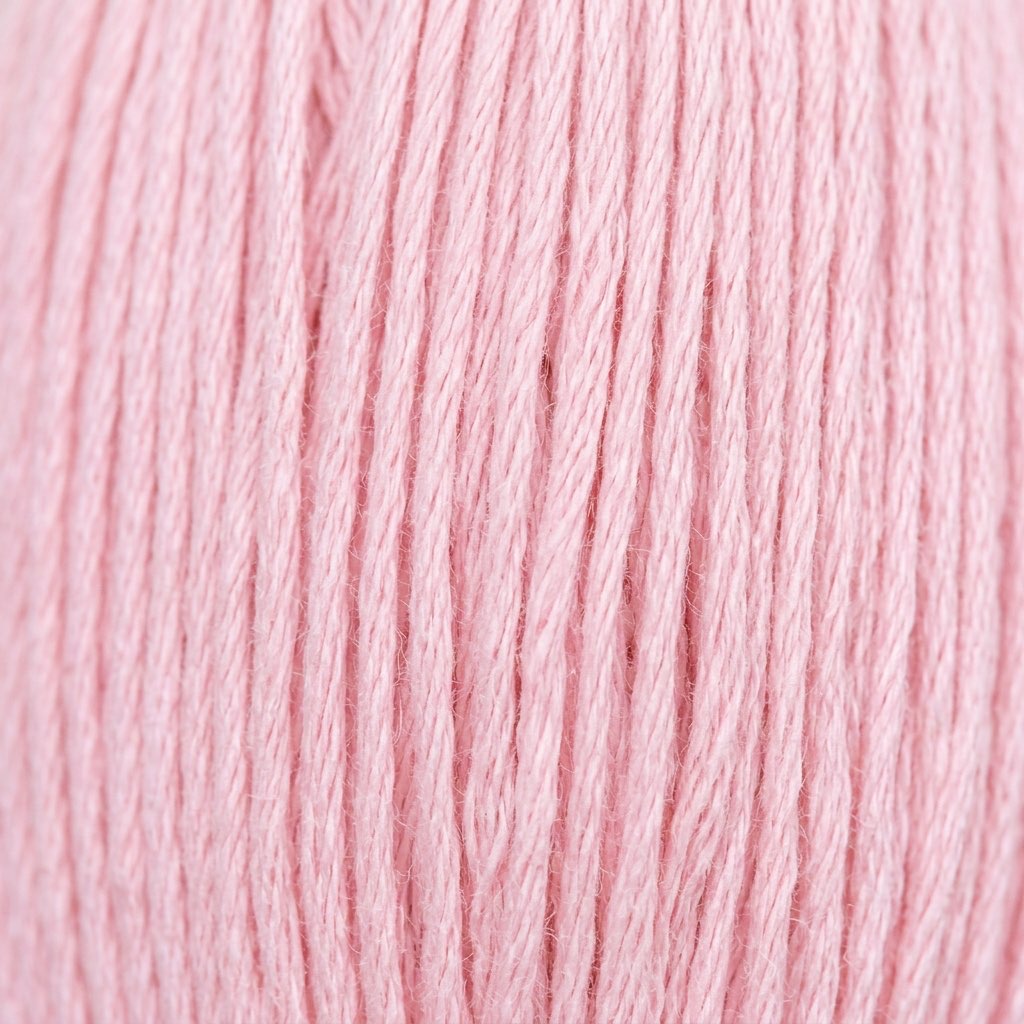
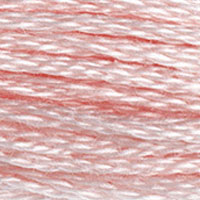
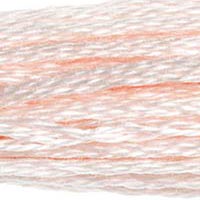
Hold a strand of DMC 3933 Very Pale Pink against a sheet of white paper and you will see the faintest trace of pink — like the blush that rises when someone pays you an unexpected compliment. This is the palest pink in the DMC range that is not simply white, and understanding when to use it versus when to skip it is the mark of a stitcher who thinks about subtlety.
The honest question with any near-white shade is: why bother? Why stitch 3933 when Blanc or Ecru are right there? The answer lies in accumulated warmth. A single stitch of 3933 is indistinguishable from white. Twenty stitches together create a barely perceptible warm glow. Two hundred stitches create a definite blush zone that reads as a different surface from the white fabric around it. The effect is cumulative, and that cumulative warmth is what makes skin, flower petals, and fabric folds look dimensional rather than flat.
Quilting Crossover — Thread Meets Fabric
If you quilt as well as stitch (and many cross-stitchers do), DMC 3933 lives in the same visual space as quilting fabrics in the "white-on-white" and "barely pink" categories — Kona Snow with the lightest blush, or Robert Kaufman's palest pink solids. This makes 3933 invaluable when you are finishing a cross-stitch piece with fabric borders or when you are creating a quilted project with an embroidered center panel.
Coordinating thread color with surrounding fabric is one of those details that separates polished finished pieces from good ones. A cross-stitched baby sampler on white Aida, bordered by a pale pink quilting cotton and backed with coordinating fabric, looks intentional and considered. DMC 3933 stitched in the design's lightest areas matches that border fabric seamlessly, creating visual continuity that the eye recognizes even if the viewer cannot articulate why the piece looks so pulled-together.
Working at the Edge of Visibility
Stitching with 3933 requires you to accept a fundamental truth: you may not be able to see your work clearly while you are doing it. On white Aida under standard room lighting, stitches in 3933 are nearly invisible. This means you need to trust your counting more than your eyes. Use a magnifier if you have one, and check your work periodically by stepping back several feet — the accumulated tint that is invisible up close becomes visible at reading distance.
Lighting matters enormously. Under daylight, 3933 is at its most visible because natural light reveals subtle color differences that artificial light flattens. Under warm incandescent light, 3933 virtually disappears on white fabric. Under cool LED light, the pink tint becomes slightly more visible. If your piece will hang in a room with warm-toned lighting, consider whether 3933 will contribute anything at all or whether you are stitching invisible stitches.
Companion Shades
DMC 3933 sits at the extreme light end of a progression that moves through DMC 3932 (Pale Pink) and DMC 819 (Light Baby Pink) into DMC 818 (Baby Pink) and eventually DMC 776 (Medium Pink). Within this progression, the steps from 3933 to 3932 to 819 are almost imperceptibly small — arguably too small to use all three in a single project. Most designers pick one or two from this cluster and leave the rest. If your pattern calls for 3933 and you only have 819, the substitution will be invisible to anyone but you.
Replacing DMC 3933 Very Pale Pink
At this extreme end of the value scale, substitution becomes almost philosophical. All listed conversions are close, and all are so near to white that the differences between them are often smaller than the differences between dye lots of the same thread.
Anchor 271 is the conversion, shared with multiple DMC pale pinks. Madeira 0501 is also shared across this range. In both cases, you are getting a barely-tinted white that will perform identically to 3933 in any practical context.
Cosmo 2608 and Sullivans 45092 are both close and both perfectly adequate. At this value, thread construction and feel become the primary differentiators between brands, not color.
Within DMC, 3932 (Pale Pink) and 819 (Light Baby Pink) are near-identical substitutes. Even DMC 818 (Baby Pink) is close enough to work in most contexts, though it does carry a slightly more visible pink tint. If your local shop carries none of these, Blanc tinted with a single strand of DMC 818 (using blended needle with one strand of each) will approximate 3933's effect on fabric.
Reference quality
How We Validate This Color Record
Use this page as a reference card for DMC 3933: the structured data, quick conversions, and long-form copy are all tied back to the same stored color record.
- Methodology
- This page renders DMC 3933, its hex value, and every brand equivalent from the site's source-of-truth color record, then checks long-form body copy against those same stored fields.
- Verification status
- Source-field checked. The page content is audited against the stored DMC number, brand equivalents, and match-quality labels before publishing.
- Last reviewed
- 2026-04-20
- Approximation warning
- Screen hex values, thread photos, and cross-brand conversions are reference aids. Dye lots, thread sheen, and fabric color can still shift the result in hand.
Decision guide
When to use the DMC 3933 reference page
This page should help you decide faster between palette planning, brand substitution, and shade comparison without turning the color record into a thin lookup page.
Best for
- + Palette planning when you want the stored DMC 3933 Very Pale Pink record, hex value #FFE8F0, and linked brand equivalents in one place.
- + Checking the quickest cross-brand shortlist before you buy floss, compare stash substitutes, or route into a more specific conversion page.
- + Finding nearby shades in the pinks family before you commit to accents, shading, or background blends.
Watch for
- ! Screen previews are only reference aids. Very Pale Pink can shift on real fabric because thread sheen, stitch coverage, and room lighting change how the color reads.
- ! A stored equivalent is still a shortlist, not a guarantee that two brands will disappear into each other in the same stitched motif.
- ! Older charts, discontinued kit floss, and dye-lot variation can all introduce small but visible differences that the page cannot detect for you.
Before you commit
- Confirm the role of DMC 3933 Very Pale Pink: decide whether you need an exact hero shade, a forgiving background, or a rough stash substitute.
- Compare on project fabric: view the skein or stitched sample on the same fabric count and color you will actually use.
- Use the linked conversion pages next: open the brand-specific pages when you need match-quality caveats before substituting away from the DMC reference.
DMC 3933 FAQ
These questions appear on the page so the FAQ schema stays aligned with what visitors can actually read.
What is the Anchor equivalent of DMC 3933?+
The closest Anchor equivalent to DMC 3933 (Very Pale Pink) is Anchor 271. This is a close match.
What color is DMC 3933?+
DMC 3933 is called "Very Pale Pink" and has a hex color value of #FFE8F0. It belongs to the pinks color family.
What is the Madeira equivalent of DMC 3933?+
The closest Madeira equivalent to DMC 3933 (Very Pale Pink) is Madeira 0501. This is a close match.
How DMC 3933 Looks on Fabric
The same thread appears different depending on your fabric. Always test on your project fabric.
White Aida
Cream / Ecru
Black Aida
Pairs Well With
DMC colors commonly used alongside 3933 Very Pale Pink.
Suggested Palette
Shading Companions
Detailed Conversions
Where to Buy DMC 3933
This section contains affiliate links. We may earn a small commission at no cost to you.
Related Guides
Free Printable Thread Conversion Chart
Pick a brand, enter your email, and we'll send you a printable chart mapping all 552 DMC colors to that brand's equivalents. Zero spam, one chart.
Thanks! Here's your free chart:
Download Your ChartOpens in a new tab. Use your browser's Print → Save as PDF.
No spam. Your email is stored securely and never shared.