
DMC 3771 — Ultra Very Light Terra Cotta
Reds family · Hex #F4BBA9
Quick Conversion Table
| Brand | Equivalent | Match |
|---|---|---|
| Anchor | 336 | exact |
| Madeira | 2605 | close |
| Cosmo ⚠ | 2552 | close |
| Sullivans | 45496 | close |
| J&P Coats | 3146 | close |
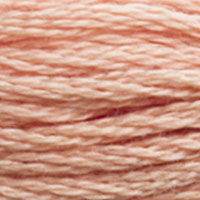
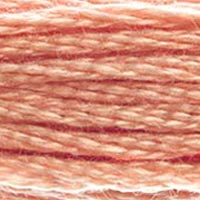
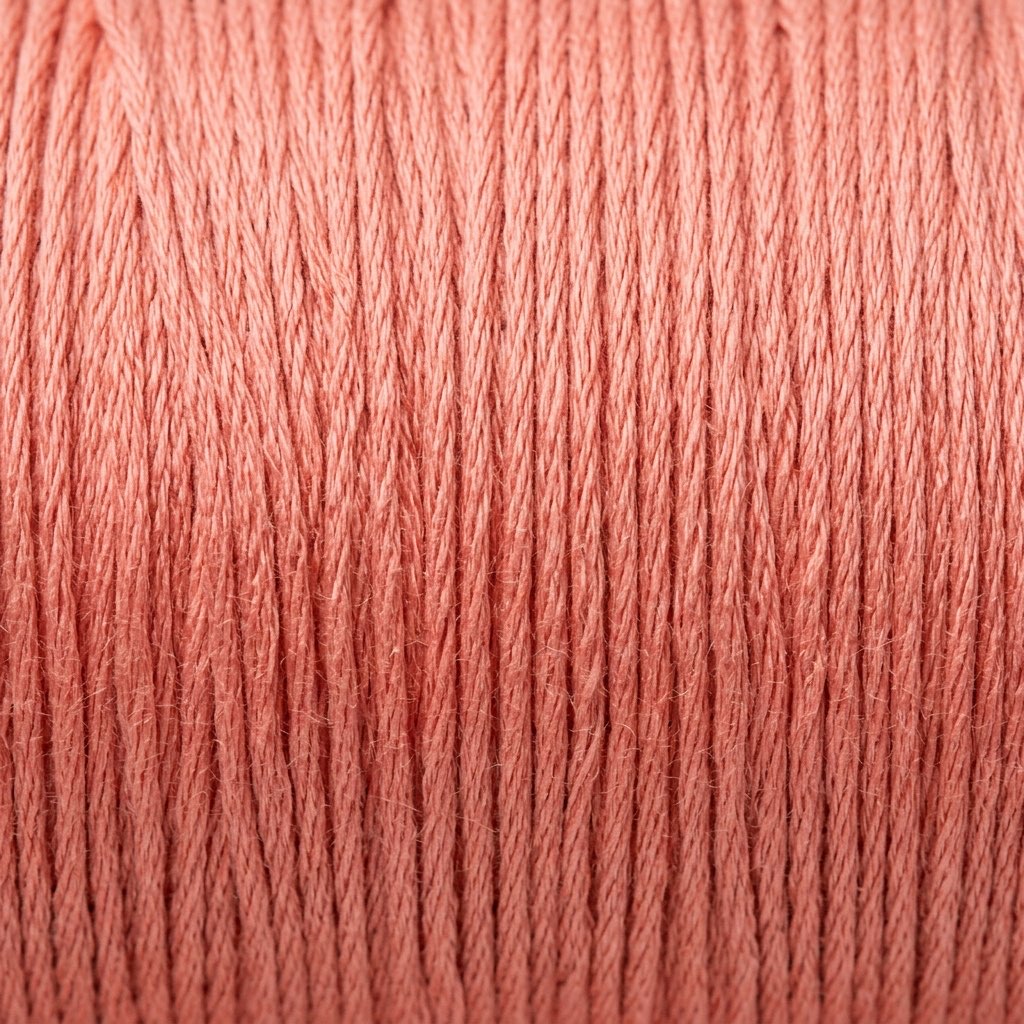
The naming convention for this color — Ultra Very Light Terra Cotta — is one of DMC's more ambitious efforts at specificity. Five words to nail exactly where this sits in the terra cotta family: at the very palest extreme, almost into peach territory, barely holding its connection to the warm red-orange of the fuller terra cottas. At hex #F4BBA9, it's a soft salmon-pink that reads as the lightest bloom of terra cotta warmth. It's not pink in any conventional sense — it's terra cotta with the saturation dialed down until it becomes a whisper.
This is a color that professional-level portrait stitchers tend to understand intuitively, because it occupies the zone between highlight and blush in human skin representation. In the full terra cotta family — running from DMC 3777 (Very Dark Terra Cotta) at one end, through DMC 3778 (Light Terra Cotta) and DMC 356 (Medium Terra Cotta), all the way to 3771 at the pale end — this thread represents the lightest skin-tone warmth before you transition to the near-cream of DMC 3770 (Very Light Tawny).
The Role of This Pale Terra Cotta
In portrait and figurative work, 3771 earns its position as a blush color: the warmth in cheeks, the color of an ear catching the light, the tint of knuckles or fingertips in pale skin. Its slightly higher saturation compared to 3770 means it can also anchor mid-light positions in medium-toned skin sequences, sitting between the highlight cream and the proper terra cotta midtones.
Outside portraiture, 3771 finds use in peach-toned floral work. Roses, peonies, and garden flowers that exist in the peachy-pink range often use this color for their lightest petals. Paired with DMC 3824 (Light Apricot) and DMC 353 (Peach), it supports a warm-toned floral palette that's different from the true pinks of the rose family without going into the orange territory of pumpkin tones.
SAL Community Presence
SALs (Stitch-Alongs) featuring skin tones regularly generate community discussion about whether 3771 or 3770 is the better highlight choice, and whether DMC 754 (Light Peach) covers similar territory. The honest answer is that 3771 sits slightly more pink-warm than 3770 (which is more cream-warm) and slightly more muted than 754 (which pushes more pink). The three aren't interchangeable — each occupies a distinct position — but knowing this lets you make informed decisions about which your specific project needs.
On linen, 3771's warmth integrates beautifully with the fabric's natural tone. This is one of those threads where evenweave stitchers sometimes prefer it to the slightly cooler alternatives specifically because linen backgrounds flatter its warmth. On white Aida, it reads as a pale peachy-pink that's clearly visible but not bold. Coverage is reliable at two strands on 14-count.
Blending and Multi-Step Shading
One useful technique when working skin tones with 3771 is to stitch a test section before committing to a large area. Work three or four stitches of 3771 adjacent to your 3770 (Very Light Tawny) section and step back — the transition should read as smooth and gradual rather than as two distinct colors. If the transition looks too abrupt, consider using a blended needle combination of one strand 3771 and one strand 3770 for a transitional row between the two values. This technique, sometimes called a blended row or transition blend, softens the value step considerably and is standard practice in highly realistic portrait cross-stitch. The extra strand management is worth it in portrait work where skin tone gradations are central to the design's success.
Anchor 336 is an exact match for DMC 3771 and is the recommended first-choice substitute. In portrait work where getting the skin tone right is critical, Anchor 336 holds up well. The thread weight and twist are similar enough to DMC that mixing brands within a single piece at this tonal position rarely causes visible problems.
Madeira 2605 is rated close rather than exact. It tends to sit slightly more pink in some dye lots — pushing slightly toward pink-mauve rather than peachy-terra cotta. In flower petal work where a slightly cooler light pink would be fine, this distinction matters less. In portrait work where you need the warmth of terra cotta, it can look slightly off against full-terra cotta companions. Test before committing.
Cosmo 2552 and Sullivans 45496 are rated close. Cosmo 2552 tends to be fairly accurate in practice, though the exact reading depends on your specific skein. Sullivans 45496 is acceptable for most uses.
Within DMC, the nearest neighbors are DMC 3770 (Very Light Tawny) — lighter and more cream-warm — and DMC 3778 (Light Terra Cotta) — one step deeper and more distinctly terra cotta. DMC 754 (Light Peach) covers similar territory but with a slightly cooler, more pink quality. For a softer alternative in floral work, DMC 948 (Very Light Peach) goes one step lighter and cooler still.
Reference quality
How We Validate This Color Record
Use this page as a reference card for DMC 3771: the structured data, quick conversions, and long-form copy are all tied back to the same stored color record.
- Methodology
- This page renders DMC 3771, its hex value, and every brand equivalent from the site's source-of-truth color record, then checks long-form body copy against those same stored fields.
- Verification status
- Source-field checked. The page content is audited against the stored DMC number, brand equivalents, and match-quality labels before publishing.
- Last reviewed
- 2026-04-20
- Approximation warning
- Screen hex values, thread photos, and cross-brand conversions are reference aids. Dye lots, thread sheen, and fabric color can still shift the result in hand.
Decision guide
When to use the DMC 3771 reference page
This page should help you decide faster between palette planning, brand substitution, and shade comparison without turning the color record into a thin lookup page.
Best for
- + Palette planning when you want the stored DMC 3771 Ultra Very Light Terra Cotta record, hex value #F4BBA9, and linked brand equivalents in one place.
- + Checking the quickest cross-brand shortlist before you buy floss, compare stash substitutes, or route into a more specific conversion page.
- + Finding nearby shades in the reds family before you commit to accents, shading, or background blends.
Watch for
- ! Screen previews are only reference aids. Ultra Very Light Terra Cotta can shift on real fabric because thread sheen, stitch coverage, and room lighting change how the color reads.
- ! A stored equivalent is still a shortlist, not a guarantee that two brands will disappear into each other in the same stitched motif.
- ! Older charts, discontinued kit floss, and dye-lot variation can all introduce small but visible differences that the page cannot detect for you.
Before you commit
- Confirm the role of DMC 3771 Ultra Very Light Terra Cotta: decide whether you need an exact hero shade, a forgiving background, or a rough stash substitute.
- Compare on project fabric: view the skein or stitched sample on the same fabric count and color you will actually use.
- Use the linked conversion pages next: open the brand-specific pages when you need match-quality caveats before substituting away from the DMC reference.
DMC 3771 FAQ
These questions appear on the page so the FAQ schema stays aligned with what visitors can actually read.
What is the Anchor equivalent of DMC 3771?+
The closest Anchor equivalent to DMC 3771 (Ultra Very Light Terra Cotta) is Anchor 336. This is an exact match.
What color is DMC 3771?+
DMC 3771 is called "Ultra Very Light Terra Cotta" and has a hex color value of #F4BBA9. It belongs to the reds color family.
What is the Madeira equivalent of DMC 3771?+
The closest Madeira equivalent to DMC 3771 (Ultra Very Light Terra Cotta) is Madeira 2605. This is a close match.
How DMC 3771 Looks on Fabric
The same thread appears different depending on your fabric. Always test on your project fabric.
White Aida
Cream / Ecru
Black Aida
Pairs Well With
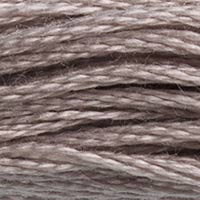
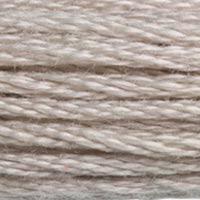
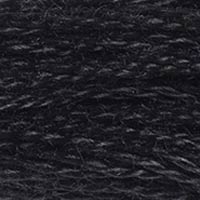
DMC colors commonly used alongside 3771 Ultra Very Light Terra Cotta.
Suggested Palette
Shading Companions
Detailed Conversions
Where to Buy DMC 3771
This section contains affiliate links. We may earn a small commission at no cost to you.
Related Guides
Free Printable Thread Conversion Chart
Pick a brand, enter your email, and we'll send you a printable chart mapping all 552 DMC colors to that brand's equivalents. Zero spam, one chart.
Thanks! Here's your free chart:
Download Your ChartOpens in a new tab. Use your browser's Print → Save as PDF.
No spam. Your email is stored securely and never shared.