
Quick Conversion Table
| Brand | Equivalent | Match |
|---|---|---|
| Anchor | 176 | close |
| Madeira | 1716 | close |
| Cosmo ⚠ | 153 | close |
| Sullivans | 45476 | close |
| J&P Coats | 7023 | close |
Blue Threads on Warm vs Cool Fabric: A Case Study
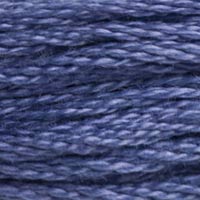
If you want a masterclass in how fabric tone transforms thread color, stitch a few test crosses of DMC 161 on three different fabrics and hold them side by side. On white Aida, 161 looks like a slightly dusty medium blue — pleasant, unassuming, clearly blue. On cream evenweave, it shifts toward blue-violet, the warm background pushing the grey component into something almost lavender. On natural linen, it settles into a handsome slate that could pass for aged denim or weathered stone. Same thread. Three different personalities.
This fabric sensitivity isn't unique to 161, but grey-blues exhibit it more dramatically than most colors because they live in the borderland between warm and cool. A saturated royal blue will look like royal blue on anything — the pigment overwhelms the fabric's influence. A grey-blue like 161 is quiet enough that the fabric's underlying color becomes part of the equation, mixing optically with the thread to produce a result that neither can achieve alone.
The Anchor of the Grey-Blue Family
As the darkest standard member of the grey-blue trio (159, 160, 161), this thread anchors the family. It defines the shadow end, sets the floor for how dark the palette goes, and provides the visual weight that keeps lighter values from floating away into pallid insignificance. Without 161, a composition using 159 and 160 can feel washed-out and indecisive. Add 161, and suddenly the lighter values have context — they're light relative to something, and that relationship creates depth.
In a stone wall or architectural element, 161 handles the deepest mortar lines, the recesses between blocks, the underside of ledges and cornices where light doesn't reach. These are the shadows that make the wall look three-dimensional rather than flat. The grey-blue quality ensures that these shadows feel natural — real stone shadows are never pure black or pure grey but carry the ambient color of sky reflection, which in temperate climates is often exactly this shade of muted blue.
For clothing in portraits and figurative work, 161 defines folds and drapes. A pair of jeans stitched with the 159-160-161 family has realistic depth: 159 for the knee where denim stretches thin and lightens, 160 for the main body of the fabric, 161 for the creases behind the knee and along the inseam. The grey-blue family captures denim's specific character better than either the pure blue or pure grey families can manage alone.
Nautical and Coastal Design
Sailor's uniforms, ship rigging against an overcast sky, the hull of a working fishing boat — northern maritime life is drenched in this shade. DMC 161 captures the blue of a naval pea coat, the grey-blue of a harbor at dawn, the color of deep water seen through sea mist. For nautical-themed samplers, 161 pairs with DMC 336 (Navy Blue) for the darkest elements, DMC 3752 (Very Light Antique Blue) for sky and foam, and DMC 3787 (Dark Brown Grey) for aged wood and rope.
Lighthouse designs — perennially popular in cross-stitch — use 161 for the sea in overcast conditions, stormy sky areas, and the blue-grey of wet rock. It's the color of water that's more about mood than about prettiness, water you respect rather than swim in. Combine with DMC 3750 (Very Dark Antique Blue) for the deep water at the base of the cliff and DMC 159 (Light Gray Blue) for the sky breaking through cloud cover.
Anchor motifs, compass roses, nautical knots, and maritime alphabets all benefit from being stitched in 161 rather than a cleaner blue. The grey muting gives these designs a weathered, authentic quality — the look of brass fittings and painted wood that have endured years of salt spray and weather. It signals that these are working nautical symbols, not decorative interpretations.
Staying in the Grey-Blue Lane
Anchor 176 is a solid starting point for substituting 161, keeping you firmly in grey-blue territory without drifting toward clean blue or pure grey. Test it against your fabric and lighting before committing to a large project, as the grey-blue balance can shift subtly between brands.
Madeira 1716 captures the right mood. Its slightly different sheen is barely noticeable at this medium-dark value — the grey muting absorbs light differences that would be obvious in a brighter thread. Cosmo 153 and Sullivans 45476 handle the general grey-blue space competently.
A common mistake: reaching for DMC 793 (Medium Cornflower Blue) or DMC 322 (Dark Baby Blue) as substitutes. Both share a similar value level but lack 161's essential grey component. They'll read as blue where 161 reads as grey-blue, and in contexts like stone walls, denim, or overcast seascapes, that distinction is the whole point. You're not stitching a blue thing; you're stitching a thing that happens to be grey-blue, and that shift in emphasis matters.
If you need a substitute within the DMC range itself, DMC 3752 (Very Light Antique Blue) is too light, and DMC 3750 (Very Dark Antique Blue) is too dark, but the antique blue family shares the same grey-cool quality. DMC 931 (Medium Antique Blue) occupies similar territory and could work in a pinch, though it's not a perfect match — it runs slightly more green-grey where 161 runs more violet-grey. Test before you commit.
Reference quality
How We Validate This Color Record
Use this page as a reference card for DMC 161: the structured data, quick conversions, and long-form copy are all tied back to the same stored color record.
- Methodology
- This page renders DMC 161, its hex value, and every brand equivalent from the site's source-of-truth color record, then checks long-form body copy against those same stored fields.
- Verification status
- Source-field checked. The page content is audited against the stored DMC number, brand equivalents, and match-quality labels before publishing.
- Last reviewed
- 2026-04-20
- Approximation warning
- Screen hex values, thread photos, and cross-brand conversions are reference aids. Dye lots, thread sheen, and fabric color can still shift the result in hand.
Decision guide
When to use the DMC 161 reference page
This page should help you decide faster between palette planning, brand substitution, and shade comparison without turning the color record into a thin lookup page.
Best for
- + Palette planning when you want the stored DMC 161 Gray Blue record, hex value #7880A4, and linked brand equivalents in one place.
- + Checking the quickest cross-brand shortlist before you buy floss, compare stash substitutes, or route into a more specific conversion page.
- + Finding nearby shades in the blues family before you commit to accents, shading, or background blends.
Watch for
- ! Screen previews are only reference aids. Gray Blue can shift on real fabric because thread sheen, stitch coverage, and room lighting change how the color reads.
- ! A stored equivalent is still a shortlist, not a guarantee that two brands will disappear into each other in the same stitched motif.
- ! Older charts, discontinued kit floss, and dye-lot variation can all introduce small but visible differences that the page cannot detect for you.
Before you commit
- Confirm the role of DMC 161 Gray Blue: decide whether you need an exact hero shade, a forgiving background, or a rough stash substitute.
- Compare on project fabric: view the skein or stitched sample on the same fabric count and color you will actually use.
- Use the linked conversion pages next: open the brand-specific pages when you need match-quality caveats before substituting away from the DMC reference.
DMC 161 FAQ
These questions appear on the page so the FAQ schema stays aligned with what visitors can actually read.
What is the Anchor equivalent of DMC 161?+
The closest Anchor equivalent to DMC 161 (Gray Blue) is Anchor 176. This is a close match.
What color is DMC 161?+
DMC 161 is called "Gray Blue" and has a hex color value of #7880A4. It belongs to the blues color family.
What is the Madeira equivalent of DMC 161?+
The closest Madeira equivalent to DMC 161 (Gray Blue) is Madeira 1716. This is a close match.
How DMC 161 Looks on Fabric
The same thread appears different depending on your fabric. Always test on your project fabric.
White Aida
Cream / Ecru
Black Aida
Pairs Well With
DMC colors commonly used alongside 161 Gray Blue.
Suggested Palette
Shading Companions
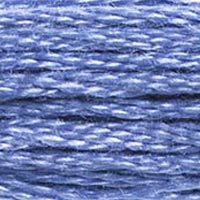

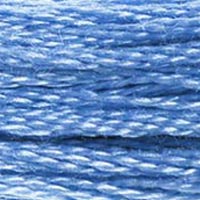
Detailed Conversions
Where to Buy DMC 161
This section contains affiliate links. We may earn a small commission at no cost to you.
Related Guides
Free Printable Thread Conversion Chart
Pick a brand, enter your email, and we'll send you a printable chart mapping all 552 DMC colors to that brand's equivalents. Zero spam, one chart.
Thanks! Here's your free chart:
Download Your ChartOpens in a new tab. Use your browser's Print → Save as PDF.
No spam. Your email is stored securely and never shared.