
Quick Conversion Table
| Brand | Equivalent | Match |
|---|---|---|
| Anchor | 907 | exact |
| Madeira | 2202 | close |
| Cosmo ⚠ | 773 | close |
| Sullivans | 45233 | close |
| J&P Coats | 6844 | close |
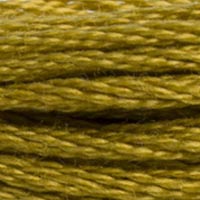
Color theory has a concept called the "key tone" — the color in a composition that carries the most chromatic information, that tells the viewer what the piece is primarily about in color terms. For any design featuring autumn leaves, dried botanical elements, aged gold metalwork, sunflowers, bees, or Mediterranean landscape, DMC 832 — Golden Olive at hex #BD9B51 — often fills this role. It's vivid enough to read clearly, muted enough to feel natural rather than artificial, and balanced enough between yellow, green, and brown to belong to any of those families while committing to none of them exclusively.
The Brightest in the Family
Positioned fourth out of five in the golden olive value sequence (with 829 and 830 darker, 833 and 834 lighter), 832 is also the most chromatically intense member of the family — the point where yellow-green reads most vividly before the color softens toward the paler values. This brightness relative to its neighbors makes 832 particularly useful as the main fill color in designs that use the golden olive family: the darker values shadow it, the lighter values highlight it, and 832 carries the primary visual impression.
For single-color designs — a monogram stitched in one golden olive tone, a simple floral bookmark, a decorative border — 832 is the most versatile single choice from the family. It's bright enough to stand alone without disappearing, and neutral enough in its undertone to work against a wide range of fabric colors and companion thread choices.
Sunflower and Bee Designs
Sunflowers have become one of the most popular cross-stitch motifs of recent years, and the golden olive family does much of the heavy lifting in convincing sunflower rendering. 832 typically serves as the primary mid-petal color — the body of the yellow petals after the brightest sun-struck highlights and before the greenish shadow at the petal base where it meets the flower center. Alongside DMC 725 (Topaz) for bright petal highlights and DMC 829 (Very Dark Golden Olive) for the deep flower center shadows, 832 makes sunflower petals look dimensional and alive.
Honeybee designs use 832 for the amber body bands — the warm yellow-green-gold of bee bodies reads correctly in 832 where a more saturated or cooler yellow would look wrong. Honeycomb cross-stitch, bee skep motifs, and honey jar illustrations all benefit from 832's warmth and natural quality.
Gold Without Metal
When stitchers want a gold effect in cross-stitch without the headache of working with metallic thread — which can shred, tangle, pierce unevenly, and be genuinely unpleasant to use — the golden olive family provides the best non-metallic approximation. 832 as the primary gold tone, with 829 or 830 for shadow and 834 or DMC 677 (Very Light Old Gold) for highlight, creates a convincing gilded impression through value contrast alone. For crown motifs in heraldic design, decorative border accents, and any piece where gold is aesthetic rather than structural, this three-color approach often produces more satisfying results than metallic thread.
Both Anchor 907 and Madeira 2202 earn exact match ratings, which is good news for stitchers who work across brands. The golden-olive balance in 832 — its most distinctive characteristic — appears to be well-calibrated across all three manufacturers for this specific value.
Cosmo 773 and Sullivans 45233 are close matches. At 832's level of chromatic intensity — more vivid than the darker family members — brand differences in thread finish become more noticeable. Cosmo's silkier thread may read as slightly brighter or more yellow than DMC's matte finish at this value. If you're using Cosmo for bright golden olive work, test in your fabric and lighting conditions first.
Within DMC, the substitution hierarchy in the golden olive family puts 831 (Medium Golden Olive) as the darker alternative and 833 (Light Golden Olive) as the lighter alternative. For designs where 832 functions as the primary fill color, 831 can substitute if you want a slightly more subdued gold feel, while 833 gives a slightly lighter, softer impression. Neither is a perfect substitute if the five-step gradient is the point, but either works adequately in designs where 832 appears as a standalone element.
Outside the golden olive family, DMC 3820 (Dark Straw) and DMC 3821 (Straw) sit nearby in character but read as warmer and more purely yellow — less complex in undertone. They're useful alternatives if you need something in the golden-yellow zone but 832's green-brown complexity isn't working for your design.
Reference quality
How We Validate This Color Record
Use this page as a reference card for DMC 832: the structured data, quick conversions, and long-form copy are all tied back to the same stored color record.
- Methodology
- This page renders DMC 832, its hex value, and every brand equivalent from the site's source-of-truth color record, then checks long-form body copy against those same stored fields.
- Verification status
- Source-field checked. The page content is audited against the stored DMC number, brand equivalents, and match-quality labels before publishing.
- Last reviewed
- 2026-04-20
- Approximation warning
- Screen hex values, thread photos, and cross-brand conversions are reference aids. Dye lots, thread sheen, and fabric color can still shift the result in hand.
Decision guide
When to use the DMC 832 reference page
This page should help you decide faster between palette planning, brand substitution, and shade comparison without turning the color record into a thin lookup page.
Best for
- + Palette planning when you want the stored DMC 832 Golden Olive record, hex value #BD9B51, and linked brand equivalents in one place.
- + Checking the quickest cross-brand shortlist before you buy floss, compare stash substitutes, or route into a more specific conversion page.
- + Finding nearby shades in the yellows family before you commit to accents, shading, or background blends.
Watch for
- ! Screen previews are only reference aids. Golden Olive can shift on real fabric because thread sheen, stitch coverage, and room lighting change how the color reads.
- ! A stored equivalent is still a shortlist, not a guarantee that two brands will disappear into each other in the same stitched motif.
- ! Older charts, discontinued kit floss, and dye-lot variation can all introduce small but visible differences that the page cannot detect for you.
Before you commit
- Confirm the role of DMC 832 Golden Olive: decide whether you need an exact hero shade, a forgiving background, or a rough stash substitute.
- Compare on project fabric: view the skein or stitched sample on the same fabric count and color you will actually use.
- Use the linked conversion pages next: open the brand-specific pages when you need match-quality caveats before substituting away from the DMC reference.
DMC 832 FAQ
These questions appear on the page so the FAQ schema stays aligned with what visitors can actually read.
What is the Anchor equivalent of DMC 832?+
The closest Anchor equivalent to DMC 832 (Golden Olive) is Anchor 907. This is an exact match.
What color is DMC 832?+
DMC 832 is called "Golden Olive" and has a hex color value of #BD9B51. It belongs to the yellows color family.
What is the Madeira equivalent of DMC 832?+
The closest Madeira equivalent to DMC 832 (Golden Olive) is Madeira 2202. This is a close match.
How DMC 832 Looks on Fabric
The same thread appears different depending on your fabric. Always test on your project fabric.
White Aida
Cream / Ecru
Black Aida
Pairs Well With
DMC colors commonly used alongside 832 Golden Olive.
Suggested Palette
Shading Companions
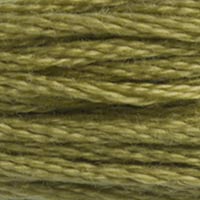
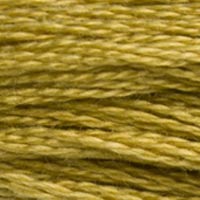
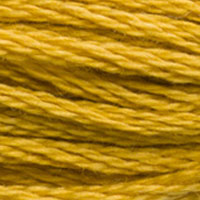
Detailed Conversions
Where to Buy DMC 832
This section contains affiliate links. We may earn a small commission at no cost to you.
Related Guides
Free Printable Thread Conversion Chart
Pick a brand, enter your email, and we'll send you a printable chart mapping all 552 DMC colors to that brand's equivalents. Zero spam, one chart.
Thanks! Here's your free chart:
Download Your ChartOpens in a new tab. Use your browser's Print → Save as PDF.
No spam. Your email is stored securely and never shared.