
Quick Conversion Table
| Brand | Equivalent | Match |
|---|---|---|
| Anchor | 925 | close |
| Madeira | 0204 | exact |
| Cosmo ⚠ | 147 | close |
| Sullivans | 45300 | close |
| J&P Coats | 2327 | close |
| Candamar | 6124 | close |
Which DMC Is the Right Pumpkin Color?
Every September, the same question floods cross-stitch forums and Facebook groups: "Which DMC number should I use for a pumpkin?" Stitchers hold skeins up to their screens, photograph them under every light source in the house, and agonize over whether their chosen orange is too red, too yellow, too dark, or too bright. The answer, in most cases, is DMC 970 Light Pumpkin. The name is not subtle about it.
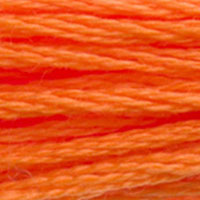
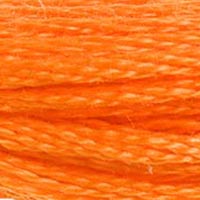
But here is the thing — calling this shade "pumpkin" pigeonholes a thread that has far more range than a single gourd. Look at the hex value (#F78B13). That high green component relative to 608's redder profile tells you this is a golden-orange, a warm amber-orange that sits squarely in the territory of things that glow. Sunset clouds at their most intense. Marigold petals at full bloom. The amber warning light on a dashboard. Tiger fur in the stripe transition zone. This is not a novelty seasonal shade — it is a workhorse orange with genuine year-round utility.
Where does 970 sit relative to its neighbors? DMC 608 (Bright Orange) is redder and hotter — it pushes toward the fire end of the spectrum. DMC 740 (Tangerine) is more purely orange with balanced red and yellow. DMC 970 is the warmest and most golden of the three, carrying enough yellow to suggest amber and honey without tipping into actual yellow-orange territory. That golden quality is what makes it read as "pumpkin" — real pumpkins are not red-orange, they are this specific golden-orange that catches late afternoon light.
Working with 970: Practical Stitching Notes
Coverage with 970 is reliably good. Two strands on 14-count Aida fill cleanly with no fabric show-through, and the thread maintains consistent color from the first stitch to the last in a skein. I have never noticed dye lot variation with this shade, though that is anecdotal — always buy enough for your project from the same purchase when possible.
On fabric choice: 970 looks its warmest and most golden on cream or ecru fabric, where the base color harmonizes with the thread's amber undertone. On white, it reads slightly cooler and more purely orange, which is fine but loses some of that characteristic warmth. On black, 970 creates a rich, glowing effect that is less aggressive than 608's neon punch — it reads more like candlelight than like a traffic cone, which is exactly what you want for those pumpkin-on-black-Aida designs that dominate autumn stitching.
For strand count, the standard two-on-14 and one-on-18 guidelines apply. If you are working over two on 28-count linen, two strands will give you full coverage but the texture of the linen weave shows through slightly, which with 970's golden tone creates a beautiful effect reminiscent of actual gourd skin — slightly textured and organic. This is one of those happy accidents where fabric texture enhances the subject matter.
Thread behavior is straightforward. 970 does not twist excessively, separates cleanly, and runs through fabric without noticeable drag. It is a well-behaved thread, which sounds like faint praise until you have spent an evening frogging a section because a temperamental thread kept snarling and creating uneven tension. Reliability matters more than excitement in a thread's handling characteristics.
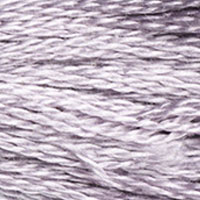
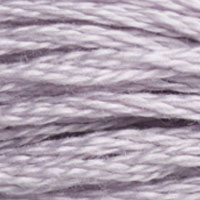
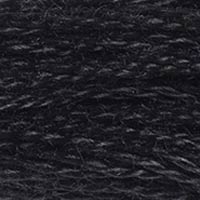
In palette building, 970 pairs beautifully with earth tones. DMC 898 (Very Dark Coffee Brown) and DMC 433 (Medium Brown) provide the dark anchor for autumn compositions. DMC 676 (Light Old Gold) and DMC 3855 (Light Autumn Gold) extend the palette toward the highlights. For sunset scenes, step through 970, 740, and 608 to build the orange intensity curve, then bridge into reds with DMC 351 (Coral) or DMC 3341 (Melon). For tiger patterns specifically, 970 is the primary stripe-adjacent fur tone, with DMC 976 (Medium Golden Brown) and DMC blanc providing the full tonal range.
One design trick worth noting: 970 makes an excellent metallic substitute. When a pattern calls for a gold or amber metallic thread but you hate working with metallics (and many of us do — parking a metallic thread is an exercise in frustration), 970 stitched as full crosses captures the warmth and glow of gold without the fraying, splitting, and general misery of metallic filament. The result is slightly less shiny but infinitely more pleasant to stitch and more durable in finished pieces.
Substituting DMC 970 Light Pumpkin
Madeira 0204 is the standout option here — it is the only exact match among the major brands, and the golden-orange warmth translates accurately. Madeira's version holds that amber quality that defines 970, and the thread weight and twist are close enough that coverage on 14-count Aida is virtually identical to DMC. If you are shopping for a substitute and have access to Madeira, this is where to start. The finish is slightly silkier than DMC, which at this particular hue actually enhances the golden character rather than fighting it.
Anchor 925 is rated close, and this is where it gets complicated. Anchor 925 is also listed as the exact match for DMC 740 (Tangerine), which is a distinctly different color — 740 is a balanced, pure orange while 970 is warmer and more golden. In practice, Anchor 925 splits the difference between the two, sitting closer to 740's pure orange than to 970's amber warmth. For projects where 970 is used as a standalone warm orange, Anchor 925 is serviceable. But if your design relies on the specific golden quality that separates 970 from 740 — in a pumpkin shading sequence, for example, where both colors appear — Anchor 925 cannot do double duty for both. You would lose a tonal step in your gradient.
Cosmo 147 is a close match that handles well. Cosmo's oranges tend to be clean and well-saturated, and their thread has a softness that many stitchers find forgiving during long stitching sessions. The golden undertone may be slightly less pronounced than in DMC 970, but for most project contexts — an autumn wreath, a harvest scene, a scattered leaf border — the difference is not going to pull anyone out of the design.
Sullivans 45300 captures the general territory of light, warm orange. The main consideration here is coverage density: Sullivans threads can run slightly thinner, so if you are filling large areas of pumpkin body color, you may want to test whether two strands covers your fabric fully before stitching a whole section. On 14-count Aida, this is rarely an issue. On 28-count evenweave over two, you may see some fabric show-through that you would not get with DMC.
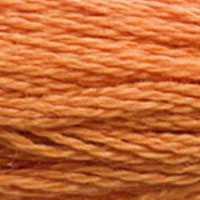
Within the DMC range, DMC 971 (Pumpkin) is one step darker and more saturated — it is the shadow companion to 970 rather than a substitute. DMC 742 (Light Tangerine) is lighter and leans more yellow, making it a highlight companion. If you genuinely cannot find 970 and need a single DMC thread to replace it, DMC 722 (Light Orange Spice) is the closest in value and warmth, though it carries a slightly more muted, spiced quality that changes the mood from "fresh pumpkin" to "pumpkin spice." That may or may not be a problem depending on your project.
Reference quality
How We Validate This Color Record
Use this page as a reference card for DMC 970: the structured data, quick conversions, and long-form copy are all tied back to the same stored color record.
- Methodology
- This page renders DMC 970, its hex value, and every brand equivalent from the site's source-of-truth color record, then checks long-form body copy against those same stored fields.
- Verification status
- Source-field checked. The page content is audited against the stored DMC number, brand equivalents, and match-quality labels before publishing.
- Last reviewed
- 2026-04-20
- Approximation warning
- Screen hex values, thread photos, and cross-brand conversions are reference aids. Dye lots, thread sheen, and fabric color can still shift the result in hand.
Decision guide
When to use the DMC 970 reference page
This page should help you decide faster between palette planning, brand substitution, and shade comparison without turning the color record into a thin lookup page.
Best for
- + Palette planning when you want the stored DMC 970 Light Pumpkin record, hex value #F78B13, and linked brand equivalents in one place.
- + Checking the quickest cross-brand shortlist before you buy floss, compare stash substitutes, or route into a more specific conversion page.
- + Finding nearby shades in the oranges family before you commit to accents, shading, or background blends.
Watch for
- ! Screen previews are only reference aids. Light Pumpkin can shift on real fabric because thread sheen, stitch coverage, and room lighting change how the color reads.
- ! A stored equivalent is still a shortlist, not a guarantee that two brands will disappear into each other in the same stitched motif.
- ! Older charts, discontinued kit floss, and dye-lot variation can all introduce small but visible differences that the page cannot detect for you.
Before you commit
- Confirm the role of DMC 970 Light Pumpkin: decide whether you need an exact hero shade, a forgiving background, or a rough stash substitute.
- Compare on project fabric: view the skein or stitched sample on the same fabric count and color you will actually use.
- Use the linked conversion pages next: open the brand-specific pages when you need match-quality caveats before substituting away from the DMC reference.
DMC 970 FAQ
These questions appear on the page so the FAQ schema stays aligned with what visitors can actually read.
What is the Anchor equivalent of DMC 970?+
The closest Anchor equivalent to DMC 970 (Light Pumpkin) is Anchor 925. This is a close match.
What color is DMC 970?+
DMC 970 is called "Light Pumpkin" and has a hex color value of #F78B13. It belongs to the oranges color family.
What is the Madeira equivalent of DMC 970?+
The closest Madeira equivalent to DMC 970 (Light Pumpkin) is Madeira 0204. This is an exact match.
How DMC 970 Looks on Fabric
The same thread appears different depending on your fabric. Always test on your project fabric.
White Aida
Cream / Ecru
Black Aida
Pairs Well With
DMC colors commonly used alongside 970 Light Pumpkin.
Suggested Palette
Shading Companions

Detailed Conversions
Where to Buy DMC 970
This section contains affiliate links. We may earn a small commission at no cost to you.
Related Guides
Free Printable Thread Conversion Chart
Pick a brand, enter your email, and we'll send you a printable chart mapping all 552 DMC colors to that brand's equivalents. Zero spam, one chart.
Thanks! Here's your free chart:
Download Your ChartOpens in a new tab. Use your browser's Print → Save as PDF.
No spam. Your email is stored securely and never shared.