
Quick Conversion Table
| Brand | Equivalent | Match |
|---|---|---|
| Anchor | 1003 | close |
| Madeira | 0310 | close |
| Cosmo ⚠ | 186 | close |
| Sullivans | 45268 | close |
| J&P Coats | 3336 | close |
| Dimensions | 6110 | close |
| Bucilla | 6110 | close |
| Candamar | 6110 | close |
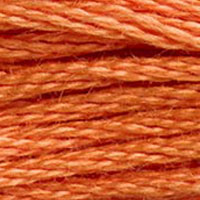
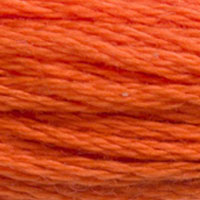
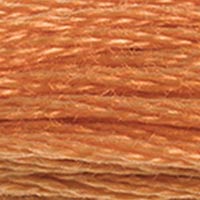
Light copper is a color that food understands well. Caramelized onions, toasted pecans, the edge of a well-made waffle, the crust of baked challah, the skin of a Cornish hen fresh from the oven — this particular orange-amber with its warm, slightly sweet quality is intimately associated with heat-applied transformation. Food and fiber both know this color. DMC 922 Light Copper, at #E27323, captures the lighter, more golden end of the copper range: still warm, still orange-red, but lit up enough that it reads as illuminated rather than shadowed.
As the lightest of the five-step copper family (918–922), DMC 922 takes the highlight position: the edge of the copper pot where light hits brightest, the tip of a fox's tail in afternoon sun, the sun-struck surface of an autumn leaf. At this value, the red component has receded enough that 922 reads primarily as orange with copper warmth rather than as red-orange. Its family classification has shifted accordingly — unlike the darker copper shades (listed under reds), 922 is categorized under oranges in the DMC system, reflecting where its actual color center of gravity lies.
Highlight Color Technique
Using light colors as highlights requires some strategic restraint. The temptation is to apply them too broadly — using 922 wherever the surface curves toward the light — but the most convincing highlight work uses the lightest value sparingly, in a small zone representing the direct reflection point. In fox or squirrel fur designs, 922 might appear in just 10–15% of the total stitch count, concentrated on the most forward-facing surfaces and the edges of the animal's outline where backlighting creates a rim-light effect.
The railroading technique is especially valuable with highlight colors. On light threads, the difference between a well-laid stitch and a twisted one is highly visible — a twisted stitch in 922 will catch light differently and may look like a slightly different color entirely. Taking a moment to railroad stitches in 922's application areas keeps the highlight reading clean and consistent.
Where Light Copper Stands Out
Beyond gradient work, DMC 922 has applications as a standalone color in designs that need warmth without depth. Stitched representations of woven baskets, dried grass, and natural fiber textures often land in exactly this color range — DMC 922 with a little DMC 738 (Very Light Tan) as a highlight and DMC 920 as a shadow creates a convincing wicker or rattan texture. Autumn cornstalk designs, dried wheat patterns, and harvest-themed stitching all benefit from 922 as their primary warm-gold element.
Skin tone work occasionally uses 922 in the warmest highlight zones for deep tan or warm brown complexions. It's not a common skin tone application, but in designs where the subject has strongly warm-toned skin catching direct light, 922 provides a highlight that's tonally harmonious with the warm skin family rather than introducing a neutral pale that reads as washed out.
Stitchers building color cards for their stash sometimes use 922 as a reference point for the "warm highlight" section — it's a useful benchmark color that helps identify where other warm threads sit in relation to it.
Madeira 0310 carries an exact rating, while Anchor 1003 is only close — the same pattern as DMC 921 (Copper), where Madeira matches more closely than Anchor. Note also that Anchor 1003 is listed as close for both DMC 921 and DMC 922, meaning the Anchor equivalent is the same for both adjacent shades. In practice this means Anchor 1003 sits somewhere between the two DMC shades and can substitute for either, but won't capture the specific value difference between them in gradient work.
If you're building a complete copper gradient in Anchor, this is one of the areas where the brand conversion breaks down somewhat — Anchor doesn't have separate exact equivalents for both 921 and 922, making the lightest end of the copper gradient less precisely replicable in Anchor than in Madeira or DMC. For stitchers who need the full copper sequence, this is a reason to consider using Madeira or staying with DMC for the lighter copper shades even if using Anchor elsewhere in a design.
Cosmo 186 and Sullivans 45268 both rate as close. Both are serviceable in standalone applications. For gradient work, the same caution as always: test the sequence before committing to make sure the steps read correctly.
Within DMC, if 922 is unavailable, DMC 921 (Copper) is the obvious adjacent darker substitute. Moving away from the copper family entirely, DMC 402 (Very Light Mahogany) provides warm light orange in roughly comparable territory. DMC 3340 (Medium Apricot) is another option if you need lighter and less orange-red than 922 provides.
Reference quality
How We Validate This Color Record
Use this page as a reference card for DMC 922: the structured data, quick conversions, and long-form copy are all tied back to the same stored color record.
- Methodology
- This page renders DMC 922, its hex value, and every brand equivalent from the site's source-of-truth color record, then checks long-form body copy against those same stored fields.
- Verification status
- Source-field checked. The page content is audited against the stored DMC number, brand equivalents, and match-quality labels before publishing.
- Last reviewed
- 2026-04-20
- Approximation warning
- Screen hex values, thread photos, and cross-brand conversions are reference aids. Dye lots, thread sheen, and fabric color can still shift the result in hand.
Decision guide
When to use the DMC 922 reference page
This page should help you decide faster between palette planning, brand substitution, and shade comparison without turning the color record into a thin lookup page.
Best for
- + Palette planning when you want the stored DMC 922 Light Copper record, hex value #E27323, and linked brand equivalents in one place.
- + Checking the quickest cross-brand shortlist before you buy floss, compare stash substitutes, or route into a more specific conversion page.
- + Finding nearby shades in the oranges family before you commit to accents, shading, or background blends.
Watch for
- ! Screen previews are only reference aids. Light Copper can shift on real fabric because thread sheen, stitch coverage, and room lighting change how the color reads.
- ! A stored equivalent is still a shortlist, not a guarantee that two brands will disappear into each other in the same stitched motif.
- ! Older charts, discontinued kit floss, and dye-lot variation can all introduce small but visible differences that the page cannot detect for you.
Before you commit
- Confirm the role of DMC 922 Light Copper: decide whether you need an exact hero shade, a forgiving background, or a rough stash substitute.
- Compare on project fabric: view the skein or stitched sample on the same fabric count and color you will actually use.
- Use the linked conversion pages next: open the brand-specific pages when you need match-quality caveats before substituting away from the DMC reference.
DMC 922 FAQ
These questions appear on the page so the FAQ schema stays aligned with what visitors can actually read.
What is the Anchor equivalent of DMC 922?+
The closest Anchor equivalent to DMC 922 (Light Copper) is Anchor 1003. This is a close match.
What color is DMC 922?+
DMC 922 is called "Light Copper" and has a hex color value of #E27323. It belongs to the oranges color family.
What is the Madeira equivalent of DMC 922?+
The closest Madeira equivalent to DMC 922 (Light Copper) is Madeira 0310. This is a close match.
How DMC 922 Looks on Fabric
The same thread appears different depending on your fabric. Always test on your project fabric.
White Aida
Cream / Ecru
Black Aida
Pairs Well With
DMC colors commonly used alongside 922 Light Copper.
Suggested Palette
Shading Companions

Detailed Conversions
Where to Buy DMC 922
This section contains affiliate links. We may earn a small commission at no cost to you.
Related Guides
Free Printable Thread Conversion Chart
Pick a brand, enter your email, and we'll send you a printable chart mapping all 552 DMC colors to that brand's equivalents. Zero spam, one chart.
Thanks! Here's your free chart:
Download Your ChartOpens in a new tab. Use your browser's Print → Save as PDF.
No spam. Your email is stored securely and never shared.