
Quick Conversion Table
| Brand | Equivalent | Match |
|---|---|---|
| Anchor | 897 | exact |
| Madeira | 0401 | close |
| Cosmo ⚠ | 655 | close |
| Sullivans | 45044 | close |
| J&P Coats | 3072 | close |
| Dimensions | 60221 | close |
| Bucilla | 6212 | close |
| Candamar | 6212 | close |
The Workhorse Dark Pink That Sampler Stitchers Swear By
Ask anyone who stitches reproduction samplers which dark pink they reach for first, and DMC 221 comes up again and again. It has the depth to define motifs, the warmth to feel historical, and the restraint to avoid looking garish. This isn't a flashy dark pink — it's a dignified one. Berry-toned, rich without being shrill, it reads as the kind of color that might have been achieved with madder root dye in the 18th century, which is precisely why the reproduction sampler community has adopted it so thoroughly.
At the very dark end of the shell pink family, 221 carries substantial visual weight. Where lighter shell pinks like 224 and 225 are soft, gentle, and recessive, 221 steps forward and demands attention. It anchors floral motifs, provides the darkest shading in rose work, and serves as a strong contrast color against lighter backgrounds. In a traditional sampler with crowns, birds, alphabets, and flowering vines, 221 is often the thread doing the heavy lifting — defining the shapes that make the design legible from across the room.
The shell pink undertone keeps 221 warm even at this dark value. Place it next to DMC 814 (Dark Garnet) or DMC 902 (Very Dark Garnet), which are similar in darkness but cooler and more blue-red, and you'll see the difference. 221 has an earthiness, a brownish warmth, that the garnets lack. That warmth is what makes it look period-appropriate in historical designs. Naturally dyed pinks from the 17th and 18th centuries tended warm because the dye sources — madder, cochineal — produced warm reds that faded into warm pinks over time.
Building the Shell Pink Gradient
The shell pink family is one of DMC's most complete gradients, and 221 is its anchor point at the dark end. Working from dark to light: 221 (Very Dark), 3721 (Dark), 3722 (Medium), 223 (Light), 152 (Medium Light), 224 (Very Light), and 225 (Ultra Very Light). That's seven distinct values in a single family, giving you extraordinary control over shading and transitions. Few color families in the DMC range offer this kind of depth.
For rose work, this gradient is golden. A single rose can use four or five of these values, from 221 in the deepest petal folds to 225 at the sun-caught outer edges, with smooth transitions through the intermediate values. The family coherence means every step feels natural — no awkward jumps, no undertone shifts, just a steady progression from deep berry to barely-there blush.
In practice, most patterns won't call for all seven values. A typical floral design might use 221, 223, and 224 — three well-spaced values that cover shadow, midtone, and highlight. If you're stitching a large, detailed rose that needs more nuance, add 3722 between the dark and midtone, and 225 as a final pale highlight. The full seven-step gradient is for serious botanical work, large-scale pieces, or thread painting where you want photographic levels of smooth shading.
Beyond Florals: 221 as a Utilitarian Dark
Don't limit 221 to flower petals. This thread works anywhere you need a dark warm pink that reads as serious rather than playful. Burgundy-toned lettering in samplers, the dark stripes in a plaid pattern, the shadow side of a red brick building, the deep tones in autumn berries — 221 handles all of these with quiet authority.
For backstitching, 221 offers an interesting alternative to black or dark brown when outlining pink or red motifs. Black backstitch around pink florals can look harsh and graphic; 221 provides definition without the stark contrast, keeping the overall mood soft even while adding structural clarity. Try it for outlining roses, hearts, or ribbon bows where you want visible but gentle contour lines.
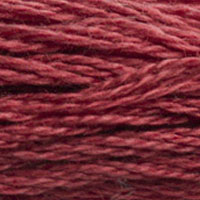
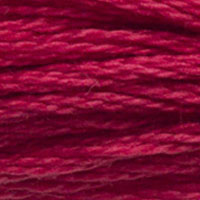
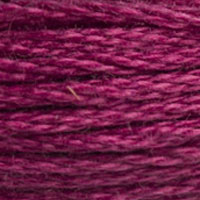
Pair 221 with DMC 3781 (Dark Mocha Brown) and DMC 3011 (Dark Khaki Green) for a classic reproduction sampler triad. Add DMC 3721 (Dark Shell Pink) as a slightly lighter alternative dark, and DMC 611 (Drab Brown) for an earthy neutral. This five-thread palette can carry an entire primitive sampler design, creating the aged, naturally-dyed look that collectors and competition judges recognize instantly.
Anchor 897 is an exact match and the substitute you should reach for first. It captures the warm, berry-toned depth of 221 faithfully, and Anchor's consistency across dye lots makes it a reliable choice for large projects or replacements mid-project. If you're stitching a reproduction sampler where the warm, historical character of 221 is essential to the aesthetic, Anchor 897 preserves that quality without compromise.
Madeira 0401 is close and handles most applications well, though some stitchers detect a fractional difference in warmth. At this dark value, Madeira's slightly smoother thread finish doesn't significantly alter the color's appearance — dark threads absorb light rather than reflecting it, which minimizes the impact of surface texture differences between brands.
Cosmo 655 and Sullivans 45044 are both close alternatives worth considering if your preferred brands aren't available. With any substitute for 221, the critical test is warmth: hold your candidate next to an orange-red (like DMC 350 or 351) and a blue-red (like DMC 814). The substitute should clearly lean toward the warm side. If it feels more at home next to the blue-reds, it's too cool and will shift the character of your palette.
Within DMC, the most common confusion is between 221 and DMC 3721 (Dark Shell Pink). They share the same hex value and are extremely close, but 221 is traditionally considered the slightly darker of the two. In practice, dye lot variation between them can make the difference negligible. If one is unavailable, the other is often a seamless stand-in. DMC 3350 (Ultra Dark Dusty Rose) is another nearby option, but it belongs to the dusty rose family and carries a cooler, greyer undertone — serviceable in mixed palettes but noticeable in a pure shell pink gradient.
Reference quality
How We Validate This Color Record
Use this page as a reference card for DMC 221: the structured data, quick conversions, and long-form copy are all tied back to the same stored color record.
- Methodology
- This page renders DMC 221, its hex value, and every brand equivalent from the site's source-of-truth color record, then checks long-form body copy against those same stored fields.
- Verification status
- Source-field checked. The page content is audited against the stored DMC number, brand equivalents, and match-quality labels before publishing.
- Last reviewed
- 2026-04-20
- Approximation warning
- Screen hex values, thread photos, and cross-brand conversions are reference aids. Dye lots, thread sheen, and fabric color can still shift the result in hand.
Decision guide
When to use the DMC 221 reference page
This page should help you decide faster between palette planning, brand substitution, and shade comparison without turning the color record into a thin lookup page.
Best for
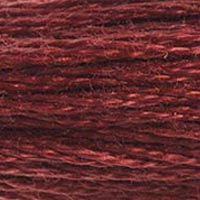
- + Palette planning when you want the stored DMC 221 Very Dark Shell Pink record, hex value #883E43, and linked brand equivalents in one place.
- + Checking the quickest cross-brand shortlist before you buy floss, compare stash substitutes, or route into a more specific conversion page.
- + Finding nearby shades in the pinks family before you commit to accents, shading, or background blends.
Watch for
- ! Screen previews are only reference aids. Very Dark Shell Pink can shift on real fabric because thread sheen, stitch coverage, and room lighting change how the color reads.
- ! A stored equivalent is still a shortlist, not a guarantee that two brands will disappear into each other in the same stitched motif.
- ! Older charts, discontinued kit floss, and dye-lot variation can all introduce small but visible differences that the page cannot detect for you.
Before you commit
- Confirm the role of DMC 221 Very Dark Shell Pink: decide whether you need an exact hero shade, a forgiving background, or a rough stash substitute.
- Compare on project fabric: view the skein or stitched sample on the same fabric count and color you will actually use.
- Use the linked conversion pages next: open the brand-specific pages when you need match-quality caveats before substituting away from the DMC reference.
DMC 221 FAQ
These questions appear on the page so the FAQ schema stays aligned with what visitors can actually read.
What is the Anchor equivalent of DMC 221?+
The closest Anchor equivalent to DMC 221 (Very Dark Shell Pink) is Anchor 897. This is an exact match.
What color is DMC 221?+
DMC 221 is called "Very Dark Shell Pink" and has a hex color value of #883E43. It belongs to the pinks color family.
What is the Madeira equivalent of DMC 221?+
The closest Madeira equivalent to DMC 221 (Very Dark Shell Pink) is Madeira 0401. This is a close match.
How DMC 221 Looks on Fabric
The same thread appears different depending on your fabric. Always test on your project fabric.
White Aida
Cream / Ecru
Black Aida
Pairs Well With
DMC colors commonly used alongside 221 Very Dark Shell Pink.
Suggested Palette
Shading Companions
Detailed Conversions
Where to Buy DMC 221
This section contains affiliate links. We may earn a small commission at no cost to you.
Related Guides
Free Printable Thread Conversion Chart
Pick a brand, enter your email, and we'll send you a printable chart mapping all 552 DMC colors to that brand's equivalents. Zero spam, one chart.
Thanks! Here's your free chart:
Download Your ChartOpens in a new tab. Use your browser's Print → Save as PDF.
No spam. Your email is stored securely and never shared.