
Quick Conversion Table
| Brand | Equivalent | Match |
|---|---|---|
| Anchor | 33 | exact |
| Madeira | 0411 | close |
| Cosmo ⚠ | 206 | close |
| Sullivans | 45245 | close |
| J&P Coats | 3152 | close |
| Candamar | 6305 | close |
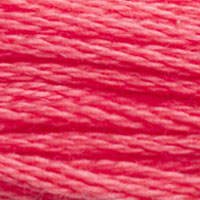
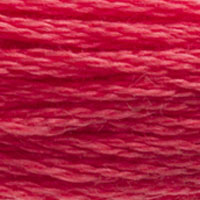
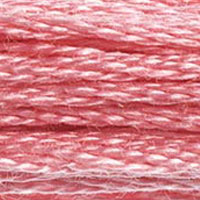
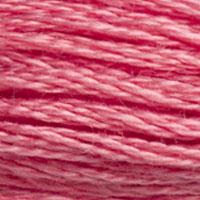
Some cross-stitch colors function as accents; others carry entire designs on their own. DMC 892 — Medium Carnation at hex #FF798C — lands in the latter category. Vivid, warm-pink with enough orange influence to feel energetic and alive, 892 is the kind of color that makes a design immediately legible from across the room. It's the main body color of the carnation family, the mid-value member that carries the most surface area in any carnation-family rendering and establishes the design's overall pink identity.
The Primary Color of Carnation Pink
In the four-value carnation family (891-894), 892 functions as the primary fill color in most multi-color applications. 891 (Dark Carnation) shadows it; 893 (Light Carnation) highlights it; 894 (Very Light Carnation) provides the final pale note. But 892 covers the most area, defines what the design reads as pink-wise, and carries the character of the carnation hue family most legibly. If you were forced to choose just one carnation color, 892 would be the defensible pick.
For stitchers who use single-color or limited-color designs — small motifs, quick projects, bookmarks and ornaments stitched in one or two colors — 892 as the sole pink gives you a vivid, warm-pink result with enough presence to read across a frame. It's brighter than the rose family and more distinctly pink-warm than the dusty rose family, which makes it ideal for designs that need pink to be unambiguous and cheerful.
Floral Work and the Carnation Gradient
Carnations, peonies, hybrid tea roses, dahlias, and tulips in mid-pink tones all use 892 as their primary body color. For realistic floral cross-stitch, 892 represents the average lit state of the petal — neither the deep shadow that 891 occupies nor the sun-lit highlight that 893 captures, but the main color the petal reads as in normal, even light.
Needle painting technique benefits from 892 as an anchor color. When you're building up petal color from shadow to highlight, 892 is the mid-point that all other values orient around. Getting 892 right means the shadows (891) feel like shadows and the highlights (893, 894) feel like light rather than arbitrary different pinks.
Pop Culture and Decorative Design Applications
Cross-stitch designs that reference specific pop culture aesthetics — certain fashion iconography, anime and illustration styles, or particularly the "barbiecore" and maximalist pink aesthetic that has resonated widely in craft communities — reach for 892 as their primary vivid pink. The color reads as assertively, joyfully pink in a way that suits bold, maximalist aesthetics.
Needlework pieces that want to feel contemporary and trend-aware rather than traditionally rustic frequently feature 892 prominently. The combination of 892 with DMC 3837 (Ultra Dark Lavender) and DMC 917 (Medium Plum) creates a vivid purple-and-pink palette that reads as energetically modern. Adding DMC 307 (Lemon Yellow) to this trio produces a palette that looks like it belongs on a festival poster rather than a sampler — which is precisely the right choice for certain design aesthetics.
Practical Stitching Notes
892's high saturation means it's one of the more transfer-happy colors in the DMC line — the dye can occasionally leave a faint mark on pale fabric if the thread is dragged across unstitched areas during stitching. Keeping your thread path clean, working with reasonable length strands (no longer than 18 inches or so), and washing hands before a stitching session all help. This is a general precaution for all saturated reds and pinks, and DMC's quality control is good — but it's worth knowing when working with pale or white fabric.
Anchor 33 and Madeira 0411 both earn exact match ratings, continuing the carnation family's excellent cross-brand calibration. The consistency of exact matches across all four family members (891-894) in both Anchor and Madeira suggests that the carnation family has been a priority for accurate cross-brand equivalents — possibly because of how widely used these colors are in popular pattern families.
Cosmo 206 and Sullivans 45245 are close matches. As with 891, Cosmo's silkier thread finish may read as slightly more vivid in person at this high saturation level. For designs where 892 is doing primary body-color work and appears in large areas, the difference between DMC's matte finish and Cosmo's silkier equivalent may affect the overall visual impression of the piece. Testing in your specific fabric is recommended before committing to a full Cosmo substitution.
Within DMC, if 892 is unavailable, DMC 893 (Light Carnation) is lighter and preserves the carnation family character, while DMC 891 (Dark Carnation) gives you more depth. Either can substitute in designs where 892 appears as a standalone color rather than as part of a four-value gradient. In gradient work, substituting 892 with either neighbor compresses the gradient at one end.
Outside the carnation family, DMC 899 (Medium Rose) is in nearby territory — slightly more blue-pink and slightly less vivid-warm than 892, but in the same general vivid-pink zone. DMC 3326 (Light Rose) is lighter and less saturated. Neither replaces 892's specific warm-vivid-pink character, but both are workable in designs where the precise carnation quality isn't the primary concern.
Reference quality
How We Validate This Color Record
Use this page as a reference card for DMC 892: the structured data, quick conversions, and long-form copy are all tied back to the same stored color record.
- Methodology
- This page renders DMC 892, its hex value, and every brand equivalent from the site's source-of-truth color record, then checks long-form body copy against those same stored fields.
- Verification status
- Source-field checked. The page content is audited against the stored DMC number, brand equivalents, and match-quality labels before publishing.
- Last reviewed
- 2026-04-20
- Approximation warning
- Screen hex values, thread photos, and cross-brand conversions are reference aids. Dye lots, thread sheen, and fabric color can still shift the result in hand.
Decision guide
When to use the DMC 892 reference page
This page should help you decide faster between palette planning, brand substitution, and shade comparison without turning the color record into a thin lookup page.
Best for
- + Palette planning when you want the stored DMC 892 Medium Carnation record, hex value #FF798C, and linked brand equivalents in one place.
- + Checking the quickest cross-brand shortlist before you buy floss, compare stash substitutes, or route into a more specific conversion page.
- + Finding nearby shades in the pinks family before you commit to accents, shading, or background blends.
Watch for
- ! Screen previews are only reference aids. Medium Carnation can shift on real fabric because thread sheen, stitch coverage, and room lighting change how the color reads.
- ! A stored equivalent is still a shortlist, not a guarantee that two brands will disappear into each other in the same stitched motif.
- ! Older charts, discontinued kit floss, and dye-lot variation can all introduce small but visible differences that the page cannot detect for you.
Before you commit
- Confirm the role of DMC 892 Medium Carnation: decide whether you need an exact hero shade, a forgiving background, or a rough stash substitute.
- Compare on project fabric: view the skein or stitched sample on the same fabric count and color you will actually use.
- Use the linked conversion pages next: open the brand-specific pages when you need match-quality caveats before substituting away from the DMC reference.
DMC 892 FAQ
These questions appear on the page so the FAQ schema stays aligned with what visitors can actually read.
What is the Anchor equivalent of DMC 892?+
The closest Anchor equivalent to DMC 892 (Medium Carnation) is Anchor 33. This is an exact match.
What color is DMC 892?+
DMC 892 is called "Medium Carnation" and has a hex color value of #FF798C. It belongs to the pinks color family.
What is the Madeira equivalent of DMC 892?+
The closest Madeira equivalent to DMC 892 (Medium Carnation) is Madeira 0411. This is a close match.
How DMC 892 Looks on Fabric
The same thread appears different depending on your fabric. Always test on your project fabric.
White Aida
Cream / Ecru
Black Aida
Pairs Well With
DMC colors commonly used alongside 892 Medium Carnation.
Suggested Palette
Shading Companions
Detailed Conversions
Where to Buy DMC 892
This section contains affiliate links. We may earn a small commission at no cost to you.
Related Guides
Free Printable Thread Conversion Chart
Pick a brand, enter your email, and we'll send you a printable chart mapping all 552 DMC colors to that brand's equivalents. Zero spam, one chart.
Thanks! Here's your free chart:
Download Your ChartOpens in a new tab. Use your browser's Print → Save as PDF.
No spam. Your email is stored securely and never shared.