
Quick Conversion Table
| Brand | Equivalent | Match |
|---|---|---|
| Anchor | 38 | exact |
| Madeira | 0609 | close |
| Cosmo ⚠ | 2105 | close |
| Sullivans | 45250 | close |
| J&P Coats | 3282 | close |
| Dimensions | 6025 | close |
| Bucilla | 115 | close |
| Candamar | 6025 | close |
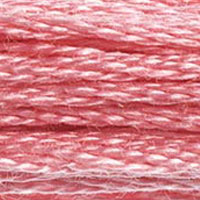
Rose pink occupies a different emotional register than carnation pink, hot pink, or baby pink. It's the pink of garden roses — more complex, slightly more blue-influenced, with a quality of mature warmth that simpler pinks lack. DMC 899, Medium Rose at hex #F27688, carries exactly this character. It's vivid enough to read clearly and warmly, but the slight blue undertone gives it a sophistication that pure coral-pinks like the carnation family don't have. This is the pink that reads as both cheerful and refined.
Position in the Rose Color Family
The rose color family in DMC spans a substantial value range, with 899 sitting in the mid-value position. Understanding this family hierarchy helps clarify 899's role in any gradient system: DMC 335 (Rose) is brighter and slightly lighter; DMC 309 (Dark Rose) provides more depth; DMC 326 (Very Dark Rose) offers the deepest shadow rose tones. 899 sits between these in a zone that reads as the primary, most recognizable rose pink — not the shadow, not the highlight, but the color the rose petal is when you think of rose pink.
For gradient work from full depth to pale, the sequence might run 326 → 309 → 335 → 899 → 818 (Baby Pink) → 819 (Light Baby Pink), giving you a remarkably complete warm-pink value range. 899's position near the lighter end of this sequence means it can serve as either the primary body color in a limited gradient or as the lighter accent in a fuller one.
Garden Rose Cross-Stitch
Garden roses are among the most popular subjects in cross-stitch, appearing in everything from cottage-style samplers to photorealistic portraiture. 899 functions as the primary petal body color for medium-pink roses — not the deep shadow center (which belongs to 309 or 326) and not the brightest sun-lit petal edge (which belongs to 818 or 819), but the main body color the eye identifies as the rose's color. Get 899 right, and the entire rose reads correctly; use a color that's too blue-pink or too warm-pink, and the rose loses its specific garden-rose character.
Climbing rose and rambling rose designs — the romantic aesthetic of roses cascading over a garden arch or tumbling down a cottage wall — use 899 as a primary working color in large quantities. These designs tend to have extensive pink areas with highlights and shadows, and 899 as the base covering most of the petal surface area creates the warmly pink visual identity before shadows and highlights are added.
Companion Colors for Rose Palettes
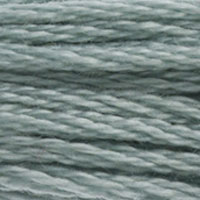
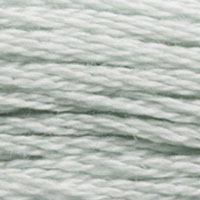
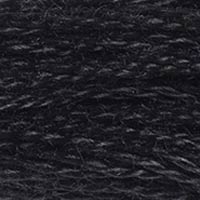
Several cross-stitch palettes anchor themselves around 899. A classic English garden palette might include 899 as the primary pink, paired with DMC 3013 (Light Khaki Green) and DMC 3012 (Medium Khaki Green) for foliage, DMC 3033 (Very Light Mocha Brown) for earth and stem tones, and DMC 3078 (Very Light Golden Yellow) for background warmth. This combination has the soft, romantic quality of a watercolor garden painting translated into thread.
Victorian and Edwardian needlework aesthetics frequently feature 899 in combination with DMC 3727 (Light Antique Mauve), DMC 3726 (Dark Antique Mauve), and DMC 3721 (Dark Shell Pink) — creating a palette that references the muted, complex pinks of Victorian floral photography and period textile design. This combination reads as both historical and romantic, and appears regularly in heritage-inspired pattern designs.
Anchor 38 and Madeira 0609 both earn exact match ratings, continuing the trend of exact matches in popular mid-value rose and pink colors. For stitchers who source across brands, this cross-brand agreement gives confidence that 899's specific rose character can be reproduced accurately from any of the three manufacturers.
Cosmo 2105 and Sullivans 45250 are close matches. The rose family's blue-influenced undertone is one of the characteristics that can vary subtly across brands, and at 899's vivid-medium level this difference may be perceptible when comparing skeins directly. In finished work, most close matches read acceptably, but for designs where 899's specific blue-warm-pink balance is the key element, testing against your fabric is recommended.
Within DMC, 899 sits in a well-populated rose family with clear neighbors on both sides. DMC 335 (Rose) is slightly brighter and can substitute if you want a bit more vivacity. DMC 3326 (Light Rose) is lighter and softer, useful if your design needs a slightly more delicate rose pink than 899 provides. DMC 309 (Dark Rose) adds depth when 899's mid-value reads as too light for a particular shadow area.
One practical note about stash organization: 899 and DMC 892 (Medium Carnation) are both vivid mid-value pinks and can look similar in poor light or in a disorganized stash. They differ in undertone (899 is more blue-pink, 892 is more warm-coral-pink) and in their family context, but if you pull the wrong one mid-project and stitch a few rows before noticing, the frogging experience is an unpleasant reminder to label your threads clearly. Both are popular enough that they often live near each other in the stash.
Reference quality
How We Validate This Color Record
Use this page as a reference card for DMC 899: the structured data, quick conversions, and long-form copy are all tied back to the same stored color record.
- Methodology
- This page renders DMC 899, its hex value, and every brand equivalent from the site's source-of-truth color record, then checks long-form body copy against those same stored fields.
- Verification status
- Source-field checked. The page content is audited against the stored DMC number, brand equivalents, and match-quality labels before publishing.
- Last reviewed
- 2026-04-20
- Approximation warning
- Screen hex values, thread photos, and cross-brand conversions are reference aids. Dye lots, thread sheen, and fabric color can still shift the result in hand.
Decision guide
When to use the DMC 899 reference page
This page should help you decide faster between palette planning, brand substitution, and shade comparison without turning the color record into a thin lookup page.
Best for
- + Palette planning when you want the stored DMC 899 Medium Rose record, hex value #F27688, and linked brand equivalents in one place.
- + Checking the quickest cross-brand shortlist before you buy floss, compare stash substitutes, or route into a more specific conversion page.
- + Finding nearby shades in the pinks family before you commit to accents, shading, or background blends.
Watch for
- ! Screen previews are only reference aids. Medium Rose can shift on real fabric because thread sheen, stitch coverage, and room lighting change how the color reads.
- ! A stored equivalent is still a shortlist, not a guarantee that two brands will disappear into each other in the same stitched motif.
- ! Older charts, discontinued kit floss, and dye-lot variation can all introduce small but visible differences that the page cannot detect for you.
Before you commit
- Confirm the role of DMC 899 Medium Rose: decide whether you need an exact hero shade, a forgiving background, or a rough stash substitute.
- Compare on project fabric: view the skein or stitched sample on the same fabric count and color you will actually use.
- Use the linked conversion pages next: open the brand-specific pages when you need match-quality caveats before substituting away from the DMC reference.
DMC 899 FAQ
These questions appear on the page so the FAQ schema stays aligned with what visitors can actually read.
What is the Anchor equivalent of DMC 899?+
The closest Anchor equivalent to DMC 899 (Medium Rose) is Anchor 38. This is an exact match.
What color is DMC 899?+
DMC 899 is called "Medium Rose" and has a hex color value of #F27688. It belongs to the pinks color family.
What is the Madeira equivalent of DMC 899?+
The closest Madeira equivalent to DMC 899 (Medium Rose) is Madeira 0609. This is a close match.
How DMC 899 Looks on Fabric
The same thread appears different depending on your fabric. Always test on your project fabric.
White Aida
Cream / Ecru
Black Aida
Pairs Well With
DMC colors commonly used alongside 899 Medium Rose.
Suggested Palette
Shading Companions
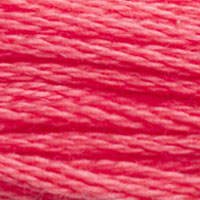
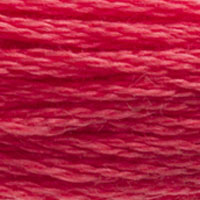
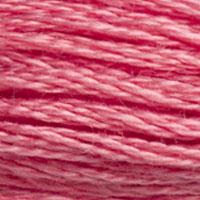
Detailed Conversions
Where to Buy DMC 899
This section contains affiliate links. We may earn a small commission at no cost to you.
Related Guides
Free Printable Thread Conversion Chart
Pick a brand, enter your email, and we'll send you a printable chart mapping all 552 DMC colors to that brand's equivalents. Zero spam, one chart.
Thanks! Here's your free chart:
Download Your ChartOpens in a new tab. Use your browser's Print → Save as PDF.
No spam. Your email is stored securely and never shared.