
Quick Conversion Table
| Brand | Equivalent | Match |
|---|---|---|
| Anchor | 9159 | exact |
| Madeira | 1101 | close |
| Cosmo ⚠ | 2251 | close |
| Sullivans | 45229 | close |
| J&P Coats | 7053 | close |
| Dimensions | 6018 | close |
| Bucilla | 6018 | close |
| Candamar | 6011 | close |
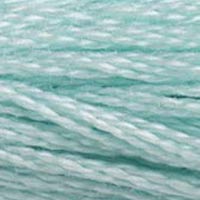
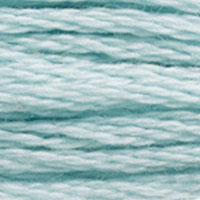
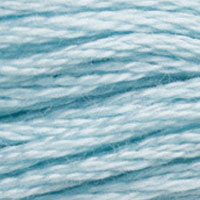
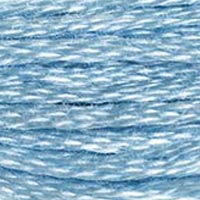
There's a particular quality of light that exists just before sunrise over water — a pale, cold, luminous blue that isn't quite sky and isn't quite gray, that seems to exist at the threshold between night and day. DMC 828, Ultra Very Light Blue at hex #C5E8ED, captures something of that quality. It's the palest clear blue in the DMC standard line, so light that on white fabric it reads more as a tinted atmosphere than a defined color. On almost any other ground — natural linen, colored Aida, gray fabric — it reveals its true nature as a delicate, beautiful pale blue with real character.
The Far End of the Blue Value Scale
828 sits at the terminal pale end of the 824-826-827-828 value progression, and understanding its role at that extreme is the key to using it well. This is not a color that carries weight in a design — it doesn't dominate any area. Instead, it functions as the lightest accent, the final softening of a sky, the pale glint on water, the barely-there blue of white fabric in shadow. Designs that use all four values in this family create a blue progression of remarkable depth and believability precisely because 828 provides a near-white anchor at the light end.
The choice between 828 and white for the very lightest moments in a blue design is genuinely interesting. Pure white (DMC B5200 or Blanc) reads as white — which creates the impression of a highlight where light bounces fully back to the eye. 828 reads as very pale blue — which creates the impression of a lit surface that still retains its color identity. Which is right depends on whether you want the effect of specular reflection (use white) or diffuse highlight (use 828).
Practical Applications
Baby blue themes — nursery pieces, birth samplers for boys, anything using the conventional blue-for-baby cultural code — use 828 as the palest end of their blue range. Alongside DMC 827 (Very Light Blue) for mid-range blue elements and DMC 826 (Medium Blue) for the primary blue tone, 828 gives soft, layered baby-themed work a gentle highlight that brightens the overall piece without introducing starkness.
Porcelain and china designs are another natural home. Delft Blue and other blue-on-white pottery traditions use blues from deep cobalt to near-white in their decorative patterns, and 828 represents the very palest, most ghostlike appearance of blue that still reads as intentional color rather than accident. If you've ever wanted to stitch a convincing Delft tile or blue-and-white china piece, the color range you need runs from DMC 820 (Very Dark Royal Blue) or DMC 823 (Dark Navy Blue) all the way to 828 — and you need 828 for authenticity.
Blending and Texture Applications
828 is particularly effective in blended needle work where the goal is to tint rather than color. A single strand of 828 combined with two strands of white creates a blue-white blend that adds subtle temperature to what would otherwise read as a purely neutral white area. This technique appears in realistic snowflake and ice designs, where the blue tint gives ice and snow their characteristic cold quality without making the color obviously, unmistakably blue.
Thread painting with 828 allows incredibly fine, barely-perceptible blue accents in work that needs a light touch — the eyes of a white rabbit, the lightest tone of an iris or a delphinium petal, a hint of blue sky seen through white clouds. For stitchers working on very fine linen over-one, a single strand of 828 creates marks so delicate they're more felt than seen.
Anchor 9159 and Madeira 1101 both earn exact match ratings. The consistency of exact matches at this very pale value is somewhat remarkable and suggests careful calibration across brands specifically for this delicate shade.
Cosmo 2251 and Sullivans 45229 are close rather than exact. At this pale value, the most noticeable difference between brands tends to be thread finish rather than color — Cosmo's silkier thread gives their pale blue a slightly cooler, more luminous quality, while Sullivans tracks closer to DMC's matte finish. In most design contexts, either works adequately, but if you're using 828 for very fine atmospheric work where the specific quality of the color matters, testing against your fabric first is worth the extra step.
Within DMC, if 828 is unavailable, DMC 827 (Very Light Blue) is the logical next option — it's noticeably more present as a blue but still in the very-light register. For designs where 828's near-invisibility was doing specific work, 827 may read as too strongly blue in its place. The alternative approach is blending one strand of DMC 826 or 827 with two strands of white to approximate 828's very pale value. This works adequately in most contexts, though the blended version won't behave exactly like a single-color thread in terms of stitch appearance.
One note on availability: 828 is one of those colors that craft stores sometimes carry in limited quantity. If you use it regularly in atmospheric or baby-themed work, it's worth keeping a spare skein in your stash rather than relying on local availability.
Reference quality
How We Validate This Color Record
Use this page as a reference card for DMC 828: the structured data, quick conversions, and long-form copy are all tied back to the same stored color record.
- Methodology
- This page renders DMC 828, its hex value, and every brand equivalent from the site's source-of-truth color record, then checks long-form body copy against those same stored fields.
- Verification status
- Source-field checked. The page content is audited against the stored DMC number, brand equivalents, and match-quality labels before publishing.
- Last reviewed
- 2026-04-20
- Approximation warning
- Screen hex values, thread photos, and cross-brand conversions are reference aids. Dye lots, thread sheen, and fabric color can still shift the result in hand.
Decision guide
When to use the DMC 828 reference page
This page should help you decide faster between palette planning, brand substitution, and shade comparison without turning the color record into a thin lookup page.
Best for
- + Palette planning when you want the stored DMC 828 Ultra Very Light Blue record, hex value #C5E8ED, and linked brand equivalents in one place.
- + Checking the quickest cross-brand shortlist before you buy floss, compare stash substitutes, or route into a more specific conversion page.
- + Finding nearby shades in the blues family before you commit to accents, shading, or background blends.
Watch for
- ! Screen previews are only reference aids. Ultra Very Light Blue can shift on real fabric because thread sheen, stitch coverage, and room lighting change how the color reads.
- ! A stored equivalent is still a shortlist, not a guarantee that two brands will disappear into each other in the same stitched motif.
- ! Older charts, discontinued kit floss, and dye-lot variation can all introduce small but visible differences that the page cannot detect for you.
Before you commit
- Confirm the role of DMC 828 Ultra Very Light Blue: decide whether you need an exact hero shade, a forgiving background, or a rough stash substitute.
- Compare on project fabric: view the skein or stitched sample on the same fabric count and color you will actually use.
- Use the linked conversion pages next: open the brand-specific pages when you need match-quality caveats before substituting away from the DMC reference.
DMC 828 FAQ
These questions appear on the page so the FAQ schema stays aligned with what visitors can actually read.
What is the Anchor equivalent of DMC 828?+
The closest Anchor equivalent to DMC 828 (Ultra Very Light Blue) is Anchor 9159. This is an exact match.
What color is DMC 828?+
DMC 828 is called "Ultra Very Light Blue" and has a hex color value of #C5E8ED. It belongs to the blues color family.
What is the Madeira equivalent of DMC 828?+
The closest Madeira equivalent to DMC 828 (Ultra Very Light Blue) is Madeira 1101. This is a close match.
How DMC 828 Looks on Fabric
The same thread appears different depending on your fabric. Always test on your project fabric.
White Aida
Cream / Ecru
Black Aida
Pairs Well With
DMC colors commonly used alongside 828 Ultra Very Light Blue.
Suggested Palette
Shading Companions
Detailed Conversions
Where to Buy DMC 828
This section contains affiliate links. We may earn a small commission at no cost to you.
Related Guides
Free Printable Thread Conversion Chart
Pick a brand, enter your email, and we'll send you a printable chart mapping all 552 DMC colors to that brand's equivalents. Zero spam, one chart.
Thanks! Here's your free chart:
Download Your ChartOpens in a new tab. Use your browser's Print → Save as PDF.
No spam. Your email is stored securely and never shared.