
Quick Conversion Table
| Brand | Equivalent | Match |
|---|---|---|
| Anchor | 128 | exact |
| Madeira | 1001 | close |
| Cosmo ⚠ | 162 | close |
| Sullivans | 45195 | close |
| J&P Coats | 7031 | close |
| Dimensions | 17031 | close |
| Bucilla | 2601 | close |
| Candamar | 6006 | close |
The Birth Sampler Blue
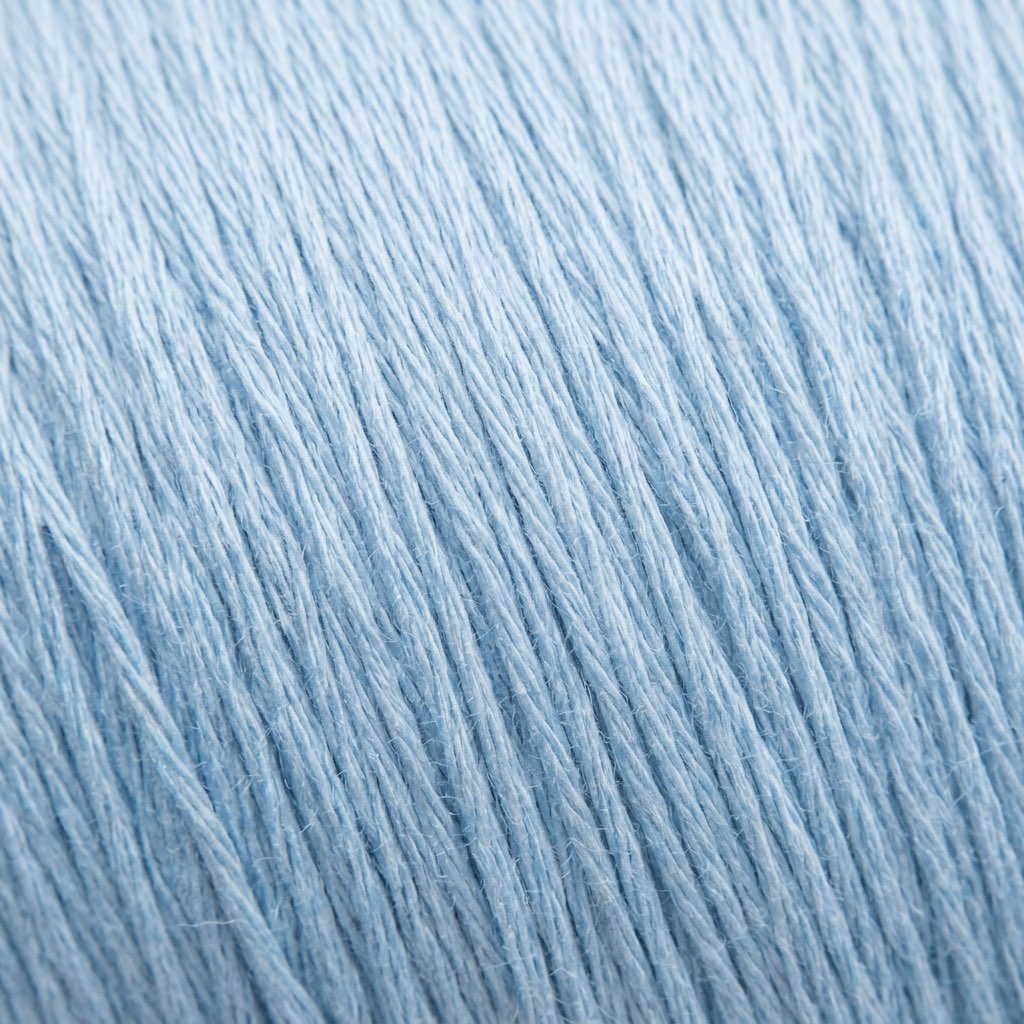
Some threads are defined by a single, overwhelming association. DMC 775 Very Light Baby Blue is the thread that announces "it's a boy" in cross-stitch, and it has been doing so for decades. If you've ever received a stitched birth sampler, congratulations card, or baby announcement, there's a strong chance that this specific shade was involved. It's the blue of hospital blankets, nursery walls, and tiny knitted booties — so culturally specific in its baby-ness that using it in any other context requires a conscious effort to see past the association.
But here's the thing: 775 is a genuinely lovely thread that deserves more than a single-role career. Strip away the baby association and what you have is a pure, warm pale blue with none of the green or grey undertones that complicate many of its neighbors. It's clean in the way that freshly washed cotton is clean — no ambiguity, no uncertainty, just blue at its gentlest and most approachable. That purity makes it useful far beyond the nursery.
Cloud Work and Atmospheric Perspective
Clouds are not white. Every stitcher who has attempted a sky background eventually discovers this. White thread on white fabric gives you nothing; you need a color to represent the sunlit side of clouds, and you need it to be pale enough to read as "bright" while carrying enough color to be visible. DMC 775 is that thread for warm-weather skies. Where DMC 747 (Very Light Sky Blue) provides a cool, icy cloud color for winter scenes, 775 offers a warm, soft cloud color for spring and summer — the difference between a March sky and a July sky captured in thread.
In atmospheric perspective — the technique of using paler, bluer values for distant objects to suggest depth — 775 represents the farthest distance. A mountain range that should appear miles away reads correctly in 775 when the nearer mountains are stitched in DMC 813 (Light Blue) or DMC 826 (Medium Blue). The warmth of 775 compared to other pale blues keeps the distant mountains from looking icy, maintaining the sense that they're far away rather than frozen.
Social Media Versus Reality
A word of warning about photographing 775: phone cameras lie about this shade. In person, 775 has a definite, readable presence — it's pale but not invisible, soft but not absent. In photographs, especially those taken with automatic white balance, 775 frequently disappears entirely, reading as indistinguishable from white fabric. If you're stitching a piece that you plan to photograph for Instagram, FlossTube, or an Etsy listing, be aware that the hours you spent carefully stitching 775 areas may not be visible in your photos without deliberate intervention.
The fix is to photograph against a slightly warm or grey background rather than pure white, and to slightly underexpose the image so that pale values retain their identity. A piece of light grey card behind your hoop will give your camera enough contrast reference to preserve the distinction between 775 and the white fabric. It sounds fussy, but if you've stitched a piece where 775 covers significant area, you want your photos to show the work you've done.
Pair 775 with DMC 3325 (Light Baby Blue) and DMC 334 (Medium Baby Blue) for the classic baby blue gradient that birth samplers rely on. For less nursery-specific applications, combine it with DMC 800 (Pale Delft Blue) and DMC 809 (Delft Blue) for a progression that reads as sophisticated porcelain rather than baby blanket. The Delft association changes the cultural context entirely, transforming the same basic blue from cute to refined.
A Well-Matched Pale Blue
Anchor 128 (exact) and Madeira 1001 (exact) both deliver 775's warm, clean pale blue with high fidelity. For pattern conversions, these are among the safest swaps in the entire DMC-to-Anchor and DMC-to-Madeira ranges. The purity of the color — no grey, no green, no purple lurking in the undertone — makes it relatively easy for other brands to match, because there are fewer variables to control.
Cosmo 162 (close) is serviceable but may introduce a barely perceptible coolness. At this extreme pale value, temperature shifts are subtle but they're real — a cooler 775 reads as slightly icy rather than warm, which changes the mood from "gentle and nurturing" to "crisp and clean." Whether that matters depends on context. For a birth sampler where warmth is part of the emotional message, stick with the exact-match brands. For a geometric pattern where 775 is a design element rather than an emotional one, the temperature shift is irrelevant.
The biggest within-DMC confusion is between 775 and DMC 747 (Very Light Sky Blue). Both are extremely pale blues, and on a color card they can look interchangeable. The difference: 775 is a warm, pure baby blue; 747 is a cool, slightly cyan-shifted sky blue. On white fabric the distinction nearly vanishes. On cream fabric, 775 harmonizes while 747 contrasts. On a color card, they're neighbors; in a stitched piece on non-white fabric, they're different emotional experiences. Choose accordingly.
Reference quality
How We Validate This Color Record
Use this page as a reference card for DMC 775: the structured data, quick conversions, and long-form copy are all tied back to the same stored color record.
- Methodology
- This page renders DMC 775, its hex value, and every brand equivalent from the site's source-of-truth color record, then checks long-form body copy against those same stored fields.
- Verification status
- Source-field checked. The page content is audited against the stored DMC number, brand equivalents, and match-quality labels before publishing.
- Last reviewed
- 2026-04-20
- Approximation warning
- Screen hex values, thread photos, and cross-brand conversions are reference aids. Dye lots, thread sheen, and fabric color can still shift the result in hand.
Decision guide
When to use the DMC 775 reference page
This page should help you decide faster between palette planning, brand substitution, and shade comparison without turning the color record into a thin lookup page.
Best for
- + Palette planning when you want the stored DMC 775 Very Light Baby Blue record, hex value #D9EBF1, and linked brand equivalents in one place.
- + Checking the quickest cross-brand shortlist before you buy floss, compare stash substitutes, or route into a more specific conversion page.
- + Finding nearby shades in the blues family before you commit to accents, shading, or background blends.
Watch for
- ! Screen previews are only reference aids. Very Light Baby Blue can shift on real fabric because thread sheen, stitch coverage, and room lighting change how the color reads.
- ! A stored equivalent is still a shortlist, not a guarantee that two brands will disappear into each other in the same stitched motif.
- ! Older charts, discontinued kit floss, and dye-lot variation can all introduce small but visible differences that the page cannot detect for you.
Before you commit
- Confirm the role of DMC 775 Very Light Baby Blue: decide whether you need an exact hero shade, a forgiving background, or a rough stash substitute.
- Compare on project fabric: view the skein or stitched sample on the same fabric count and color you will actually use.
- Use the linked conversion pages next: open the brand-specific pages when you need match-quality caveats before substituting away from the DMC reference.
DMC 775 FAQ
These questions appear on the page so the FAQ schema stays aligned with what visitors can actually read.
What is the Anchor equivalent of DMC 775?+
The closest Anchor equivalent to DMC 775 (Very Light Baby Blue) is Anchor 128. This is an exact match.
What color is DMC 775?+
DMC 775 is called "Very Light Baby Blue" and has a hex color value of #D9EBF1. It belongs to the blues color family.
What is the Madeira equivalent of DMC 775?+
The closest Madeira equivalent to DMC 775 (Very Light Baby Blue) is Madeira 1001. This is a close match.
How DMC 775 Looks on Fabric
The same thread appears different depending on your fabric. Always test on your project fabric.

White Aida
Cream / Ecru
Black Aida
Pairs Well With
DMC colors commonly used alongside 775 Very Light Baby Blue.
Suggested Palette
Shading Companions

Detailed Conversions
Where to Buy DMC 775
This section contains affiliate links. We may earn a small commission at no cost to you.
Related Guides
Free Printable Thread Conversion Chart
Pick a brand, enter your email, and we'll send you a printable chart mapping all 552 DMC colors to that brand's equivalents. Zero spam, one chart.
Thanks! Here's your free chart:
Download Your ChartOpens in a new tab. Use your browser's Print → Save as PDF.
No spam. Your email is stored securely and never shared.