
Quick Conversion Table
| Brand | Equivalent | Match |
|---|---|---|
| Anchor | 1064 | exact |
| Madeira | 1110 | close |
| Cosmo ⚠ | 565 | close |
| Sullivans | 45133 | close |
| J&P Coats | 7168 | close |
| Dimensions | 6597 | close |
| Bucilla | 1597 | close |
| Candamar | 6191 | close |
Where Does Blue End and Green Begin?
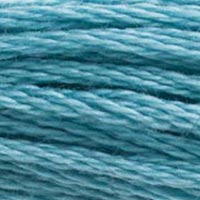
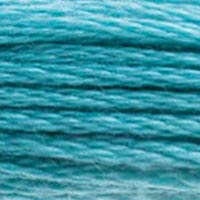
Ask ten stitchers whether DMC 597 is a blue thread or a green thread and you'll get a genuinely interesting argument. The hex value — #5BA3B3 — places it squarely in the teal zone, that contested borderland where blue and green share sovereignty and neither fully controls the territory. Different lighting conditions will push your perception one way or the other. Under cool fluorescent light, 597 reads more blue. Under warm incandescent light, the green component surfaces. In natural daylight, it sits exactly on the fence, which is either maddening or delightful depending on your tolerance for ambiguity.
DMC files 597 in the blue family, and that's a reasonable call — the blue component does dominate slightly. But experienced stitchers know to think of this thread not as a blue with green contamination or a green with blue pretensions, but as its own thing entirely. Turquoise is a color that predates our instinct to sort everything into primary categories. The mineral it's named after — that opaque blue-green stone prized for millennia — has never been blue, has never been green, has always been both. DMC 597 captures that duality honestly.
Tropical Water and the Promise of Warmth
There are beaches where the water is exactly this color. Not the deep, dramatic blue of the open ocean, not the pale aqua of a shallow lagoon, but that specific mid-depth turquoise where the water is deep enough to have real color but shallow enough that sunlight still penetrates and lights the sandy bottom. If you have ever stitched — or wanted to stitch — a beach scene and found yourself frustrated that your blue looked like an ocean instead of a tropical shallows, 597 solves that problem.
The green component is what does it. Pure blue reads as deep, cold, distant. Add green, and the water warms. It becomes approachable, swimable, the kind of water that makes you want to walk in rather than admire from a cliff. For tropical fish designs, coral reef scenes, or Caribbean-themed samplers, 597 provides the environmental context that tells the viewer: this water is warm.
Peacock Territory and Jewel-Tone Palettes
DMC 597 overlaps thematically with the peacock blues — DMC 806 (Dark Peacock Blue) and DMC 807 (Peacock Blue) — but differs from them in important ways. The peacock blues lean cooler and slightly more saturated; 597 is warmer, with more green content and a slightly earthier quality. Think of it this way: 806 and 807 are the blue-green of a peacock's neck feathers in shade. DMC 597 is those same feathers in direct sunlight, where the green flares up and the blue steps back.
For jewel-tone palettes, 597 pairs magnificently with DMC 3837 (Ultra Dark Lavender) or DMC 550 (Very Dark Violet) for a peacock-and-amethyst combination that's luxurious without being garish. Add DMC 783 (Medium Topaz) or DMC 3852 (Very Dark Straw) for gold accents and you're in the territory of Byzantine mosaics — those glittering walls of tessellated glass and gold leaf that used exactly this blue-green-purple-gold palette to signal divine splendor.
In mandala designs, 597 works especially well as the secondary color alongside a dominant purple or violet. The blue-green creates visual cooling that balances purple's intensity, and the two colors have enough contrast to maintain readability in complex geometric patterns while sharing enough spectral territory to feel harmonious rather than jarring.
Preserving the Blue-Green Balance
The critical thing about substituting 597 is maintaining its position on the blue-green axis. Shift too far toward blue and you lose the warmth that makes turquoise feel like turquoise. Shift too far toward green and the thread reads as teal or sea-green, a different color with different associations.
Anchor 1064, rated exact, handles this balance well. If you're converting a DMC pattern to Anchor, this is one of the swaps you can make without test-stitching — the correspondence is close enough that the finished piece will read identically. Madeira 1110, also exact, delivers the same fidelity. Madeira's slight sheen difference is negligible at this value and saturation; both brands produce a thread that reads as honest turquoise.
Cosmo 565 (close match) may drift marginally toward greener territory. In a design where 597 sits surrounded by blues, a greener lean will make it stand out as more of an outlier — more "the green one" and less "the transitional one." If 597's role is to bridge blue and green elements in your palette, that extra green can disrupt the bridge. Sullivans 45133 occupies similar close-but-not-exact territory.
Within DMC, don't swap 597 for DMC 807 (Peacock Blue) without checking both in person. They share the blue-green family but 807 is cooler and slightly more saturated — a swap that works in one direction (replacing 807 with 597 to warm a palette) but may not work in the other. For the closest within-brand alternative, look at DMC 3810 (Dark Turquoise), which shares the territory but sits at a slightly different value.
Reference quality
How We Validate This Color Record
Use this page as a reference card for DMC 597: the structured data, quick conversions, and long-form copy are all tied back to the same stored color record.
- Methodology
- This page renders DMC 597, its hex value, and every brand equivalent from the site's source-of-truth color record, then checks long-form body copy against those same stored fields.
- Verification status
- Source-field checked. The page content is audited against the stored DMC number, brand equivalents, and match-quality labels before publishing.
- Last reviewed
- 2026-04-20
- Approximation warning
- Screen hex values, thread photos, and cross-brand conversions are reference aids. Dye lots, thread sheen, and fabric color can still shift the result in hand.
Decision guide
When to use the DMC 597 reference page
This page should help you decide faster between palette planning, brand substitution, and shade comparison without turning the color record into a thin lookup page.
Best for
- + Palette planning when you want the stored DMC 597 Turquoise record, hex value #5BA3B3, and linked brand equivalents in one place.
- + Checking the quickest cross-brand shortlist before you buy floss, compare stash substitutes, or route into a more specific conversion page.
- + Finding nearby shades in the blues family before you commit to accents, shading, or background blends.
Watch for
- ! Screen previews are only reference aids. Turquoise can shift on real fabric because thread sheen, stitch coverage, and room lighting change how the color reads.
- ! A stored equivalent is still a shortlist, not a guarantee that two brands will disappear into each other in the same stitched motif.
- ! Older charts, discontinued kit floss, and dye-lot variation can all introduce small but visible differences that the page cannot detect for you.
Before you commit
- Confirm the role of DMC 597 Turquoise: decide whether you need an exact hero shade, a forgiving background, or a rough stash substitute.
- Compare on project fabric: view the skein or stitched sample on the same fabric count and color you will actually use.
- Use the linked conversion pages next: open the brand-specific pages when you need match-quality caveats before substituting away from the DMC reference.
DMC 597 FAQ
These questions appear on the page so the FAQ schema stays aligned with what visitors can actually read.
What is the Anchor equivalent of DMC 597?+
The closest Anchor equivalent to DMC 597 (Turquoise) is Anchor 1064. This is an exact match.
What color is DMC 597?+
DMC 597 is called "Turquoise" and has a hex color value of #5BA3B3. It belongs to the blues color family.
What is the Madeira equivalent of DMC 597?+
The closest Madeira equivalent to DMC 597 (Turquoise) is Madeira 1110. This is a close match.
How DMC 597 Looks on Fabric
The same thread appears different depending on your fabric. Always test on your project fabric.
White Aida
Cream / Ecru
Black Aida
Pairs Well With
DMC colors commonly used alongside 597 Turquoise.
Suggested Palette
Shading Companions

Detailed Conversions
Where to Buy DMC 597
This section contains affiliate links. We may earn a small commission at no cost to you.
Related Guides
Free Printable Thread Conversion Chart
Pick a brand, enter your email, and we'll send you a printable chart mapping all 552 DMC colors to that brand's equivalents. Zero spam, one chart.
Thanks! Here's your free chart:
Download Your ChartOpens in a new tab. Use your browser's Print → Save as PDF.
No spam. Your email is stored securely and never shared.