
Quick Conversion Table
| Brand | Equivalent | Match |
|---|---|---|
| Anchor | 159 | exact |
| Madeira | 0908 | close |
| Cosmo ⚠ | 154 | close |
| Sullivans | 45477 | close |
| J&P Coats | 7053 | close |
The Vanishing Point of Blue
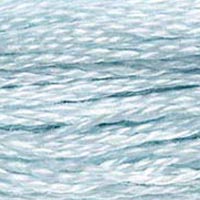
How light can a blue be before it stops being blue and becomes white with a memory of color? DMC 162 lives at exactly that threshold — the vanishing point where blue thins to almost nothing. Hold it against Blanc and you see the difference: a whisper of sky, a suggestion of atmosphere, a tint so subtle that your eye registers it more as coolness than as color. Hold it against even DMC 3325 (Light Baby Blue) and 162 seems to dissolve in comparison.
Threads this pale present unique challenges and unique opportunities. The challenge is visibility: on white Aida, 162 barely distinguishes itself from the fabric. You might stitch an entire motif and step back to find it's ghosted away into the background. The opportunity is exactly the same phenomenon put to intentional use. When you want something present but not prominent — a background wash, a highlight that's more about temperature than contrast, a sky so pale it's barely there — 162 is the thread that delivers subtlety no darker blue can match.
Building Gradients: The Last Step Before White
In the blue family's value progression, 162 serves as the final step before you reach Blanc. It's the shade that bridges between "lightest colored blue" and "white," and that bridging function makes it essential for smooth gradients. Without it, the jump from DMC 3756 (Ultra Very Light Baby Blue) or DMC 3841 (Pale Baby Blue) to white can look abrupt — a visible line where color suddenly stops. Thread 162 smooths that transition, creating one more gentle step that the eye travels without noticing.
For sky gradients in landscape work, this matters enormously. The horizon in a clear sky doesn't snap from blue to white; it fades imperceptibly, and the more thread values you use in that fade, the more convincing the illusion. A gradient from DMC 322 (Dark Baby Blue) through 334, 3325, 3841, 162, and finally Blanc creates a sky so smooth it could be airbrushed. Remove 162 from that sequence, and the transition gets just slightly less smooth — not ruined, but not as good.
Water highlights follow the same principle. The brightest reflection on a lake's surface isn't pure white — it's a blue so pale it's barely perceptible, surrounded by progressively darker blues. Thread 162 captures that penultimate moment before pure light, the highlight that still carries the faintest memory of the water's color.
Fabric Matters More Than Usual
With a thread this pale, fabric choice isn't a preference — it's a design decision that fundamentally alters the result. On white Aida, 162 is nearly invisible, which can be deliberate (shadow effects, subtle texture in white-on-white designs) or frustrating (you expected more contrast and got none). On cream or ecru Aida, 162 suddenly has presence — the warm fabric makes the cool thread visible, and you get a genuinely pretty, frosty blue that reads clearly.
On natural linen, 162 is at its best. The linen's warm, organic texture provides exactly enough contrast for 162 to register as blue while maintaining its ethereal quality. Over-two on 28-count linen, each cross of 162 looks like a tiny window of sky set into the fabric — an effect that's particularly beautiful in hardanger-inspired designs or whitework pieces that incorporate a single pale color for accent.
For stitchers working baby-themed designs, 162 on white fabric creates the softest possible "boy blue" effect — gentle enough for nursery decor, subtle enough that it doesn't scream "gendered color palette." Pair with DMC 3756 (Ultra Very Light Baby Blue) for the main baby blue areas and let 162 handle the palest backgrounds and highlights. The two threads together, both barely-there blues, create a dreamy atmosphere that deeper blues would shatter.
Exact Match Territory: Anchor 159
Good news for once: Anchor 159 is rated an exact match, meaning you can swap it in with confidence. At this extreme pale value, even "close" matches tend to work because the color is so desaturated that small differences are genuinely invisible in the finished piece. The main thing to verify is that your substitute reads as cool (blue-white) rather than warm (cream-white) — that temperature distinction is the only thing that really registers at this value level.
Madeira 0908 is a close match that performs well. At ultra-pale values, the sheen difference between brands can actually matter more than the color difference — a shinier thread reflects more light and can appear even paler, while a matte thread absorbs light and appears fractionally darker. Test a few stitches on your actual fabric in your actual working light before committing to a large fill area.
Cosmo 154 and Sullivans 45477 both land in the "barely blue" space. Any of these will work for practical purposes. The real risk with substituting ultra-pale threads isn't getting the wrong shade — it's getting the wrong visibility. Make sure your substitute still reads as "not-white" on your specific fabric. A shade that's visually indistinguishable from Blanc on your white Aida defeats the purpose of having it in the design at all.
Within the DMC range, don't confuse 162 with DMC 3756 (Ultra Very Light Baby Blue) — they're close, but 3756 has a slightly greener, cooler cast while 162 runs a touch warmer. In most applications the difference is negligible, but in a gradient where both appear as adjacent steps, you want the right one in the right slot.
Reference quality
How We Validate This Color Record
Use this page as a reference card for DMC 162: the structured data, quick conversions, and long-form copy are all tied back to the same stored color record.
- Methodology
- This page renders DMC 162, its hex value, and every brand equivalent from the site's source-of-truth color record, then checks long-form body copy against those same stored fields.
- Verification status
- Source-field checked. The page content is audited against the stored DMC number, brand equivalents, and match-quality labels before publishing.
- Last reviewed
- 2026-04-20
- Approximation warning
- Screen hex values, thread photos, and cross-brand conversions are reference aids. Dye lots, thread sheen, and fabric color can still shift the result in hand.
Decision guide
When to use the DMC 162 reference page
This page should help you decide faster between palette planning, brand substitution, and shade comparison without turning the color record into a thin lookup page.
Best for
- + Palette planning when you want the stored DMC 162 Ultra Very Light Blue record, hex value #DBECF5, and linked brand equivalents in one place.
- + Checking the quickest cross-brand shortlist before you buy floss, compare stash substitutes, or route into a more specific conversion page.
- + Finding nearby shades in the blues family before you commit to accents, shading, or background blends.
Watch for
- ! Screen previews are only reference aids. Ultra Very Light Blue can shift on real fabric because thread sheen, stitch coverage, and room lighting change how the color reads.
- ! A stored equivalent is still a shortlist, not a guarantee that two brands will disappear into each other in the same stitched motif.
- ! Older charts, discontinued kit floss, and dye-lot variation can all introduce small but visible differences that the page cannot detect for you.
Before you commit
- Confirm the role of DMC 162 Ultra Very Light Blue: decide whether you need an exact hero shade, a forgiving background, or a rough stash substitute.
- Compare on project fabric: view the skein or stitched sample on the same fabric count and color you will actually use.
- Use the linked conversion pages next: open the brand-specific pages when you need match-quality caveats before substituting away from the DMC reference.
DMC 162 FAQ
These questions appear on the page so the FAQ schema stays aligned with what visitors can actually read.
What is the Anchor equivalent of DMC 162?+
The closest Anchor equivalent to DMC 162 (Ultra Very Light Blue) is Anchor 159. This is an exact match.
What color is DMC 162?+
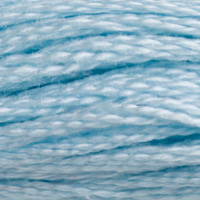
DMC 162 is called "Ultra Very Light Blue" and has a hex color value of #DBECF5. It belongs to the blues color family.
What is the Madeira equivalent of DMC 162?+
The closest Madeira equivalent to DMC 162 (Ultra Very Light Blue) is Madeira 0908. This is a close match.
How DMC 162 Looks on Fabric
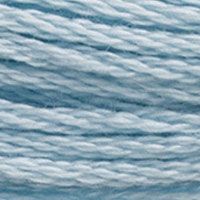
The same thread appears different depending on your fabric. Always test on your project fabric.
White Aida
Cream / Ecru
Black Aida
Pairs Well With
DMC colors commonly used alongside 162 Ultra Very Light Blue.
Suggested Palette
Shading Companions
Detailed Conversions
Where to Buy DMC 162
This section contains affiliate links. We may earn a small commission at no cost to you.
Related Guides
Free Printable Thread Conversion Chart
Pick a brand, enter your email, and we'll send you a printable chart mapping all 552 DMC colors to that brand's equivalents. Zero spam, one chart.
Thanks! Here's your free chart:
Download Your ChartOpens in a new tab. Use your browser's Print → Save as PDF.
No spam. Your email is stored securely and never shared.