
Quick Conversion Table
| Brand | Equivalent | Match |
|---|---|---|
| Anchor | 924 | exact |
| Madeira | 1503 | close |
| Cosmo ⚠ | 634 | close |
| Sullivans | 45131 | close |
| J&P Coats | 6267 | close |
| Candamar | 6269 | close |
Moss, Lichen, and the Greens That Grow on Stone
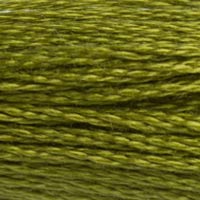
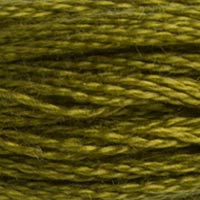
Reach down and scrape your fingernail across a damp north-facing stone wall. That dark, concentrated green you find under your nail — dense, almost yellow in its warmth, alive in a way that defies the hostile substrate it clings to — that's DMC 580. Dark Moss Green earns its name with unusual honesty. This is not a metaphorical moss. It is the actual, literal color of Bryophyta doing its thing on a surface that has no business supporting life.
What makes 580 unusual in DMC's green catalog is how aggressively yellow it skews. At hex #888D33, the blue component is essentially absent — this is a green achieved almost entirely through yellow with just enough darkness to prevent it from reading as gold or chartreuse. It's the opposite of the blue-greens (the 501/502/503 family) and the teal-greens (the 991/992/993 family). Where those threads feel cool and aquatic, 580 feels terrestrial, mineral, ancient. It's the green of biology that has adapted to rock and bark and shadow.
The Love-It-or-Hate-It Yellow-Green Problem
Yellow-greens polarize stitchers. Some find them vibrant and energizing — the color of spring at its most exuberant. Others find them acidic, difficult to pair, and visually aggressive. DMC 580, being a dark yellow-green, sidesteps some of this controversy by containing the intensity within a lower value. It's vivid, but it's not screaming. Think of it as the introvert at the chartreuse family reunion — same DNA, much quieter personality.
That said, 580 demands thoughtful pairing. Surround it with cool blues and it will fight for attention, creating a temperature clash that the eye reads as disharmony. But pair it with warm browns (DMC 898, 938), deep golds (DMC 832, 833), and other warm-leaning greens (DMC 937, 935) and it settles into a rich, autumnal palette that feels cohesive and sophisticated. This is a forest floor color, and forest floor palettes are its natural habitat.
Technique: Stitching Dense, Dark Yellow-Greens
Dark yellow-greens like 580 present a specific technical challenge: they can look patchy if your coverage is uneven. The strong yellow undertone means that any spot where the fabric shows through doesn't just look like a gap — it reads as a jarring white or cream spot against a color that has no white in its composition. The contrast is more visually disruptive than a similar gap in a mid-value thread.
On 14-count Aida, two strands of 580 give solid coverage with minimal fabric show-through. Railroad consistently to keep the strands flat and maximize coverage. On 18-count Aida or 28-count linen over two, you may find that two strands feel slightly bulky — but resist the temptation to drop to one strand, because the coverage gap with a single strand at this color will be conspicuous. Instead, use two strands with slightly reduced tension, allowing the thread to spread and fill the stitch square more evenly.
For its companion DMC 581 (Moss Green), the lighter value in this mini-family, 580 provides the shadow anchor. Together they create a moss palette that works for everything from stone wall textures to forest floor scenes. Extend the range with DMC 937 (Medium Avocado Green) for a warmer variation and DMC 730 (Very Dark Olive Green) for the deepest shadow notes. Add DMC 3013 (Light Khaki Green) at the highlight end for lichen-on-stone effects that feel genuinely dimensional.
That extreme yellow bias in DMC 580 makes substitution trickier than average. Many "moss green" shades in other brands have more blue in their mix, resulting in a cooler, more conventionally green appearance. The key quality to match is the almost-chartreuse warmth at a dark value — if your substitute looks like a normal dark green, it's wrong.
Anchor 924 gets it right. The yellow-green balance is faithful, and the dark value holds. This is the substitute to grab without hesitation. Madeira 1503 is equally matched and maintains that distinctive warm intensity. Both are exact matches for a reason — this is an unusual enough color that approximations tend to fail.
Cosmo 634 enters close territory, and here's where careful testing matters. If Cosmo's version skews even slightly toward conventional green — losing that yellow punch — the substitution will change the character of your moss greens from "warm and alive" to "standard and expected." Hold Cosmo 634 against your DMC 581 (if you're using the pair together) and see if the family relationship still reads correctly.
Sullivans 45131 is a functional substitute for general use. Within DMC, don't swap 580 for DMC 936 (Very Dark Avocado Green), which is darker and less yellow, or DMC 3345 (Dark Hunter Green), which is cooler and more blue. The closest DMC relative is actually DMC 581 (Moss Green), but it's lighter — a neighbor in the family, not a replacement.
Reference quality
How We Validate This Color Record
Use this page as a reference card for DMC 580: the structured data, quick conversions, and long-form copy are all tied back to the same stored color record.
- Methodology
- This page renders DMC 580, its hex value, and every brand equivalent from the site's source-of-truth color record, then checks long-form body copy against those same stored fields.
- Verification status
- Source-field checked. The page content is audited against the stored DMC number, brand equivalents, and match-quality labels before publishing.
- Last reviewed
- 2026-04-20
- Approximation warning
- Screen hex values, thread photos, and cross-brand conversions are reference aids. Dye lots, thread sheen, and fabric color can still shift the result in hand.
Decision guide
When to use the DMC 580 reference page
This page should help you decide faster between palette planning, brand substitution, and shade comparison without turning the color record into a thin lookup page.
Best for
- + Palette planning when you want the stored DMC 580 Dark Moss Green record, hex value #888D33, and linked brand equivalents in one place.
- + Checking the quickest cross-brand shortlist before you buy floss, compare stash substitutes, or route into a more specific conversion page.
- + Finding nearby shades in the greens family before you commit to accents, shading, or background blends.
Watch for
- ! Screen previews are only reference aids. Dark Moss Green can shift on real fabric because thread sheen, stitch coverage, and room lighting change how the color reads.
- ! A stored equivalent is still a shortlist, not a guarantee that two brands will disappear into each other in the same stitched motif.
- ! Older charts, discontinued kit floss, and dye-lot variation can all introduce small but visible differences that the page cannot detect for you.
Before you commit
- Confirm the role of DMC 580 Dark Moss Green: decide whether you need an exact hero shade, a forgiving background, or a rough stash substitute.
- Compare on project fabric: view the skein or stitched sample on the same fabric count and color you will actually use.
- Use the linked conversion pages next: open the brand-specific pages when you need match-quality caveats before substituting away from the DMC reference.
DMC 580 FAQ
These questions appear on the page so the FAQ schema stays aligned with what visitors can actually read.
What is the Anchor equivalent of DMC 580?+
The closest Anchor equivalent to DMC 580 (Dark Moss Green) is Anchor 924. This is an exact match.
What color is DMC 580?+
DMC 580 is called "Dark Moss Green" and has a hex color value of #888D33. It belongs to the greens color family.
What is the Madeira equivalent of DMC 580?+
The closest Madeira equivalent to DMC 580 (Dark Moss Green) is Madeira 1503. This is a close match.
How DMC 580 Looks on Fabric
The same thread appears different depending on your fabric. Always test on your project fabric.
White Aida
Cream / Ecru
Black Aida
Pairs Well With
DMC colors commonly used alongside 580 Dark Moss Green.
Suggested Palette
Shading Companions

Detailed Conversions
Where to Buy DMC 580
This section contains affiliate links. We may earn a small commission at no cost to you.
Related Guides
Free Printable Thread Conversion Chart
Pick a brand, enter your email, and we'll send you a printable chart mapping all 552 DMC colors to that brand's equivalents. Zero spam, one chart.
Thanks! Here's your free chart:
Download Your ChartOpens in a new tab. Use your browser's Print → Save as PDF.
No spam. Your email is stored securely and never shared.