
Quick Conversion Table
| Brand | Equivalent | Match |
|---|---|---|
| Anchor | 832 | exact |
| Madeira | 2108 | close |
| Cosmo ⚠ | 367 | close |
| Sullivans | 45145 | close |
| J&P Coats | 5388 | close |
| Bucilla | 3612 | close |
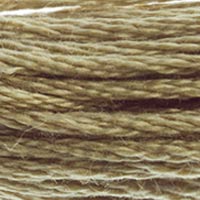
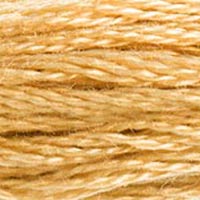
Sandstone. Aged parchment. The lightest area of a wren's breast. Late-summer prairie grass in full sun. DMC 612 Light Drab Brown sits at the lighter, warmer end of the drab brown family — still in khaki territory, still a warm neutral rather than a vivid color, but with enough light value to function as a mid-tone highlight or a primary light color in earth-toned palettes. Where DMC 611 (Drab Brown) is mud, 612 is dry soil; where 611 is burlap, 612 is unbleached muslin. The distinction is subtle but the role is different.
The Gradient Role — Light Warm Neutral
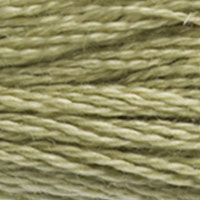
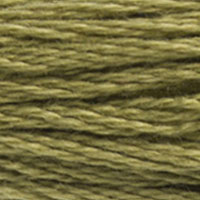
In any palette that uses 611 as the darker value, 612 naturally extends the gradient one step lighter. Together they form a two-value earth-tone pair useful for a wide range of naturalistic subjects. Add DMC 613 (Very Light Drab Brown) as the even-lighter step and you have a three-value khaki-neutral family sufficient for many animal fur and bark texture applications.
The warmer quality of 612 compared to 611 — it has more yellow-gold content as it lifts in value — means it reads more clearly as a light warm neutral rather than simply a lighter version of the same greyed khaki. This warmth makes it useful in contexts where 611 would be too grey or neutral. The straw-wheat zone in bird plumage (think house finch belly, or the pale breast of a thrush) hits almost exactly here, as does the light area of a deer's winter belly fur.
Natural Fiber and Textile Subjects
The drab brown family was, historically, the color of natural undyed textiles — and 612 captures the lighter version of that story. Stitching a scene that includes unbleached linen, natural wool, wicker baskets, burlap hessian sacking, or rough-cut wood produces the best results with 612 for the illuminated surfaces and 611 for the shadowed areas. In designs depicting historical domestic scenes, colonial and pioneer imagery, or rural craft subjects, this thread family is essentially mandatory.
The revival of interest in folk art, colonial reproduction needlework, and historical sampler patterns has increased demand for the drab brown family. Antique samplers from the 17th–18th centuries used vegetable and mineral dyes that have often faded to warm khaki neutrals over the centuries, and reproducing them authentically requires exactly this family of threads rather than bright modern equivalents.
Broader Palette Roles
Beyond its natural-subject applications, 612 functions as a warm neutral in the general sense — a thread that can appear in many palettes as a supporting color without imposing its own personality on the design. In this respect it resembles DMC 3033 (Very Light Mocha Brown) and DMC 644 (Medium Beige Gray) as general-purpose warm light neutrals that earn a place in many stitchers' needle when the design calls for a light earthy or straw-toned accent. Pairing 612 with DMC 3860 (Cocoa) or DMC 3862 (Dark Mocha Beige) creates a warm neutral palette ranging from tan-light to medium-warm-brown — suitable for wooden furniture in interior scene designs, or for the earth tones of a late summer garden.
Anchor 832 and Madeira 2108 both hold exact match ratings, making this one of the easier substitution decisions in the light brown and neutral zone. Both alternatives should perform identically to the DMC original in virtually all applications. For stitchers who prefer Anchor or Madeira as their primary brand, stocking the appropriate equivalent number is entirely sufficient.
Anchor 832 is a well-known and widely stocked number. It sits in a heavily used part of Anchor's brown-neutral range, which means availability through local needlework shops and online retailers is generally good. No cross-testing ceremony needed — just confirm the number and stitch.
Madeira 2108 is the dedicated Madeira equivalent (different from 2106 which covers 611, confirming proper family differentiation). Madeira's light drab brown performs well and has good consistency across dye lots. If you're building a stash of the drab brown family in Madeira, both 2106 and 2108 are reliable choices that track their DMC counterparts accurately.
Cosmo 367 is rated close — the minor tonal difference compared to the exact-rated alternatives likely reflects a slight warmth variation. In the light khaki zone this is a subtle distinction, and Cosmo 367 should serve well for most applications. For designs where 611 and 612 appear together in the same gradient, testing that Cosmo 367 and Cosmo 734 (the 611 equivalent) step naturally together is the main thing to verify.
Sullivans 45145 performs adequately for general use. Light warm neutrals in the Sullivans range are among their more reliable offerings — as noted throughout the drab brown family, these neutral colors are less prone to dramatic quality variation than vivid colors. For background fills and supporting roles in larger designs, Sullivans 45145 is a sound economy choice.
Within DMC's range, DMC 613 (Very Light Drab Brown) is one step lighter if you need to extend the gradient. DMC 3046 (Medium Yellow Beige) shares some of the warm khaki character but reads slightly more golden — a reasonable alternative if 612 is unavailable and a slightly warmer result is acceptable.
Reference quality
How We Validate This Color Record
Use this page as a reference card for DMC 612: the structured data, quick conversions, and long-form copy are all tied back to the same stored color record.
- Methodology
- This page renders DMC 612, its hex value, and every brand equivalent from the site's source-of-truth color record, then checks long-form body copy against those same stored fields.
- Verification status
- Source-field checked. The page content is audited against the stored DMC number, brand equivalents, and match-quality labels before publishing.
- Last reviewed
- 2026-04-20
- Approximation warning
- Screen hex values, thread photos, and cross-brand conversions are reference aids. Dye lots, thread sheen, and fabric color can still shift the result in hand.
Decision guide
When to use the DMC 612 reference page
This page should help you decide faster between palette planning, brand substitution, and shade comparison without turning the color record into a thin lookup page.
Best for
- + Palette planning when you want the stored DMC 612 Light Drab Brown record, hex value #BC9A78, and linked brand equivalents in one place.
- + Checking the quickest cross-brand shortlist before you buy floss, compare stash substitutes, or route into a more specific conversion page.
- + Finding nearby shades in the browns family before you commit to accents, shading, or background blends.
Watch for
- ! Screen previews are only reference aids. Light Drab Brown can shift on real fabric because thread sheen, stitch coverage, and room lighting change how the color reads.
- ! A stored equivalent is still a shortlist, not a guarantee that two brands will disappear into each other in the same stitched motif.
- ! Older charts, discontinued kit floss, and dye-lot variation can all introduce small but visible differences that the page cannot detect for you.
Before you commit
- Confirm the role of DMC 612 Light Drab Brown: decide whether you need an exact hero shade, a forgiving background, or a rough stash substitute.
- Compare on project fabric: view the skein or stitched sample on the same fabric count and color you will actually use.
- Use the linked conversion pages next: open the brand-specific pages when you need match-quality caveats before substituting away from the DMC reference.
DMC 612 FAQ
These questions appear on the page so the FAQ schema stays aligned with what visitors can actually read.
What is the Anchor equivalent of DMC 612?+
The closest Anchor equivalent to DMC 612 (Light Drab Brown) is Anchor 832. This is an exact match.
What color is DMC 612?+
DMC 612 is called "Light Drab Brown" and has a hex color value of #BC9A78. It belongs to the browns color family.
What is the Madeira equivalent of DMC 612?+
The closest Madeira equivalent to DMC 612 (Light Drab Brown) is Madeira 2108. This is a close match.
How DMC 612 Looks on Fabric
The same thread appears different depending on your fabric. Always test on your project fabric.
White Aida
Cream / Ecru
Black Aida
Pairs Well With
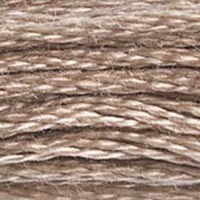
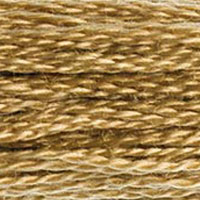
DMC colors commonly used alongside 612 Light Drab Brown.
Suggested Palette
Shading Companions
Detailed Conversions
Where to Buy DMC 612
This section contains affiliate links. We may earn a small commission at no cost to you.
Related Guides
Free Printable Thread Conversion Chart
Pick a brand, enter your email, and we'll send you a printable chart mapping all 552 DMC colors to that brand's equivalents. Zero spam, one chart.
Thanks! Here's your free chart:
Download Your ChartOpens in a new tab. Use your browser's Print → Save as PDF.
No spam. Your email is stored securely and never shared.