
Quick Conversion Table
| Brand | Equivalent | Match |
|---|---|---|
| Anchor | 844 | exact |
| Madeira | 1513 | close |
| Cosmo ⚠ | 924 | close |
| Sullivans | 45332 | close |
| J&P Coats | 6010 | close |
| Candamar | 6182 | close |
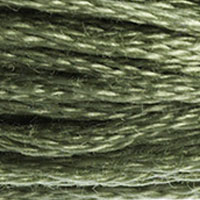
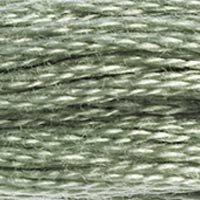
In a well-balanced botanical palette, the mid-value colors carry the most visual weight — they're the colors that define forms, create the base from which lighter highlights and darker shadows push out in both directions. DMC 3052 Medium Green Gray does this job beautifully for muted, naturalistic greenery. It's a medium-value gray-green with enough color to read unambiguously as green while carrying enough gray to feel genuinely naturalistic rather than decoratively bright. Call it the anchor of the green-gray family.
The Green-Gray Family as a System
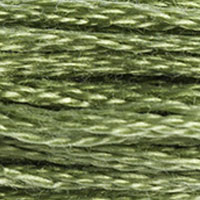
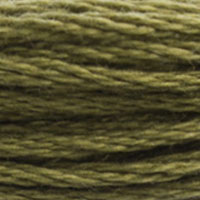
DMC produces a three-value green-gray progression: DMC 3053 (Green Gray) as the lightest and most yellow-influenced; DMC 3052 (Medium Green Gray) as the middle value; DMC 3051 (Dark Green Gray) as the darkest, most gray-dominated tone. Used together, these three threads create a gray-green shading sequence that's unlike anything else in the DMC range — not the bright viridian-influenced greens, not the khaki-olive greens, but specifically the kind of gray-shifted green that appears in overcast daylight, in deep shade, in photographs taken on cloudy days.
DMC 3052 is the hub of this system. The transition from 3051 to 3052 involves a significant jump in both value and warmth — the medium becomes notably lighter and more green-influenced. The transition from 3052 to 3053 is subtler — the light green-gray becomes slightly more yellow-green and less gray. Understanding these transitions helps you place each value correctly when shading complex foliage.
Versatility Across Design Styles
Muted and vintage-style botanical designs are the natural habitat for DMC 3052, but its usefulness extends considerably further. Landscape backgrounds benefit from the color at middle distance — the gray-green of hedgerows and fields seen from several hundred meters away. Wildlife plumage on certain birds (many warblers, vireos, and thrushes have this exact gray-olive-green in their coloring) uses 3052 as a primary fill color rather than just a shadow tone.
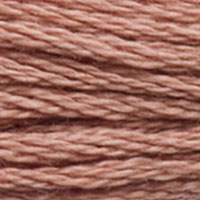
In sampler designs with traditional botanical borders, DMC 3052 often appears as the main vine or leaf color — the consistent mid-value green that ties the design together. Paired with DMC 3041 (Medium Antique Violet) and DMC 3047 (Light Yellow Beige), it builds a sophisticated muted-botanical palette that's become a signature of a certain style of contemporary sampler design.
Stitchers working on reproduction antique pieces and historical needlework patterns find DMC 3052 essential. Colors like this — complex, muted, gray-shifted — are the ones that most closely approximate how natural dyes aged and faded over centuries. A reproduction 18th-century embroidery piece rendered in saturated modern thread colors looks obviously new; one that uses the green-gray family, antique violets, and warm neutrals looks convincingly aged.
Coverage and Technique Notes
Medium-value colors in the gray-green range can be slightly tricky on Aida because the relatively low contrast between the thread and a white or ecru ground can make it hard to see mistakes during stitching. Parking and methodical row stitching work well with DMC 3052 — they provide a regular visual check on coverage that helps catch missed stitches or coverage gaps before they become buried under adjacent colors.
Both Anchor 844 and Madeira 1513 are exact matches for DMC 3052. This is particularly good news because the green-gray family is genuinely difficult to replicate — the specific gray-green character of these threads isn't produced by many other sources. If you're using Anchor or Madeira as your primary thread brand, either equivalent is reliable for this mid-value gray-green.
Cosmo 924 and Sullivans 45332 are close matches. Cosmo's muted green equivalents are generally well-regarded; Sullivans' greens vary more widely in quality across their range, so an in-person check before substituting in a prominent role is advisable.
Within the DMC range, if 3052 is unavailable, the most reasonable stash substitute is DMC 523 (Light Fern Green) — it sits in a similar gray-green territory but is slightly more blue-influenced. DMC 3363 (Medium Pine Green) is darker and more purely green but can sometimes serve the mid-value role in a pinch. If you're substituting 3052 within the full green-gray family (3051, 3052, 3053), try to maintain the value relationships — the substitute should read clearly lighter than your 3051 equivalent and darker than your 3053 equivalent. Disrupting these relationships is what makes gradient substitutions go wrong.
Reference quality
How We Validate This Color Record
Use this page as a reference card for DMC 3052: the structured data, quick conversions, and long-form copy are all tied back to the same stored color record.
- Methodology
- This page renders DMC 3052, its hex value, and every brand equivalent from the site's source-of-truth color record, then checks long-form body copy against those same stored fields.
- Verification status
- Source-field checked. The page content is audited against the stored DMC number, brand equivalents, and match-quality labels before publishing.
- Last reviewed
- 2026-04-20
- Approximation warning
- Screen hex values, thread photos, and cross-brand conversions are reference aids. Dye lots, thread sheen, and fabric color can still shift the result in hand.
Decision guide
When to use the DMC 3052 reference page
This page should help you decide faster between palette planning, brand substitution, and shade comparison without turning the color record into a thin lookup page.
Best for
- + Palette planning when you want the stored DMC 3052 Medium Green Gray record, hex value #889268, and linked brand equivalents in one place.
- + Checking the quickest cross-brand shortlist before you buy floss, compare stash substitutes, or route into a more specific conversion page.
- + Finding nearby shades in the greens family before you commit to accents, shading, or background blends.
Watch for
- ! Screen previews are only reference aids. Medium Green Gray can shift on real fabric because thread sheen, stitch coverage, and room lighting change how the color reads.
- ! A stored equivalent is still a shortlist, not a guarantee that two brands will disappear into each other in the same stitched motif.
- ! Older charts, discontinued kit floss, and dye-lot variation can all introduce small but visible differences that the page cannot detect for you.
Before you commit
- Confirm the role of DMC 3052 Medium Green Gray: decide whether you need an exact hero shade, a forgiving background, or a rough stash substitute.
- Compare on project fabric: view the skein or stitched sample on the same fabric count and color you will actually use.
- Use the linked conversion pages next: open the brand-specific pages when you need match-quality caveats before substituting away from the DMC reference.
DMC 3052 FAQ
These questions appear on the page so the FAQ schema stays aligned with what visitors can actually read.
What is the Anchor equivalent of DMC 3052?+
The closest Anchor equivalent to DMC 3052 (Medium Green Gray) is Anchor 844. This is an exact match.
What color is DMC 3052?+
DMC 3052 is called "Medium Green Gray" and has a hex color value of #889268. It belongs to the greens color family.
What is the Madeira equivalent of DMC 3052?+
The closest Madeira equivalent to DMC 3052 (Medium Green Gray) is Madeira 1513. This is a close match.
How DMC 3052 Looks on Fabric
The same thread appears different depending on your fabric. Always test on your project fabric.
White Aida
Cream / Ecru
Black Aida
Pairs Well With
DMC colors commonly used alongside 3052 Medium Green Gray.
Suggested Palette
Shading Companions
Detailed Conversions
Where to Buy DMC 3052
This section contains affiliate links. We may earn a small commission at no cost to you.
Related Guides
Free Printable Thread Conversion Chart
Pick a brand, enter your email, and we'll send you a printable chart mapping all 552 DMC colors to that brand's equivalents. Zero spam, one chart.
Thanks! Here's your free chart:
Download Your ChartOpens in a new tab. Use your browser's Print → Save as PDF.
No spam. Your email is stored securely and never shared.