
Quick Conversion Table
| Brand | Equivalent | Match |
|---|---|---|
| Anchor | 308 | exact |
| Madeira | 2104 | close |
| Cosmo ⚠ | 706 | close |
| Sullivans | 45199 | close |
| J&P Coats | 5309 | close |
| Dimensions | 6111 | close |
| Bucilla | 3783 | close |
| Candamar | 6112 | close |
Cross-stitch patterns built around antique gold, aged amber, rich autumn color, or warm brown-gold shading inevitably land on DMC 781 Very Dark Topaz as a structural component. It's not the brightest gold in the palette — that role usually goes to DMC 783 (Medium Topaz) or lighter family members. It's not the deepest shadow — DMC 780 (Ultra Very Dark Topaz) handles that. Instead, 781 occupies the critical position one step above the deepest shadow: the dark-but-not-black tone that defines form and creates richness in warm golden palettes.
Gradient Architecture: The Topaz Sequence
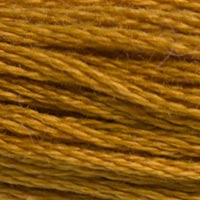
The full topaz family creates a remarkably complete shading range for warm gold tones. From the deeper DMC 780 through 781, then 782 (Dark Topaz), 783 (Medium Topaz), and lighter yellow-golds like DMC 742 (Light Tangerine) or DMC 677 (Very Light Old Gold), you have everything needed for realistic gold shading work. DMC 781 specifically is the tone that transitions from shadow (780) to deep mid-tone (782), and getting this step right is what makes gold-colored subjects look genuinely dimensional.
In lion mane work, for instance, 781 appears in the deep fur areas between 780's darkest shadows and 782's lighter fur masses. In jewelry and decorative metalwork designs, 781 handles the recessed areas that aren't quite the deepest shadow but are clearly in shade. In wood grain work, 781 fills the broader dark grain bands while 780 handles the sharpest, darkest grain lines.
Warm Brown Territory: The Hue Bridge
DMC 781 sits at an interesting color-family boundary. At this saturation level and value, the color reads as a warm brown-gold rather than a recognizable yellow — it shares visual territory with both the topaz family above it and the hazelnut/coffee brown family below it. This makes it useful in warm brown palettes that need a touch of warmth and luminosity that pure browns don't provide.
In mixed-palette design work, 781 sometimes acts as the bridge between a gold sequence and a brown sequence — it reads naturally next to both DMC 782 (golden) and DMC 869 (Very Dark Hazelnut Brown) without creating an abrupt color transition. This bridging quality is particularly useful in autumnal landscape designs where warm gold foliage transitions into brown earth and branch colors.
Equestrian and Horse Designs
Brown and golden-colored horse breeds — palominos, buckskins, chestnuts, and bays — make extensive use of the topaz family, with 781 often handling the deep shading in the coat and mane. Palomino horses specifically have a golden body color that maps very naturally onto the topaz gradient, with 781 providing the body shadow color that keeps the horse from reading as flat gold. Chestnut horses use 781 in the darker red-brown areas of their coat, where the color reads as a rich, warm dark brown rather than obviously golden.
For cross-stitch stitchers who work on equestrian designs as part of a horse-related hobby (and the overlap between horse people and stitchers is apparently significant, judging by FlossTube), having multiple skeins of 781 on hand is practically a necessity.
Historical Design: Medieval Gold and Heraldic Work
Traditional needlework patterns featuring heraldic elements, medieval gold thread imitation, and historical document reproduction all use the topaz family extensively. DMC 781 often appears as the deep gold tone in heraldic crowns, golden shields, and decorative border elements that need more dimensionality than a flat golden fill provides. Crown motifs using 781 alongside 782 and 783 for the raised areas read as convincingly three-dimensional despite being worked in flat cotton thread.
Anchor 308 is the exact-rated match for DMC 781, though it's worth noting that the same Anchor number maps to DMC 780 (Ultra Very Dark Topaz) as well in some conversion charts — Anchor's range doesn't perfectly differentiate between these two closely related DMC shades. If your design uses both 780 and 781, buying both DMC shades rather than using Anchor 308 for both is preferable. Madeira 2104 is exact-rated and is a reliable independent match for 781 specifically.
Cosmo 706 and Sullivans 45199 are close-rated. Both should work in most applications, though for designs where the precise step between 780 and 781 is important to the shading gradient, the exact-rated Madeira substitution is the safer choice.
Within DMC, DMC 780 (Ultra Very Dark Topaz) is the step darker and can substitute in areas where slightly more depth is acceptable. DMC 782 (Dark Topaz) is the step lighter. If you've run short of 781 mid-piece, DMC 782 used in the 781 areas will lighten the shadows slightly but generally maintain the design's intent better than a more dramatically different substitute would. The topaz family substitutes within itself gracefully as long as you stay within one or two steps of the original.
Reference quality
How We Validate This Color Record
Use this page as a reference card for DMC 781: the structured data, quick conversions, and long-form copy are all tied back to the same stored color record.
- Methodology
- This page renders DMC 781, its hex value, and every brand equivalent from the site's source-of-truth color record, then checks long-form body copy against those same stored fields.
- Verification status
- Source-field checked. The page content is audited against the stored DMC number, brand equivalents, and match-quality labels before publishing.
- Last reviewed
- 2026-04-20
- Approximation warning
- Screen hex values, thread photos, and cross-brand conversions are reference aids. Dye lots, thread sheen, and fabric color can still shift the result in hand.
Decision guide
When to use the DMC 781 reference page
This page should help you decide faster between palette planning, brand substitution, and shade comparison without turning the color record into a thin lookup page.
Best for
- + Palette planning when you want the stored DMC 781 Very Dark Topaz record, hex value #A26D20, and linked brand equivalents in one place.
- + Checking the quickest cross-brand shortlist before you buy floss, compare stash substitutes, or route into a more specific conversion page.
- + Finding nearby shades in the yellows family before you commit to accents, shading, or background blends.
Watch for
- ! Screen previews are only reference aids. Very Dark Topaz can shift on real fabric because thread sheen, stitch coverage, and room lighting change how the color reads.
- ! A stored equivalent is still a shortlist, not a guarantee that two brands will disappear into each other in the same stitched motif.
- ! Older charts, discontinued kit floss, and dye-lot variation can all introduce small but visible differences that the page cannot detect for you.
Before you commit
- Confirm the role of DMC 781 Very Dark Topaz: decide whether you need an exact hero shade, a forgiving background, or a rough stash substitute.
- Compare on project fabric: view the skein or stitched sample on the same fabric count and color you will actually use.
- Use the linked conversion pages next: open the brand-specific pages when you need match-quality caveats before substituting away from the DMC reference.
DMC 781 FAQ
These questions appear on the page so the FAQ schema stays aligned with what visitors can actually read.
What is the Anchor equivalent of DMC 781?+
The closest Anchor equivalent to DMC 781 (Very Dark Topaz) is Anchor 308. This is an exact match.
What color is DMC 781?+
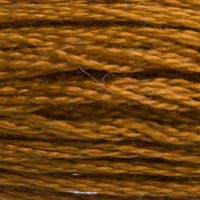
DMC 781 is called "Very Dark Topaz" and has a hex color value of #A26D20. It belongs to the yellows color family.
What is the Madeira equivalent of DMC 781?+
The closest Madeira equivalent to DMC 781 (Very Dark Topaz) is Madeira 2104. This is a close match.
How DMC 781 Looks on Fabric
The same thread appears different depending on your fabric. Always test on your project fabric.

White Aida
Cream / Ecru
Black Aida
Pairs Well With
DMC colors commonly used alongside 781 Very Dark Topaz.
Suggested Palette
Shading Companions
Detailed Conversions
Where to Buy DMC 781
This section contains affiliate links. We may earn a small commission at no cost to you.
Related Guides
Free Printable Thread Conversion Chart
Pick a brand, enter your email, and we'll send you a printable chart mapping all 552 DMC colors to that brand's equivalents. Zero spam, one chart.
Thanks! Here's your free chart:
Download Your ChartOpens in a new tab. Use your browser's Print → Save as PDF.
No spam. Your email is stored securely and never shared.