
Quick Conversion Table
| Brand | Equivalent | Match |
|---|---|---|
| Anchor | 152 | close |
| Madeira | 1009 | close |
| Cosmo ⚠ | 178 | close |
| Sullivans | 45209 | close |
The Deepest Blue Before Black
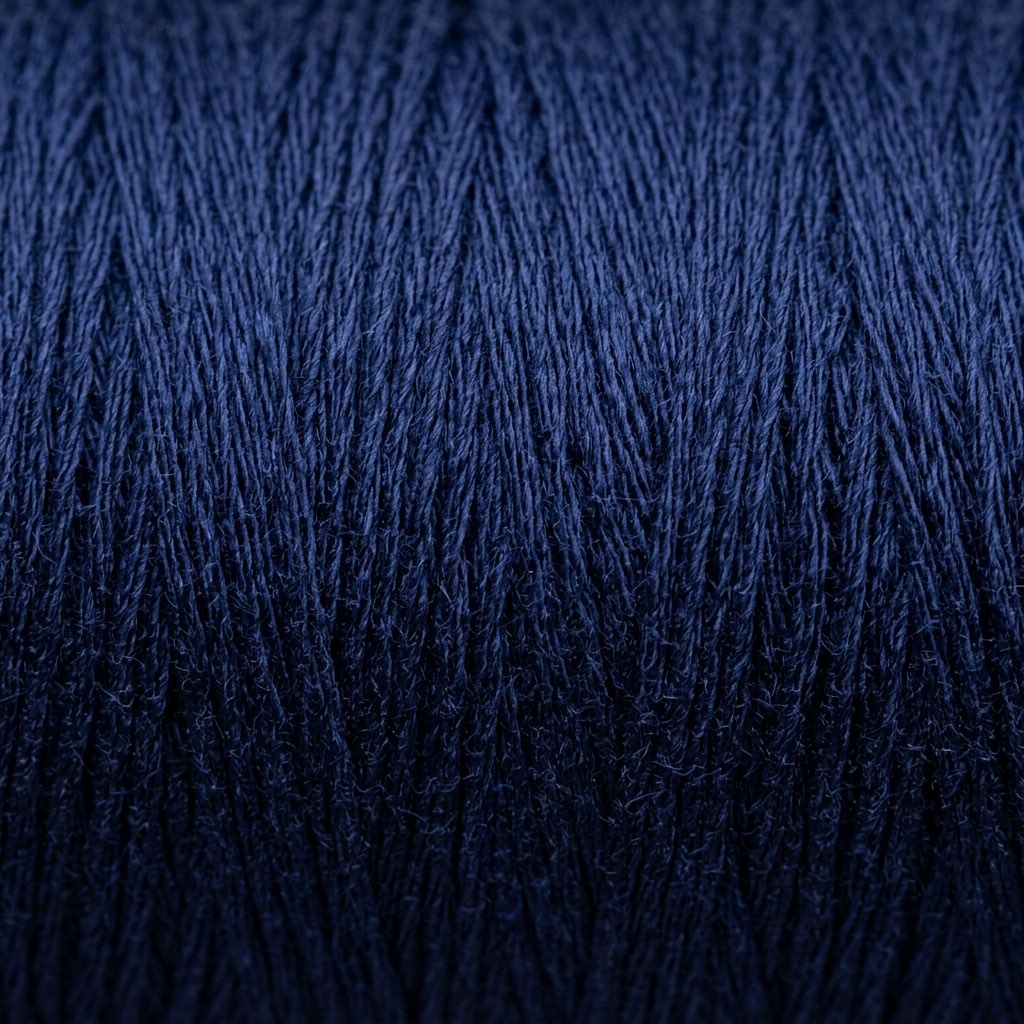
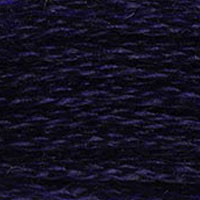
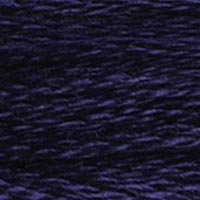
DMC 3960 lives in the narrowest of spaces — the sliver of color between true navy and black where blue still exists but barely announces itself. Under incandescent light, you might mistake it for DMC 310 Black and not realize the error until morning sun hits your hoop and reveals the faintest indigo warmth buried underneath. This is the thread equivalent of looking up at the night sky ten minutes after sunset, when darkness has nearly won but hasn't quite extinguished every trace of blue along the horizon.
As one of DMC's newer additions to the blue range, 3960 fills a gap that experienced stitchers had been improvising around for years. Before it arrived, getting a near-black navy meant either accepting that DMC 939 (Very Dark Navy Blue) was as dark as you could go, or blending a strand of 939 with a strand of 310 in a needle — a workable hack, but one that introduced the slight unevenness that blended needles always bring. With 3960, that improvisation is no longer necessary. You get a solid, single-dye thread that reads as almost-black-with-blue-memory, and the consistency stitch to stitch is flawless.
Deep Sea Darkness in Thread
If you have ever been scuba diving — or watched enough nature documentaries to feel like you have — you know what happens to color as you descend. Red vanishes first, then orange, then yellow. Green hangs on stubbornly for a while. And finally, in the deepest waters where sunlight is just a rumor, everything resolves into this exact shade: a blue so dark it has forgotten what the surface looks like. DMC 3960 is the abyssal zone in thread form. It belongs in underwater scenes not as the water itself, but as the deep backdrop behind everything else — the void behind the coral, the darkness beyond the reach of a diver's torch.
For stitchers working ocean-themed pieces, the distinction between 3960 and plain black matters enormously. Black is the absence of light, full stop. But 3960 is the absence of light in water, which retains that spectral memory of blue even when you can barely perceive it. Stitch an anglerfish scene using 310 for the background and the result is a creature floating in space. Stitch the same scene with 3960 and the creature is unmistakably submerged. The difference is subtle, but it communicates depth — literal oceanic depth — in a way that black never can.
Working with Near-Black Blues
The practical challenge with a thread this dark is visibility. On black or dark navy Aida, your stitches will vanish entirely, which is either a problem or a feature depending on the design. On white or natural Aida at 14-count, 3960 provides gorgeous, rich coverage that reads as emphatically dark without the flatness of true black. The faint blue undertone gives the stitched surface a quality of depth that straight black can't achieve — your eye perceives not just a dark area but a dark area with something happening underneath, the way deep water has dimension that a painted-on shadow lacks.
Pair 3960 with DMC 823 (Dark Navy Blue) and DMC 939 (Very Dark Navy Blue) for a dark-end navy gradient that descends from recognizably blue into the abyss. Add DMC 797 (Royal Blue) and DMC 820 (Very Dark Royal Blue) to extend the range upward into mid-value territory. This five-thread family gives you everything you need for night sky gradients, deep water scenes, or the shadow areas of blue gemstones — sapphires, blue topaz, the deep blue flash in labradorite.
On social media, be warned: 3960 photographs darker than it reads in person. Phone cameras compress dark values aggressively, and you may find that carefully stitched areas of 3960 look indistinguishable from black in photographs. Good lighting helps — natural, indirect daylight at an angle that catches the thread's sheen reveals the blue undertone. Some stitchers who post their WIPs on Instagram and FlossTube have learned to slightly overexpose their photos to pull out the differentiation between their darkest blues and blacks. If your project relies on that distinction being visible, factor in how it will photograph before you commit hours to the darkest values.
Finding Equivalents at the Edge of Darkness
At this extreme end of the value scale, substitution becomes tricky because the differences between brands are compressed into an almost imperceptibly narrow range. Anchor 152 is listed as a close match rather than exact, and that "close" designation matters here — at these values, even a slight shift toward pure black or toward purple-navy changes the character of the thread significantly when seen alongside lighter blues in the same piece.
Madeira 1009 is similarly a close match and tends to have the faintest warm cast that DMC 3960 avoids. For most applications this won't matter — when a thread is this dark, undertone differences shrink to near-invisibility under normal viewing conditions. But if you're stitching a gradient that descends through several navy shades into 3960, any warmth in the substitute may create a visible discontinuity against the cooler DMC threads surrounding it.
Cosmo 178, also a close match, tends to offer slightly more visible blue at this depth, which could actually be an advantage if you want the "not quite black" quality to be more readable. It depends on whether you want viewers to immediately perceive the blue or only discover it upon close inspection.
Within the DMC range itself, DMC 939 is the most obvious alternative if 3960 is unavailable, though it sits a step lighter on the value scale. If you absolutely need that near-black reading and can't source 3960, a blended needle of one strand DMC 939 and one strand DMC 310 (Black) approximates the effect, though you sacrifice the consistent dye quality of a single-thread solution. Test any substitute against your other navy threads under both natural and artificial light — what looks identical under LEDs may diverge under daylight.
Reference quality
How We Validate This Color Record
Use this page as a reference card for DMC 3960: the structured data, quick conversions, and long-form copy are all tied back to the same stored color record.
- Methodology
- This page renders DMC 3960, its hex value, and every brand equivalent from the site's source-of-truth color record, then checks long-form body copy against those same stored fields.
- Verification status
- Source-field checked. The page content is audited against the stored DMC number, brand equivalents, and match-quality labels before publishing.
- Last reviewed
- 2026-04-20
- Approximation warning
- Screen hex values, thread photos, and cross-brand conversions are reference aids. Dye lots, thread sheen, and fabric color can still shift the result in hand.
Decision guide
When to use the DMC 3960 reference page
This page should help you decide faster between palette planning, brand substitution, and shade comparison without turning the color record into a thin lookup page.
Best for
- + Palette planning when you want the stored DMC 3960 Very Dark Navy Blue record, hex value #0A0A50, and linked brand equivalents in one place.
- + Checking the quickest cross-brand shortlist before you buy floss, compare stash substitutes, or route into a more specific conversion page.
- + Finding nearby shades in the blues family before you commit to accents, shading, or background blends.
Watch for
- ! Screen previews are only reference aids. Very Dark Navy Blue can shift on real fabric because thread sheen, stitch coverage, and room lighting change how the color reads.
- ! A stored equivalent is still a shortlist, not a guarantee that two brands will disappear into each other in the same stitched motif.
- ! Older charts, discontinued kit floss, and dye-lot variation can all introduce small but visible differences that the page cannot detect for you.
Before you commit
- Confirm the role of DMC 3960 Very Dark Navy Blue: decide whether you need an exact hero shade, a forgiving background, or a rough stash substitute.
- Compare on project fabric: view the skein or stitched sample on the same fabric count and color you will actually use.
- Use the linked conversion pages next: open the brand-specific pages when you need match-quality caveats before substituting away from the DMC reference.
DMC 3960 FAQ
These questions appear on the page so the FAQ schema stays aligned with what visitors can actually read.
What is the Anchor equivalent of DMC 3960?+
The closest Anchor equivalent to DMC 3960 (Very Dark Navy Blue) is Anchor 152. This is a close match.
What color is DMC 3960?+
DMC 3960 is called "Very Dark Navy Blue" and has a hex color value of #0A0A50. It belongs to the blues color family.
What is the Madeira equivalent of DMC 3960?+
The closest Madeira equivalent to DMC 3960 (Very Dark Navy Blue) is Madeira 1009. This is a close match.
How DMC 3960 Looks on Fabric
The same thread appears different depending on your fabric. Always test on your project fabric.
White Aida
Cream / Ecru
Black Aida
Pairs Well With
DMC colors commonly used alongside 3960 Very Dark Navy Blue.
Suggested Palette
Shading Companions
Detailed Conversions
Where to Buy DMC 3960
This section contains affiliate links. We may earn a small commission at no cost to you.
Related Guides
Free Printable Thread Conversion Chart
Pick a brand, enter your email, and we'll send you a printable chart mapping all 552 DMC colors to that brand's equivalents. Zero spam, one chart.
Thanks! Here's your free chart:
Download Your ChartOpens in a new tab. Use your browser's Print → Save as PDF.
No spam. Your email is stored securely and never shared.