
DMC 119 — Variegated Dk Navy & Lt Navy
Blues family · Hex #203888
Quick Conversion Table
| Brand | Equivalent | Match |
|---|---|---|
| Anchor | 152 | close |
| Madeira | 1009 | close |
| Cosmo ⚠ | 2627 | close |
| Sullivans | 45211 | close |
Naval History on a Skein
Navy blue has a pedigree that most colors would envy. The British Royal Navy adopted dark indigo-blue uniforms in 1748, and the color became so associated with maritime authority that it eventually took the institution's name. Every naval tradition since — French, American, Japanese — has claimed some variant of this shade. DMC 119 captures that heritage in variegated form, shifting between the commanding depth of a dress uniform's darkest folds and the lighter navy that shows where fabric catches the light.
The name itself tells you what you're getting: Dark Navy and Light Navy, back and forth along the strand. This is a higher-contrast variegation than you'll find in DMC 117 (Variegated Blue) or even DMC 102 (Variegated Royal Blue). The dark portions are genuinely dark — close to the depth of DMC 336 (Navy Blue) or even DMC 939 (Very Dark Navy Blue) — while the lighter passages lift into the medium-dark range where individual stitches read more distinctly. That range creates real drama, and it demands more intentionality in how you use it.
Night Skies and Deep Water
If you're stitching a night sky, DMC 119 should be on your shortlist. The natural variation between dark and light navy mimics the way the night sky isn't actually one uniform shade — it's darker overhead, lighter near the horizon, punctuated by areas of relative brightness where scattered starlight or urban glow washes the darkness. Stitch a large sky area in 119 and you get this atmospheric variation built into every row without needing to chart a complex gradient.
Deep ocean water is the other obvious application. The surface of the sea at night, the middle depths where sunlight fades to twilight, the edge of an underwater shelf where shallow turquoise gives way to abyss — these transitions live in 119's wheelhouse. Pair it with DMC 3750 (Very Dark Antique Blue) for the deepest shadow areas and DMC 312 (Very Dark Baby Blue) for the transitional zones, and you have a deep-water palette that communicates genuine depth.
The high contrast of this variegation also makes it effective for celestial designs. Constellations stitched on a DMC 119 background gain a cosmic quality — the lighter passages of the thread suggest nebulae or the faint glow of the Milky Way, while the darker sections provide the void between stars. Thread 119 essentially gives you a night sky that looks lived-in and real rather than flat and uniform.
Handling the Contrast
The wider tonal range in DMC 119 compared to gentler variegated threads means your stitching method matters significantly. Cross-country stitching creates a strong peppering effect — dark stitches popping up next to light ones in a pattern dictated by the thread rather than the design. Some stitchers love this energy; others find it distracting. If you want smoother gradation, the Danish method in neat rows distributes the shifts more predictably.
Thread length control becomes even more important here. With gentle variegation, a longer thread just means more subtle shifts; with 119's more dramatic range, a longer thread can create large blocks of dark followed by large blocks of light that may or may not align with your design in a flattering way. Shorter lengths — 12 inches or less — give you more control, even if they mean more frequent thread changes. For a full-coverage navy background, this trade-off is usually worth making.
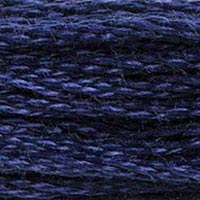
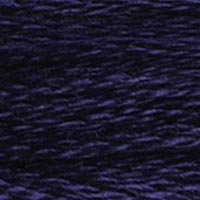
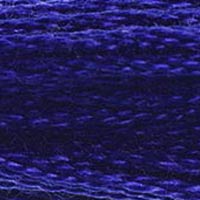
On fabric choice: 119's dark tones disappear on dark fabric (obviously), but on white Aida, even the lighter passages read as genuinely dark. This thread has enough saturation across its entire range to hold up as a background color, which isn't true of all variegated threads. On 14-count Aida with two strands, the coverage is dense enough that the white fabric doesn't peek through the darker portions — a common concern with dark variegated threads where the lighter dye areas can look thin.
Navigating Navy Variegation Substitutes
Substituting DMC 119 forces a choice: do you match the color or the effect? Anchor 152 gives you a solid very dark navy blue that captures the darker end of 119's range — fine for small areas where the variegation wouldn't register anyway, but a substantial change for large background fills. Madeira 1009 sits in similar territory, a dependable deep navy that lacks the tonal movement.
The fundamental problem is that no solid thread replicates what variegation does. If your design uses 119 for a night sky or deep water background, switching to a solid will make that area feel flat and static. You lose the atmospheric quality. In those cases, consider whether the pattern might work with two alternating solid navies — perhaps DMC 336 and DMC 312 — stitched in alternating rows or randomly swapped every few stitches to approximate the variation.
Cosmo 2627 matches the general navy character, and Sullivans 45211 does the same. Both are perfectly adequate when the pattern simply needs dark blue. But for designs that chose 119 specifically for its dual-tone nature, explore each brand's own variegated or overdyed offerings. Many specialty dyers produce hand-overdyed navies that transition through similar dark-to-medium-dark ranges.
Within the DMC range itself, if you can't find 119, you might consider stitching with DMC 939 (Very Dark Navy Blue) and occasionally blending in a strand of DMC 311 (Medium Navy Blue) using blended needle technique — one strand of each — to create a homemade variegation effect that approximates 119's visual texture without being identical.
Reference quality
How We Validate This Color Record
Use this page as a reference card for DMC 119: the structured data, quick conversions, and long-form copy are all tied back to the same stored color record.
- Methodology
- This page renders DMC 119, its hex value, and every brand equivalent from the site's source-of-truth color record, then checks long-form body copy against those same stored fields.
- Verification status
- Source-field checked. The page content is audited against the stored DMC number, brand equivalents, and match-quality labels before publishing.
- Last reviewed
- 2026-04-20
- Approximation warning
- Screen hex values, thread photos, and cross-brand conversions are reference aids. Dye lots, thread sheen, and fabric color can still shift the result in hand.
Decision guide
When to use the DMC 119 reference page
This page should help you decide faster between palette planning, brand substitution, and shade comparison without turning the color record into a thin lookup page.
Best for
- + Palette planning when you want the stored DMC 119 Variegated Dk Navy & Lt Navy record, hex value #203888, and linked brand equivalents in one place.
- + Checking the quickest cross-brand shortlist before you buy floss, compare stash substitutes, or route into a more specific conversion page.
- + Finding nearby shades in the blues family before you commit to accents, shading, or background blends.
Watch for
- ! Screen previews are only reference aids. Variegated Dk Navy & Lt Navy can shift on real fabric because thread sheen, stitch coverage, and room lighting change how the color reads.
- ! A stored equivalent is still a shortlist, not a guarantee that two brands will disappear into each other in the same stitched motif.
- ! Older charts, discontinued kit floss, and dye-lot variation can all introduce small but visible differences that the page cannot detect for you.
Before you commit
- Confirm the role of DMC 119 Variegated Dk Navy & Lt Navy: decide whether you need an exact hero shade, a forgiving background, or a rough stash substitute.
- Compare on project fabric: view the skein or stitched sample on the same fabric count and color you will actually use.
- Use the linked conversion pages next: open the brand-specific pages when you need match-quality caveats before substituting away from the DMC reference.
DMC 119 FAQ
These questions appear on the page so the FAQ schema stays aligned with what visitors can actually read.
What is the Anchor equivalent of DMC 119?+
The closest Anchor equivalent to DMC 119 (Variegated Dk Navy & Lt Navy) is Anchor 152. This is a close match.
What color is DMC 119?+
DMC 119 is called "Variegated Dk Navy & Lt Navy" and has a hex color value of #203888. It belongs to the blues color family.
What is the Madeira equivalent of DMC 119?+
The closest Madeira equivalent to DMC 119 (Variegated Dk Navy & Lt Navy) is Madeira 1009. This is a close match.
How DMC 119 Looks on Fabric
The same thread appears different depending on your fabric. Always test on your project fabric.
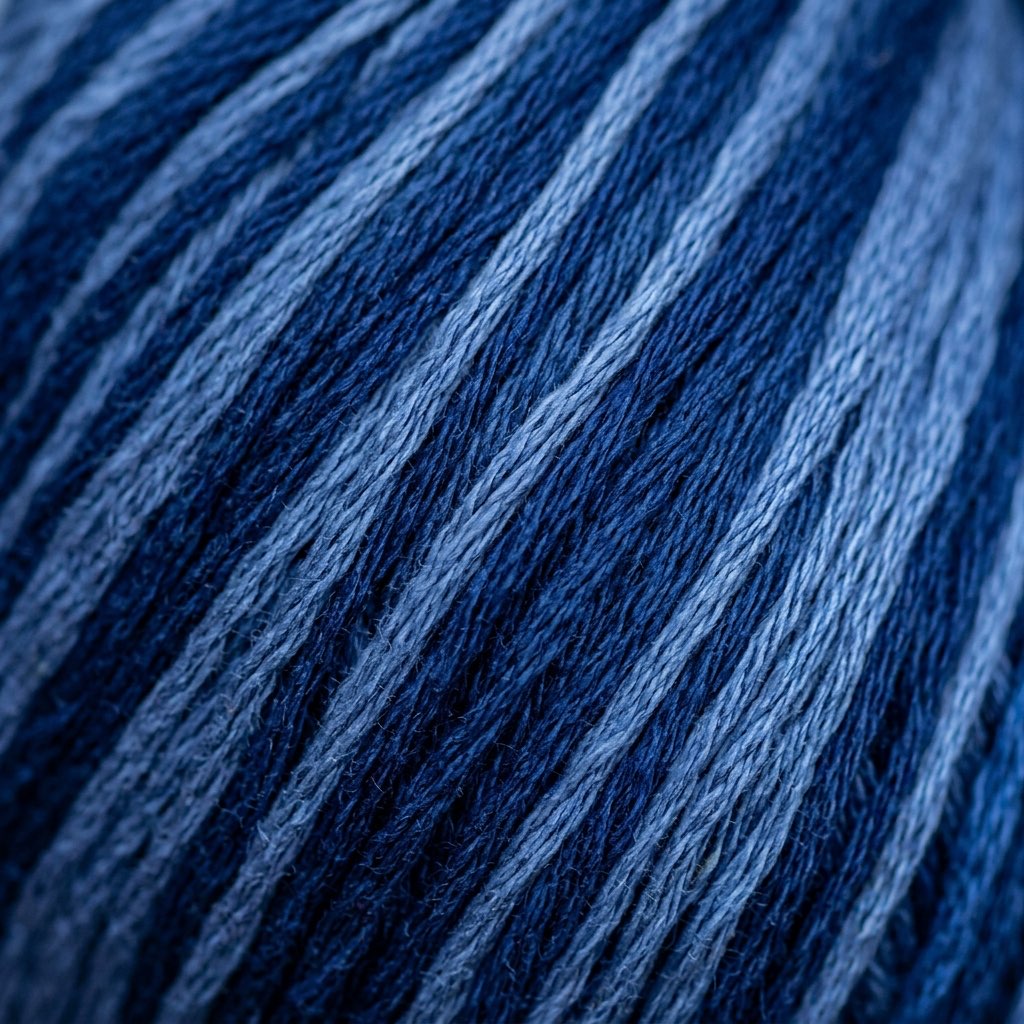
White Aida
Cream / Ecru
Black Aida
Pairs Well With
DMC colors commonly used alongside 119 Variegated Dk Navy & Lt Navy.
Suggested Palette
Shading Companions
Detailed Conversions
Where to Buy DMC 119
This section contains affiliate links. We may earn a small commission at no cost to you.
Related Guides
Free Printable Thread Conversion Chart
Pick a brand, enter your email, and we'll send you a printable chart mapping all 552 DMC colors to that brand's equivalents. Zero spam, one chart.
Thanks! Here's your free chart:
Download Your ChartOpens in a new tab. Use your browser's Print → Save as PDF.
No spam. Your email is stored securely and never shared.