
DMC 3856 — Ultra Very Light Mahogany
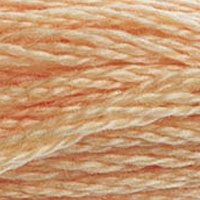
Browns family · Hex #FFD3B5
Quick Conversion Table
| Brand | Equivalent | Match |
|---|---|---|
| Anchor | 347 | close |
| Madeira | 2309 | close |
| Cosmo ⚠ | 126 | close |
| Sullivans | 45454 | close |
| J&P Coats | 3335 | close |
| Dimensions | 15345 | close |
| Bucilla | 6224 | close |
The Palest Skin Tone in the Brown Family
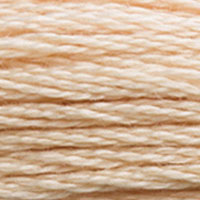
"Ultra Very Light" is about as qualified as a DMC color name gets, and DMC 3856 earns every modifier. At #FFD3B5, this is a warm, peach-tinged near-white that reads as the palest peachy-cream imaginable — the color of very fair skin in golden light, of the palest wood shaving curled from fresh pine, or the inside of a dried rose petal. It barely reads as "brown" in any conventional sense, but its warm undertone places it firmly in the mahogany family's lightest extreme.
The name "mahogany" here refers not to color but to lineage — 3856 is the palest value in DMC's mahogany color family, which extends through progressively darker and redder-brown shades toward deep reddish-brown at the dark end. As an extreme light value, 3856 functions primarily as a skin tone highlight, a pale warm flesh for portraiture work, and a very light warm accent in designs that need cream without the blue-white cast that stark white or off-white colors can produce.
Skin Tones in Cross-Stitch: Why This Color Matters
Stitching convincing human skin tones is one of the more technically demanding aspects of portrait and figure embroidery, and it requires a careful selection of light, mid, and dark values that all read as skin without tipping into orange, gray, or pink. DMC 3856 sits at the very light end of the skin tone palette for lighter-toned human figures: it's the color of a highlight on a cheek in warm light, the pale of an eyelid, the brightest area of a forehead.
In the mahogany family, 3856 pairs with DMC 402 (Very Light Mahogany), DMC 301 (Medium Mahogany), and darker mahogany shades to create a complete warm-flesh gradient. For portrait work using the mahogany family, 3856 occupies the lightest stop, providing the pale, luminous highlights that give dimensionality to a stitched face. Without a color this light in the gradient, portraits can look flat — the light sources are implied but not quite present.
Beyond skin tones, 3856 appears in designs where a very warm, peachy cream is needed: the palest petals of a peach or apricot blossom, the interior highlight of a warm-colored seashell, the pale warm wood of a cedar interior in an architectural design. Anywhere that a warm near-white is called for but stark white would look cold, 3856 fills the need.
On white Aida, this color can nearly disappear in small amounts — the contrast between the thread and the fabric is minimal. This means it works best for highlights and detail accents in small quantities rather than large fills. On cream linen, it virtually merges with the ground, which can be intentional — for example, in a skin tone area of a portrait stitched on linen, where the cream ground acts as an additional lightest value visible through the stitches, effectively extending the light range naturally.
Very light warm-peach tones like 3856 are among the harder colors to match accurately across brands, since small hue and saturation differences are proportionally more visible at high values.
Anchor 347 is close. Anchor's ultra-light skin tones can lean slightly warmer or slightly pinker than DMC's equivalent, depending on the specific production batch. Testing Anchor 347 against your specific project's skin tone palette is recommended before committing — even a small hue shift in the lightest value can affect how convincing the overall gradient looks.
Madeira 2309 is close. Madeira's light mahogany range is reasonably consistent, and 2309 is a functional substitute in most applications. Some stitchers report it reads as very slightly more orange-peach than 3856's more purely cream-peach quality.
Cosmo 126 is close. As the lightest member of Cosmo's mahogany/rosewood family, 126 performs adequately in most pale warm-skin contexts. Saturation is comparable to the DMC version at this value.
Sullivans 45454 is close and suitable for standalone use. As with other very light Sullivans colors, dye lot confirmation is especially important since light colors show lot variation more visibly than dark ones.
- For a slightly pinker alternative at similar lightness, DMC 819 (Light Baby Pink) or DMC 3716 (Very Light Dusty Rose) provide a cooler, more pink quality for fair-skinned portraiture highlights.
- If the design needs a slightly warmer alternative than 3856 before stepping up to the next mahogany shade, DMC 951 (Light Tawny) bridges the gap between very pale and medium warm skin tones.
Reference quality
How We Validate This Color Record
Use this page as a reference card for DMC 3856: the structured data, quick conversions, and long-form copy are all tied back to the same stored color record.
- Methodology
- This page renders DMC 3856, its hex value, and every brand equivalent from the site's source-of-truth color record, then checks long-form body copy against those same stored fields.
- Verification status
- Source-field checked. The page content is audited against the stored DMC number, brand equivalents, and match-quality labels before publishing.
- Last reviewed
- 2026-04-20
- Approximation warning
- Screen hex values, thread photos, and cross-brand conversions are reference aids. Dye lots, thread sheen, and fabric color can still shift the result in hand.
Decision guide
When to use the DMC 3856 reference page
This page should help you decide faster between palette planning, brand substitution, and shade comparison without turning the color record into a thin lookup page.
Best for
- + Palette planning when you want the stored DMC 3856 Ultra Very Light Mahogany record, hex value #FFD3B5, and linked brand equivalents in one place.
- + Checking the quickest cross-brand shortlist before you buy floss, compare stash substitutes, or route into a more specific conversion page.
- + Finding nearby shades in the browns family before you commit to accents, shading, or background blends.
Watch for
- ! Screen previews are only reference aids. Ultra Very Light Mahogany can shift on real fabric because thread sheen, stitch coverage, and room lighting change how the color reads.
- ! A stored equivalent is still a shortlist, not a guarantee that two brands will disappear into each other in the same stitched motif.
- ! Older charts, discontinued kit floss, and dye-lot variation can all introduce small but visible differences that the page cannot detect for you.
Before you commit
- Confirm the role of DMC 3856 Ultra Very Light Mahogany: decide whether you need an exact hero shade, a forgiving background, or a rough stash substitute.
- Compare on project fabric: view the skein or stitched sample on the same fabric count and color you will actually use.
- Use the linked conversion pages next: open the brand-specific pages when you need match-quality caveats before substituting away from the DMC reference.
DMC 3856 FAQ
These questions appear on the page so the FAQ schema stays aligned with what visitors can actually read.
What is the Anchor equivalent of DMC 3856?+
The closest Anchor equivalent to DMC 3856 (Ultra Very Light Mahogany) is Anchor 347. This is a close match.
What color is DMC 3856?+
DMC 3856 is called "Ultra Very Light Mahogany" and has a hex color value of #FFD3B5. It belongs to the browns color family.
What is the Madeira equivalent of DMC 3856?+
The closest Madeira equivalent to DMC 3856 (Ultra Very Light Mahogany) is Madeira 2309. This is a close match.
How DMC 3856 Looks on Fabric
The same thread appears different depending on your fabric. Always test on your project fabric.
White Aida
Cream / Ecru
Black Aida
Pairs Well With
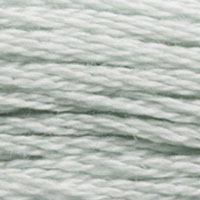
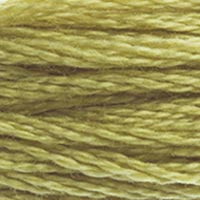
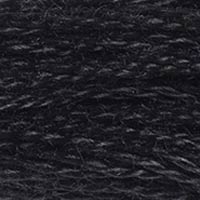
DMC colors commonly used alongside 3856 Ultra Very Light Mahogany.
Suggested Palette
Shading Companions
Detailed Conversions
Where to Buy DMC 3856
This section contains affiliate links. We may earn a small commission at no cost to you.
Related Guides
Free Printable Thread Conversion Chart
Pick a brand, enter your email, and we'll send you a printable chart mapping all 552 DMC colors to that brand's equivalents. Zero spam, one chart.
Thanks! Here's your free chart:
Download Your ChartOpens in a new tab. Use your browser's Print → Save as PDF.
No spam. Your email is stored securely and never shared.