
Quick Conversion Table
| Brand | Equivalent | Match |
|---|---|---|
| Anchor | 893 | exact |
| Madeira | 0808 | close |
| Cosmo ⚠ | 652 | close |
| Sullivans | 45046 | close |
| J&P Coats | 3068 | close |
| Dimensions | 13240 | close |
| Bucilla | 10224 | close |
| Candamar | 6260 | close |
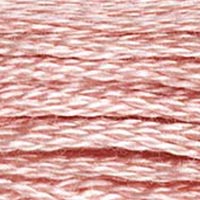
Blush pinks carry enormous tonal weight in embroidery, and DMC 224 Very Light Shell Pink is among the most useful of them. Its lightness means it functions as a highlight color — the soft bright on a petal's curve, the sun-catching edge of a shell, the delicate flush of fair skin — while still having enough color to read clearly against white or off-white fabric. That sweet spot between "too pale to matter" and "too saturated to be a highlight" is surprisingly narrow, and DMC 224 sits squarely in it.
Palette Position: The Essential Highlight
In the shell pink family, DMC 224 serves as the penultimate light — one step above the near-white of DMC 225 (Ultra Very Light Shell Pink) and one step below the more clearly defined pink of DMC 223 (Light Shell Pink). Understanding this position helps you deploy it correctly: DMC 224 is the color you use when you've already used 223 for the mid-tone and need something lighter for the bright areas, but don't want to jump all the way to a pink-tinged white.
In a typical five-value floral shading sequence using the shell pink family, the distribution might look like: DMC 221 for the deepest shadow, DMC 222 for second-shadow, DMC 223 for mid-tone, DMC 224 for the bright areas, and DMC 225 or even a near-white like DMC 3713 (Very Light Salmon) for the extreme highlights. Each value does a different job, and 224's job is that luminous upper-mid area where light is clearly present but hasn't bleached the color out entirely.
Practical Uses Beyond Florals
Skin tones in portrait cross-stitch depend heavily on very light pinks and peachy neutrals, and DMC 224 is frequently part of that toolkit. For fairer complexion shading, it represents the well-lit areas of the face or hands — the forehead in full light, the bridge of the nose, the upper cheeks. Used alongside DMC 3713 (Very Light Salmon) and DMC 353 (Peach), it can build a convincing light-to-mid skin tone gradient without veering into the orange territory that plagues a lot of portrait work.
Baby and childhood imagery — nursery samplers, birth announcements, infant portraits — naturally gravitates toward soft pinks, and DMC 224's delicate character is well-suited to the context. It has none of the assertiveness of a saturated pink; it reads as gentle and soft without being sugary. Wedding samplers, anniversary pieces, and romantic floral borders all use it for similar reasons.
Stitching Notes
Very light threads on white or near-white fabrics can be tricky: the low contrast makes it easy to miss misplaced stitches until they're well established. If you're working DMC 224 on white 18-count evenweave, consider using a light-colored backing behind your hoop during stitching so the pale pink reads more clearly against the work surface. Frogging pale threads is straightforward since they don't leave shadow marks as readily as darker colors, but finding the errant stitches in the first place is the challenge.
Railroading is worth the effort with light threads — the sheen of properly separated strands makes pale colors read more clearly, and with DMC 224 every bit of luminosity helps the color hold its own in the finished piece.
Anchor 893 is an exact match and can be used interchangeably with DMC 224 in projects where this is the primary or sole pink thread. For pieces where DMC 224 functions as one step in a shell pink shading sequence, it's best to match the full sequence within a single brand rather than mixing — even a small hue or value difference in one step can make the gradient look uneven.
Madeira 0808 and Cosmo 652 are close matches. Both brands' conversion equivalents in this pale range are generally reliable, but pale pinks are among the most difficult colors to convert precisely because small differences in saturation are highly visible when the thread is this light. When possible, get a sample or check photos from stitchers who've used the substitute in similar contexts.
Sullivans 45046 is listed close. If DMC 224 is used predominantly as a large fill area rather than a fine highlight, the slight differences in Sullivans' shade are less likely to matter. If it's serving as a critical highlight next to precisely matched darker shell pinks, get the exact thread. In a pinch from stash, DMC 3713 (Very Light Salmon) can approximate the look but adds a slightly more peachy cast that may or may not work depending on the surrounding palette.
Reference quality
How We Validate This Color Record
Use this page as a reference card for DMC 224: the structured data, quick conversions, and long-form copy are all tied back to the same stored color record.
- Methodology
- This page renders DMC 224, its hex value, and every brand equivalent from the site's source-of-truth color record, then checks long-form body copy against those same stored fields.
- Verification status
- Source-field checked. The page content is audited against the stored DMC number, brand equivalents, and match-quality labels before publishing.
- Last reviewed
- 2026-04-20
- Approximation warning
- Screen hex values, thread photos, and cross-brand conversions are reference aids. Dye lots, thread sheen, and fabric color can still shift the result in hand.
Decision guide
When to use the DMC 224 reference page
This page should help you decide faster between palette planning, brand substitution, and shade comparison without turning the color record into a thin lookup page.
Best for
- + Palette planning when you want the stored DMC 224 Very Light Shell Pink record, hex value #EBB7AF, and linked brand equivalents in one place.
- + Checking the quickest cross-brand shortlist before you buy floss, compare stash substitutes, or route into a more specific conversion page.
- + Finding nearby shades in the pinks family before you commit to accents, shading, or background blends.
Watch for
- ! Screen previews are only reference aids. Very Light Shell Pink can shift on real fabric because thread sheen, stitch coverage, and room lighting change how the color reads.
- ! A stored equivalent is still a shortlist, not a guarantee that two brands will disappear into each other in the same stitched motif.
- ! Older charts, discontinued kit floss, and dye-lot variation can all introduce small but visible differences that the page cannot detect for you.
Before you commit
- Confirm the role of DMC 224 Very Light Shell Pink: decide whether you need an exact hero shade, a forgiving background, or a rough stash substitute.
- Compare on project fabric: view the skein or stitched sample on the same fabric count and color you will actually use.
- Use the linked conversion pages next: open the brand-specific pages when you need match-quality caveats before substituting away from the DMC reference.
DMC 224 FAQ
These questions appear on the page so the FAQ schema stays aligned with what visitors can actually read.
What is the Anchor equivalent of DMC 224?+
The closest Anchor equivalent to DMC 224 (Very Light Shell Pink) is Anchor 893. This is an exact match.
What color is DMC 224?+
DMC 224 is called "Very Light Shell Pink" and has a hex color value of #EBB7AF. It belongs to the pinks color family.
What is the Madeira equivalent of DMC 224?+
The closest Madeira equivalent to DMC 224 (Very Light Shell Pink) is Madeira 0808. This is a close match.
How DMC 224 Looks on Fabric
The same thread appears different depending on your fabric. Always test on your project fabric.
White Aida
Cream / Ecru
Black Aida
Pairs Well With
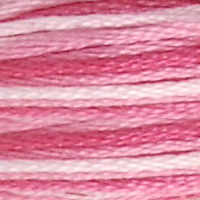
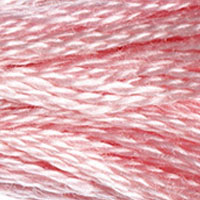
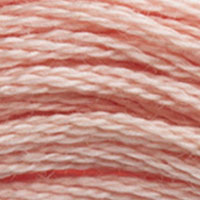
DMC colors commonly used alongside 224 Very Light Shell Pink.
Suggested Palette
Detailed Conversions
Where to Buy DMC 224
This section contains affiliate links. We may earn a small commission at no cost to you.
Related Guides
Free Printable Thread Conversion Chart
Pick a brand, enter your email, and we'll send you a printable chart mapping all 552 DMC colors to that brand's equivalents. Zero spam, one chart.
Thanks! Here's your free chart:
Download Your ChartOpens in a new tab. Use your browser's Print → Save as PDF.
No spam. Your email is stored securely and never shared.