
Quick Conversion Table
| Brand | Equivalent | Match |
|---|---|---|
| Anchor | 162 | exact |
| Madeira | 1107 | close |
| Cosmo ⚠ | 2253 | close |
| Sullivans | 45380 | close |
| J&P Coats | 7161 | close |
| Dimensions | 17169 | close |
| Candamar | 6088 | close |
Wedgwood blue has a history longer than most of us realize. The color takes its name from the Josiah Wedgwood pottery tradition — that distinctive slate-toned blue seen on jasperware cameos and classical relief pieces that became synonymous with refined English taste in the 18th century. When DMC named this thread Medium Wedgwood, they weren't just reaching for a poetic label. The color genuinely carries those associations: controlled, intelligent, slightly restrained, more sophisticated than a simple sky blue but far warmer than a cold navy.
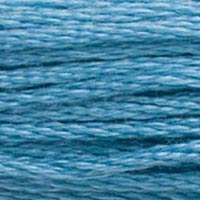
DMC 3760 sits at the medium value in the Wedgwood family, which makes it a workhorse in ways the lighter and darker relatives simply can't match. At hex #3E85A2, it reads as a cool-leaning teal-blue with enough depth to carry its own weight as a primary color. It doesn't need to hide in shadows or wash out in highlights — this is the mid-range color that organizes a blue-toned palette and makes everything around it legible.
Where This Color Does Its Best Work
The Wedgwood family — running from DMC 3756 (Ultra Very Light Baby Blue) through to DMC 336 (Navy Blue) on the deeper end — gives you a surprisingly complete tonal range. But 3760 specifically earns its place in coastal scenes, blue-and-white florals, and any design where you need a mid-tone blue that reads as slightly sophisticated rather than simply cheerful.
In sampler work, 3760 carries geometric patterns beautifully. The slightly grayed undertone prevents it from shouting, which means it plays nicely with cream linens and natural evenweave in a way that pure brights sometimes don't. If you're working a traditional border or a repeating pattern that needs to look considered rather than casual, this is the blue that gets the job done without demanding attention.
For seascape and maritime designs, 3760 is genuinely useful in shading sequences. Pair it with DMC 3761 (Light Sky Blue) for highlights and DMC 3765 (Very Dark Peacock Blue) for shadows, and you can build convincing wave texture without reaching for a dozen different blues. Some stitchers use it as a blended needle partner with DMC 322 (Baby Blue) to soften the transition between sky and horizon.
Fabric Behavior and Thread Characteristics
On white 18-count Aida, 3760 reads clean and true — exactly what the label promises. Move it to a natural or antique white evenweave and the warm undertone of the fabric brings out a slightly warmer quality in the blue, which can work in your favor for vintage-styled pieces. On dark fabrics, this is a color that holds its identity without needing to be over-spun — two strands over-two on linen reads clearly and with good coverage.
Railroading this thread makes a noticeable difference with 3760. Because the color has enough depth that slight twist variations are visible, taking the time to railroad gives you that polished, even coverage that's especially important in large fill areas or in the kind of precise band sampler work where Wedgwood blues traditionally appear.
Palette Building with Medium Wedgwood
The color theory case for 3760 is interesting because it sits at a crossroads between blue and teal. Its complement leans toward a warm terracotta-orange, which means pairing it with DMC 356 (Medium Terra Cotta) or DMC 3830 (Terra Cotta) creates those satisfying complementary contrasts that feel classical without being clichéd. It's a combination that shows up in traditional Dutch tile work and Delft pottery — appropriately historical given the Wedgwood origins.
Within a cool palette, 3760 anchors blues and blue-greens without tipping either direction. Combine it with DMC 3768 (Dark Gray Green) for a moody coastal palette, or with DMC 518 (Light Wedgwood) to build a clean monochromatic progression. The Wedgwood family genuinely rewards stitchers who work within it — there's a coherence to these threads that makes gradient work feel intentional rather than accidental.
Both Anchor 162 and Madeira 1107 are rated as exact matches for 3760, which is genuinely good news if you're working cross-brand or restocking mid-project. The Anchor equivalent sits at the same value and undertone, though some stitchers note that Anchor threads in this range carry a slightly silkier sheen than DMC — not necessarily better or worse, but something to account for if you're mixing brands within a single project, since the sheen difference can become visible in raking light.
Madeira 1107 is similarly close in color but tends to have a firmer twist. If you're parking and picking up frequently — as you would in a complex shading sequence — Madeira holds up slightly better under repeated tension changes. Worth knowing if you're planning a project heavy on this color.
Cosmo 2253 and Sullivans 45380 are both rated close rather than exact. The Cosmo skews a touch warmer and slightly lighter in some dye lots, so before committing it to a large area, do a test stitch next to any DMC 3760 already in your project. The visual difference is usually minor — you'd notice it side by side but probably not in isolation.
If 3760 is unavailable and you need a true substitute, DMC 518 (Light Wedgwood) is one step lighter and may work for highlight areas. DMC 517 (Dark Wedgwood) goes one step darker and can substitute in shadow positions. For a different family with similar overall character, DMC 807 (Peacock Blue) is in the same cool teal-blue neighborhood, though it's noticeably brighter.
Reference quality
How We Validate This Color Record
Use this page as a reference card for DMC 3760: the structured data, quick conversions, and long-form copy are all tied back to the same stored color record.
- Methodology
- This page renders DMC 3760, its hex value, and every brand equivalent from the site's source-of-truth color record, then checks long-form body copy against those same stored fields.
- Verification status
- Source-field checked. The page content is audited against the stored DMC number, brand equivalents, and match-quality labels before publishing.
- Last reviewed
- 2026-04-20
- Approximation warning
- Screen hex values, thread photos, and cross-brand conversions are reference aids. Dye lots, thread sheen, and fabric color can still shift the result in hand.
Decision guide
When to use the DMC 3760 reference page
This page should help you decide faster between palette planning, brand substitution, and shade comparison without turning the color record into a thin lookup page.
Best for
- + Palette planning when you want the stored DMC 3760 Medium Wedgwood record, hex value #3E85A2, and linked brand equivalents in one place.
- + Checking the quickest cross-brand shortlist before you buy floss, compare stash substitutes, or route into a more specific conversion page.
- + Finding nearby shades in the blues family before you commit to accents, shading, or background blends.
Watch for
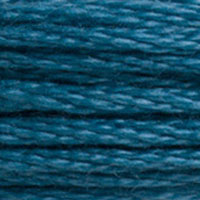
- ! Screen previews are only reference aids. Medium Wedgwood can shift on real fabric because thread sheen, stitch coverage, and room lighting change how the color reads.
- ! A stored equivalent is still a shortlist, not a guarantee that two brands will disappear into each other in the same stitched motif.
- ! Older charts, discontinued kit floss, and dye-lot variation can all introduce small but visible differences that the page cannot detect for you.
Before you commit
- Confirm the role of DMC 3760 Medium Wedgwood: decide whether you need an exact hero shade, a forgiving background, or a rough stash substitute.
- Compare on project fabric: view the skein or stitched sample on the same fabric count and color you will actually use.
- Use the linked conversion pages next: open the brand-specific pages when you need match-quality caveats before substituting away from the DMC reference.
DMC 3760 FAQ
These questions appear on the page so the FAQ schema stays aligned with what visitors can actually read.
What is the Anchor equivalent of DMC 3760?+
The closest Anchor equivalent to DMC 3760 (Medium Wedgwood) is Anchor 162. This is an exact match.
What color is DMC 3760?+
DMC 3760 is called "Medium Wedgwood" and has a hex color value of #3E85A2. It belongs to the blues color family.
What is the Madeira equivalent of DMC 3760?+
The closest Madeira equivalent to DMC 3760 (Medium Wedgwood) is Madeira 1107. This is a close match.
How DMC 3760 Looks on Fabric
The same thread appears different depending on your fabric. Always test on your project fabric.
White Aida
Cream / Ecru
Black Aida
Pairs Well With
DMC colors commonly used alongside 3760 Medium Wedgwood.
Suggested Palette
Shading Companions
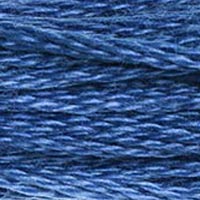
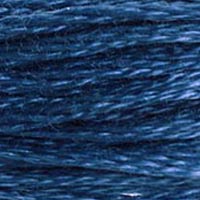
Detailed Conversions
Where to Buy DMC 3760
This section contains affiliate links. We may earn a small commission at no cost to you.
Related Guides
Free Printable Thread Conversion Chart
Pick a brand, enter your email, and we'll send you a printable chart mapping all 552 DMC colors to that brand's equivalents. Zero spam, one chart.
Thanks! Here's your free chart:
Download Your ChartOpens in a new tab. Use your browser's Print → Save as PDF.
No spam. Your email is stored securely and never shared.