
Quick Conversion Table
| Brand | Equivalent | Match |
|---|---|---|
| Anchor | 895 | exact |
| Madeira | 0812 | close |
| Cosmo ⚠ | 653 | close |
| Sullivans | 45045 | close |
| J&P Coats | 3240 | close |
| Dimensions | 60223 | close |
| Bucilla | 223 | close |
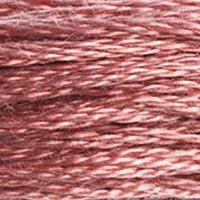
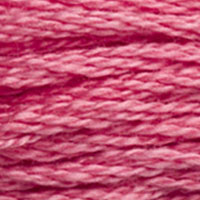
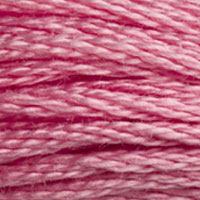
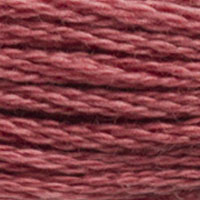
There's a specific pink that appears in Victorian botanical prints, in antique quilt blocks, in faded album covers from the 1970s — a pink that's been softened by time, that has dustiness built into its character. DMC 223 Light Shell Pink is that pink. It sits at the warm end of the muted pink spectrum, with enough gray in its composition to look sophisticated rather than girlish, and enough warmth to feel welcoming rather than clinical. It's been a consistent favorite in cross-stitch design for decades, and the reasons for that are worth understanding.
The Shell Pink Family
DMC's shell pink series runs across several closely related values: DMC 221 (Very Dark Shell Pink) at the deep end, DMC 222 (Dark Shell Pink), DMC 223 (Light Shell Pink) in the mid-range, DMC 224 (Very Light Shell Pink) as the lighter step, and DMC 225 (Ultra Very Light Shell Pink) as the near-white extreme. This five-step progression is one of the most useful shading sequences in the entire DMC line — each step is distinct enough to add visual depth while remaining harmonious with the others.
Within this family, DMC 223 is the one that gets used most broadly outside the shading sequence itself. It's versatile enough to stand alone as a medium-value muted pink without needing to be read as part of a graduated set. That standalone usefulness is what makes it such a frequent presence in stash collections — stitchers buy it for one project and find themselves reaching for it again and again.
Historical and Vintage Design Connections
The muted, dusty character of DMC 223 connects it directly to a long tradition in textile arts. Victorian samplers, Hardanger work, and many historical embroidery patterns used similarly toned pinks — colors that had often faded from more vibrant original hues but were later deliberately reproduced as the aesthetic became associated with heritage and craft tradition. When modern pattern designers want to evoke that feeling of age and handwork, DMC 223 (alongside its shell pink companions) tends to appear in the palette.
This is also why DMC 223 works so well in reproduction samplers and antique-inspired designs. The dustiness of the hue reads as authentic in context — it looks like it could have been colored with natural dyes or have faded gracefully from something slightly richer. On antique white or ecru linen, the effect is especially convincing.
Contemporary Uses and Palette Building
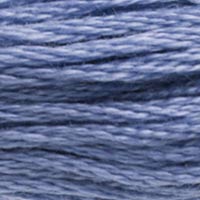
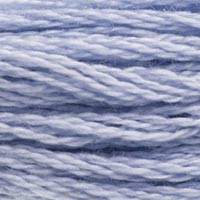
Outside vintage aesthetics, DMC 223 turns up in contemporary botanical designs where the goal is naturalistic rather than saturated color. Real flower petals — roses, peonies, hellebores — often show this kind of dusted-down pink in their mid-tones, and a well-rendered botanical flower relies on getting those muted mid-values right. Pair DMC 223 with DMC 3726 (Dark Antique Mauve) for the shadow areas and DMC 224 (Very Light Shell Pink) for highlights, adding DMC 3727 (Light Antique Mauve) as an alternative if you want slightly cooler shadows.
For wildlife and nature designs, DMC 223 earns its place in bird plumage (flamingos, roseate spoonbills), shell textures (hence the name), and the delicate flushed coloring of some rabbit and hedgehog breeds. Portrait work occasionally calls for it in skin tone shading — particularly in lighter complexions where the shadows have a rosy warmth without going full red.
Anchor 895 is an exact match for DMC 223 — one of the more reliable conversions in the shell pink family. If you're working with Anchor threads and need this specific dusty-warm pink, Anchor 895 should drop in without adjustment. Madeira 0812 and Cosmo 653 are close but not exact; both sit in the correct range but may read as slightly more or less saturated depending on lighting.
Sullivans 45045 is listed as close. If you're substituting in a piece where DMC 223 is part of a shell pink shading sequence, be particularly careful with close-match substitutions — the relationship between adjacent values in the sequence matters as much as the individual hue. A substitute that shifts the mid-tone even slightly can disrupt the smoothness of the gradient.
If you're genuinely stuck and need to build the color from stash, DMC 3722 (Medium Shell Pink) is a close neighbor with slightly more warmth, and DMC 3354 (Light Dusty Rose) sits in a similar territory with a slightly cooler cast. Neither is a precise replacement, but both can work in less color-critical applications. The dusty quality of DMC 223 is difficult to approximate with saturated pinks — diluting a brighter pink by blending with a neutral strand sometimes helps but rarely achieves the exact character of a purpose-made muted thread.
Reference quality
How We Validate This Color Record
Use this page as a reference card for DMC 223: the structured data, quick conversions, and long-form copy are all tied back to the same stored color record.
- Methodology
- This page renders DMC 223, its hex value, and every brand equivalent from the site's source-of-truth color record, then checks long-form body copy against those same stored fields.
- Verification status
- Source-field checked. The page content is audited against the stored DMC number, brand equivalents, and match-quality labels before publishing.
- Last reviewed
- 2026-04-20
- Approximation warning
- Screen hex values, thread photos, and cross-brand conversions are reference aids. Dye lots, thread sheen, and fabric color can still shift the result in hand.
Decision guide
When to use the DMC 223 reference page
This page should help you decide faster between palette planning, brand substitution, and shade comparison without turning the color record into a thin lookup page.
Best for
- + Palette planning when you want the stored DMC 223 Light Shell Pink record, hex value #CC847C, and linked brand equivalents in one place.
- + Checking the quickest cross-brand shortlist before you buy floss, compare stash substitutes, or route into a more specific conversion page.
- + Finding nearby shades in the pinks family before you commit to accents, shading, or background blends.
Watch for
- ! Screen previews are only reference aids. Light Shell Pink can shift on real fabric because thread sheen, stitch coverage, and room lighting change how the color reads.
- ! A stored equivalent is still a shortlist, not a guarantee that two brands will disappear into each other in the same stitched motif.
- ! Older charts, discontinued kit floss, and dye-lot variation can all introduce small but visible differences that the page cannot detect for you.
Before you commit
- Confirm the role of DMC 223 Light Shell Pink: decide whether you need an exact hero shade, a forgiving background, or a rough stash substitute.
- Compare on project fabric: view the skein or stitched sample on the same fabric count and color you will actually use.
- Use the linked conversion pages next: open the brand-specific pages when you need match-quality caveats before substituting away from the DMC reference.
DMC 223 FAQ
These questions appear on the page so the FAQ schema stays aligned with what visitors can actually read.
What is the Anchor equivalent of DMC 223?+
The closest Anchor equivalent to DMC 223 (Light Shell Pink) is Anchor 895. This is an exact match.
What color is DMC 223?+
DMC 223 is called "Light Shell Pink" and has a hex color value of #CC847C. It belongs to the pinks color family.
What is the Madeira equivalent of DMC 223?+
The closest Madeira equivalent to DMC 223 (Light Shell Pink) is Madeira 0812. This is a close match.
How DMC 223 Looks on Fabric
The same thread appears different depending on your fabric. Always test on your project fabric.
White Aida
Cream / Ecru
Black Aida
Pairs Well With
DMC colors commonly used alongside 223 Light Shell Pink.
Suggested Palette
Shading Companions
Detailed Conversions
Where to Buy DMC 223
This section contains affiliate links. We may earn a small commission at no cost to you.
Related Guides
Free Printable Thread Conversion Chart
Pick a brand, enter your email, and we'll send you a printable chart mapping all 552 DMC colors to that brand's equivalents. Zero spam, one chart.
Thanks! Here's your free chart:
Download Your ChartOpens in a new tab. Use your browser's Print → Save as PDF.
No spam. Your email is stored securely and never shared.