
Quick Conversion Table
| Brand | Equivalent | Match |
|---|---|---|
| Anchor | 175 | close |
| Madeira | 1715 | close |
| Cosmo ⚠ | 152 | close |
| Sullivans | 45475 | close |
| J&P Coats | 7051 | close |
Wedgwood Blue by Another Name
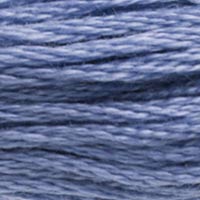
Josiah Wedgwood changed the world's idea of what pottery could look like when he developed his jasperware in the 1770s. Those iconic white-on-blue cameos — classical figures, mythological scenes, geometric borders — became one of the most recognizable design aesthetics in history. And the blue he chose wasn't a bright cobalt or a deep navy but a soft, grey-touched blue that somehow managed to look both ancient and modern. DMC 160, Medium Gray Blue, is essentially Wedgwood's blue realized in embroidery floss.
What makes this shade so distinctly "Wedgwood" is the balance between blue and grey. There's enough blue to be unambiguously blue — this isn't a grey pretending — but enough grey to strip away the friendliness that pure medium blue usually carries. The result is a color with composure. It doesn't excite; it composes. It doesn't pop; it grounds. These are qualities that matter enormously in cross-stitch, where a single wrong shade can make a carefully planned palette feel unbalanced.
The Middle Child That Holds Everything Together
As the middle value in the grey-blue family (DMC 159, 160, 161), thread 160 does the heavy structural lifting. The lightest value (159) works highlights and pale backgrounds. The darkest (161) anchors shadows and outlines. But 160 is where the main body of any grey-blue element lives — the mid-tone that occupies the most real estate and defines the overall impression of the color in the finished piece.
In practice, this means 160 is the grey-blue thread you'll use the most of. A stone castle wall will need 161 for the deepest mortar lines and recesses, 159 for the highlighted edges of individual blocks, and 160 for everything else — the main face of each stone, the overall impression of grey-blue masonry that the viewer registers from across the room. Budget your thread purchases accordingly; you'll need more 160 than the other two combined in most designs.
Fabric choice matters more with grey-blues than with saturated colors. On white Aida, 160 reads as a definite medium blue with grey tendencies — pleasant and clean. On cream or ecru, the warm fabric pushes the grey forward, and 160 reads as a sophisticated blue-grey that could pass for aged linen in the right light. On natural linen, you get the most authentic Wedgwood effect: the linen's texture combines with the thread's grey-blue to create something that genuinely resembles old English pottery.
Practical Applications: From Sampler to Seascape
Period-appropriate samplers — particularly those inspired by 18th and early 19th century English originals — frequently call for a blue in this exact range. Historical samplers rarely used the bright, pure blues that modern stitchers default to; the blues available from natural dyes (woad, indigo) at common concentrations produced exactly this kind of greyed, sophisticated blue. Using 160 in a reproduction sampler immediately lends the piece an authentic quality that bright blues would undermine.
Seascape and coastal designs benefit from 160 in overcast conditions — the color of the North Sea under cloud cover, the Atlantic on a grey autumn afternoon, harbor water reflecting a slate sky. These aren't the turquoise Caribbean blues that tropical scenes demand; they're the blues of northern waters, and they pair with DMC 3768 (Dark Gray Green) for kelp and rocks, DMC 647 (Medium Beaver Grey) for driftwood, and Blanc for foam and breaking waves.
Fashion and portrait cross-stitch — yes, it exists, and it's having a moment — uses 160 for denim, chambray, and blue-grey fabrics in clothing. If you're stitching a portrait where the subject wears a denim shirt or a blue-grey blazer, 160 gives you the body of the fabric, with 161 for folds and shadows and 159 for highlighted areas where the fabric catches light. The grey component is essential here; pure blue wouldn't read as fabric but as color.
Preserving the Wedgwood Balance
Anchor 175 is the substitute to try first. It maintains the crucial grey-blue balance that defines this color, and in side-by-side testing, it holds up well against DMC 160 across different fabric types. The slightly different thread twist doesn't alter the color perception at this medium value.
Madeira 1715 performs solidly in this slot. Its marginally smoother finish can actually enhance the refined quality that makes grey-blues appealing in the first place — there's something about a polished thread surface that suits this particular shade. Cosmo 152 captures the general idea. Sullivans 45475 is adequate for designs where 160 appears in supporting roles.
The common substitution error is grabbing a standard medium blue — DMC 799 (Medium Delft Blue) or DMC 809 (Delft Blue) — and assuming it will work because the value is similar. It won't. Those threads read as blue that happens to be medium. DMC 160 reads as grey-blue that happens to be medium. The grey is structural, not incidental, and removing it changes the entire aesthetic from restrained elegance to cheerful brightness.
If working the 159-160-161 family, substitute as a group. A slightly warmer or cooler 160 won't matter if your 159 and 161 shift with it, maintaining the internal family relationships. What looks wrong is a cool, steely 160 sandwiched between warm versions of its siblings, or vice versa.
Reference quality
How We Validate This Color Record
Use this page as a reference card for DMC 160: the structured data, quick conversions, and long-form copy are all tied back to the same stored color record.
- Methodology
- This page renders DMC 160, its hex value, and every brand equivalent from the site's source-of-truth color record, then checks long-form body copy against those same stored fields.
- Verification status
- Source-field checked. The page content is audited against the stored DMC number, brand equivalents, and match-quality labels before publishing.
- Last reviewed
- 2026-04-20
- Approximation warning
- Screen hex values, thread photos, and cross-brand conversions are reference aids. Dye lots, thread sheen, and fabric color can still shift the result in hand.
Decision guide
When to use the DMC 160 reference page
This page should help you decide faster between palette planning, brand substitution, and shade comparison without turning the color record into a thin lookup page.
Best for
- + Palette planning when you want the stored DMC 160 Medium Gray Blue record, hex value #999FB7, and linked brand equivalents in one place.
- + Checking the quickest cross-brand shortlist before you buy floss, compare stash substitutes, or route into a more specific conversion page.
- + Finding nearby shades in the blues family before you commit to accents, shading, or background blends.
Watch for
- ! Screen previews are only reference aids. Medium Gray Blue can shift on real fabric because thread sheen, stitch coverage, and room lighting change how the color reads.
- ! A stored equivalent is still a shortlist, not a guarantee that two brands will disappear into each other in the same stitched motif.
- ! Older charts, discontinued kit floss, and dye-lot variation can all introduce small but visible differences that the page cannot detect for you.
Before you commit
- Confirm the role of DMC 160 Medium Gray Blue: decide whether you need an exact hero shade, a forgiving background, or a rough stash substitute.
- Compare on project fabric: view the skein or stitched sample on the same fabric count and color you will actually use.
- Use the linked conversion pages next: open the brand-specific pages when you need match-quality caveats before substituting away from the DMC reference.
DMC 160 FAQ
These questions appear on the page so the FAQ schema stays aligned with what visitors can actually read.
What is the Anchor equivalent of DMC 160?+
The closest Anchor equivalent to DMC 160 (Medium Gray Blue) is Anchor 175. This is a close match.
What color is DMC 160?+
DMC 160 is called "Medium Gray Blue" and has a hex color value of #999FB7. It belongs to the blues color family.
What is the Madeira equivalent of DMC 160?+
The closest Madeira equivalent to DMC 160 (Medium Gray Blue) is Madeira 1715. This is a close match.
How DMC 160 Looks on Fabric
The same thread appears different depending on your fabric. Always test on your project fabric.
White Aida
Cream / Ecru
Black Aida
Pairs Well With
DMC colors commonly used alongside 160 Medium Gray Blue.
Suggested Palette
Shading Companions
Detailed Conversions
Where to Buy DMC 160
This section contains affiliate links. We may earn a small commission at no cost to you.
Related Guides
Free Printable Thread Conversion Chart
Pick a brand, enter your email, and we'll send you a printable chart mapping all 552 DMC colors to that brand's equivalents. Zero spam, one chart.
Thanks! Here's your free chart:
Download Your ChartOpens in a new tab. Use your browser's Print → Save as PDF.
No spam. Your email is stored securely and never shared.