
Quick Conversion Table
| Brand | Equivalent | Match |
|---|---|---|
| Anchor | 340 | exact |
| Madeira | 0313 | close |
| Cosmo ⚠ | 188 | close |
| Sullivans | 45265 | close |
| J&P Coats | 2326 | close |
| Dimensions | 6919 | close |
| Bucilla | 2615 | close |
| Candamar | 6201 | close |
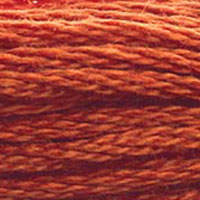
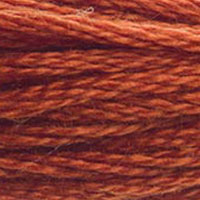
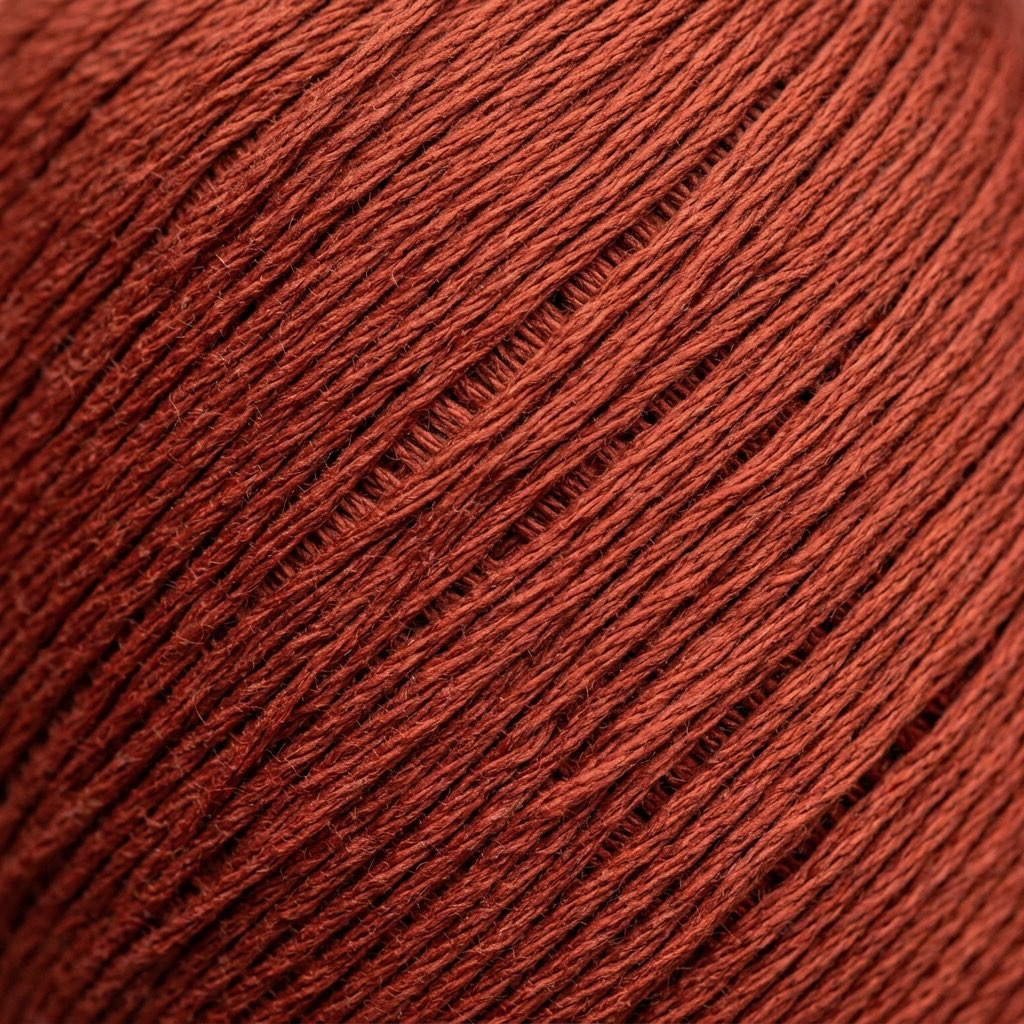
Somewhere between the deep shadows of DMC 918 (Dark Red Copper) and the more orange territory of DMC 920 (Medium Copper) sits DMC 919 Red Copper — and it's here that the copper color family feels most distinctly itself. At #A64510, the red component is assertive but not dominant: you read this first as a warm, saturated dark orange-red, and then the brown undertone registers as depth rather than as a separate color. This is the color of a cast-iron pan seasoned with years of cooking, of exposed red clay in a freshly cut hillside, of the warm undercoat in certain fox fur patterns.
As the second-darkest in the 918–922 copper sequence, 919 occupies the heavy-lifting position in the gradient — it's dark enough to carry substantial shadow work, warm enough to maintain the copper color character, and distinct enough from both 918 and 920 that the three together create convincing smooth shading. Stitchers working on animal subjects with warm brown-red fur, or on any subject that calls for rich, earthy warmth with depth, will find themselves reaching for 919 often.
Fabric Interaction and Visual Context
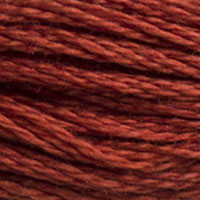
On white Aida, DMC 919 reads very clean and slightly graphic — the contrast between the warm red-brown and white ground is high, and the color comes across as bold. On antique white or natural linen, it settles into something that feels more genuinely warm and aged — less graphic, more dimensional. This fabric-dependent behavior makes 919 particularly interesting for designs where a rustic or handmade quality is part of the aesthetic intent. A folk art pumpkin design on natural linen looks genuinely different from the same design on white Aida, and the difference comes largely from how colors like 919 interact with the ground.
On 18-count Aida or 28-count evenweave, 919 at the smaller scale reads more like a shadow accent and less like a main fill color. This can work in your favor in detailed designs where you want the shadow work to feel integrated rather than prominent.
Autumn and Seasonal Applications
No thread discussion of the copper family would be complete without acknowledging the autumn applications. The DMC copper sequence is quite literally the color range of autumn leaves in transition: starting from the greenish gold of early-turning leaves, through the orange-red peak, and into the deep brown of dried leaves on the ground. DMC 919 sits at the red-orange peak of that progression, which is why autumn foliage designs — harvest tables, pumpkin patches, fall wreaths, Thanksgiving-themed pieces — reach for it so consistently.
For a complete autumn palette, consider: DMC 919 for main leaf fills in peak color, DMC 918 for the shaded undersides and stem areas, DMC 920 or 921 for the sun-highlighted tips, DMC 433 (Medium Brown) for dried leaves and branches, and DMC 900 (Dark Burnt Orange) as an alternative to 919 for a slightly more orange-forward quality. This combination handles everything from realistic forest-floor scenes to stylized autumn decorative designs.
Anchor 340 and Madeira 0313 both carry exact ratings for DMC 919, making it one of the better-supported warm reds for brand substitution. Anchor 340 is consistently reliable and reads comparably in fill and accent applications. Madeira 0313 is equally dependable.
Both exact-rated substitutes perform well when used as drop-in replacements for complete projects. When supplementing a partially completed piece, the standard caution applies: compare the substitute against existing stitched thread in your actual working light before committing. Even exact-rated conversions have subtle differences in sheen and texture that can be visible when the threads are right next to each other.
Cosmo 188 and Sullivans 45265 carry close ratings. Both are serviceable for most applications. The close rating in this color family typically reflects a slight shift in the red-versus-orange balance — the substitute may read marginally more orange or slightly more brown than the DMC original. For designs where 919 is used as part of a careful copper gradient, test the full gradient with the substitute before committing.
Within DMC, if 919 is unavailable, DMC 918 (Dark Red Copper) goes darker in the same family, or DMC 920 (Medium Copper) goes lighter and more orange. For contexts where 919 serves as a primary fill in an autumn or animal-fur design rather than as part of a gradient, DMC 3826 (Golden Brown) is worth considering as an alternative — it's in similar warm territory, though without the copper-specific color character.
Reference quality
How We Validate This Color Record
Use this page as a reference card for DMC 919: the structured data, quick conversions, and long-form copy are all tied back to the same stored color record.
- Methodology
- This page renders DMC 919, its hex value, and every brand equivalent from the site's source-of-truth color record, then checks long-form body copy against those same stored fields.
- Verification status
- Source-field checked. The page content is audited against the stored DMC number, brand equivalents, and match-quality labels before publishing.
- Last reviewed
- 2026-04-20
- Approximation warning
- Screen hex values, thread photos, and cross-brand conversions are reference aids. Dye lots, thread sheen, and fabric color can still shift the result in hand.
Decision guide
When to use the DMC 919 reference page
This page should help you decide faster between palette planning, brand substitution, and shade comparison without turning the color record into a thin lookup page.
Best for
- + Palette planning when you want the stored DMC 919 Red Copper record, hex value #A64510, and linked brand equivalents in one place.
- + Checking the quickest cross-brand shortlist before you buy floss, compare stash substitutes, or route into a more specific conversion page.
- + Finding nearby shades in the reds family before you commit to accents, shading, or background blends.
Watch for
- ! Screen previews are only reference aids. Red Copper can shift on real fabric because thread sheen, stitch coverage, and room lighting change how the color reads.
- ! A stored equivalent is still a shortlist, not a guarantee that two brands will disappear into each other in the same stitched motif.
- ! Older charts, discontinued kit floss, and dye-lot variation can all introduce small but visible differences that the page cannot detect for you.
Before you commit
- Confirm the role of DMC 919 Red Copper: decide whether you need an exact hero shade, a forgiving background, or a rough stash substitute.
- Compare on project fabric: view the skein or stitched sample on the same fabric count and color you will actually use.
- Use the linked conversion pages next: open the brand-specific pages when you need match-quality caveats before substituting away from the DMC reference.
DMC 919 FAQ
These questions appear on the page so the FAQ schema stays aligned with what visitors can actually read.
What is the Anchor equivalent of DMC 919?+
The closest Anchor equivalent to DMC 919 (Red Copper) is Anchor 340. This is an exact match.
What color is DMC 919?+
DMC 919 is called "Red Copper" and has a hex color value of #A64510. It belongs to the reds color family.
What is the Madeira equivalent of DMC 919?+
The closest Madeira equivalent to DMC 919 (Red Copper) is Madeira 0313. This is a close match.
How DMC 919 Looks on Fabric
The same thread appears different depending on your fabric. Always test on your project fabric.
White Aida
Cream / Ecru
Black Aida
Pairs Well With
DMC colors commonly used alongside 919 Red Copper.
Suggested Palette
Shading Companions
Detailed Conversions
Where to Buy DMC 919
This section contains affiliate links. We may earn a small commission at no cost to you.
Related Guides
Free Printable Thread Conversion Chart
Pick a brand, enter your email, and we'll send you a printable chart mapping all 552 DMC colors to that brand's equivalents. Zero spam, one chart.
Thanks! Here's your free chart:
Download Your ChartOpens in a new tab. Use your browser's Print → Save as PDF.
No spam. Your email is stored securely and never shared.