
Quick Conversion Table
| Brand | Equivalent | Match |
|---|---|---|
| Anchor | 1049 | close |
| Madeira | 2306 | close |
| Cosmo ⚠ | 2129 | close |
| Sullivans | 45049 | close |
| J&P Coats | 5000 | close |
| Dimensions | 6109 | close |
| Bucilla | 6109 | close |
Warm Enough to Toast Your Hands By
Some threads you buy because a pattern tells you to. DMC 301 is one you start reaching for because you've learned what it can do. Medium Mahogany occupies that sweet spot in the brown spectrum where warmth and depth coexist in perfect balance — rich enough to carry weight in a design, warm enough to radiate energy, saturated enough to hold its own against bolder colors. It's the burnt sienna of the embroidery world, and once you understand its character, you'll find uses for it everywhere.
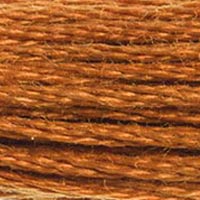
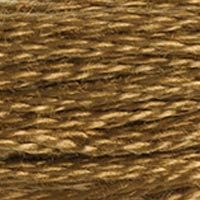
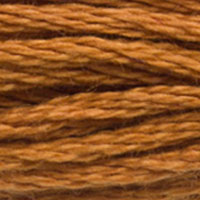
The color itself lands somewhere between a polished copper penny and a bar of dark milk chocolate. There's a definite orange-red fire running through it — this is a brown with opinions, not a wallflower — but it never tips into actual orange. Hold it next to DMC 920 (Medium Copper) and you can see the difference clearly: 920 is a red masquerading as brown, while 301 is a brown that happens to have a warm soul. That distinction matters when you're building palettes, because 301 stays grounded. It belongs to the earth, not the sunset.
In the mahogany family, 301 serves as the crucial middle voice between the near-black depth of DMC 300 (Very Dark Mahogany) and the bright, pumpkin-adjacent warmth of DMC 3776 (Light Mahogany). It's the value where the mahogany character is most visible — dark enough to show the red-brown richness, light enough that the red undertone actually reads to the eye rather than being swallowed by darkness. If a pattern uses only one mahogany thread, it's often 301, because this is where the family's personality lives.
The Coffee Connection
Here's a comparison that might help you understand 301's exact character: think about coffee. Not the drink in your mug — think about freshly roasted beans at different roast levels. A light roast is DMC 3826 (Golden Brown) — all warmth and brightness, the bean's origin showing clearly. A medium roast is 301 — deeper, richer, the sugars caramelized, warmth still present but now with complexity and body. A dark roast is DMC 300 — deep, intense, the warmth still there but buried under layers of depth. An espresso roast is DMC 938 (Ultra Dark Coffee Brown) — almost black, warmth mostly gone, just intensity.
This isn't just a pretty analogy. The coffee comparison actually helps when you're selecting threads for kitchen samplers, coffee-themed designs, and food illustration pieces. DMC 301 is literally the color of a well-roasted medium-dark bean. If you're stitching a coffee grinder, an espresso machine, a bag of beans spilling across a table, 301 is your primary body color for the beans themselves, with 300 for shadows and 3776 for the highlights where light catches the oily surface.
Hair Color Matching for Portrait Work
Portrait cross-stitch is having a moment — pixel-art portraits, traditional portrait samplers, even photo-realistic thread paintings are filling FlossTube channels and Instagram feeds. And one of the most common challenges stitchers face is getting hair color right. DMC 301 is the answer to a question every portrait stitcher eventually asks: what color is auburn hair in shadow?
Auburn and chestnut hair colors live in 301's territory. The warm red-brown reads as natural hair in a way that neutral browns don't — human hair, especially in the red-brown family, has the same kind of internal warmth that 301 carries. For a subject with auburn hair, try building the palette around 301 as your primary mid-tone, with DMC 300 for the deepest shadow areas (under the hairline, between sections where hair overlaps), DMC 3776 for the brighter sections where light hits, and DMC 3856 (Ultra Very Light Mahogany) for highlight strands catching direct sunlight.
The blended needle technique is particularly effective for hair: one strand of 301 paired with one strand of 3776 creates a transition value that's perfect for the areas between shadow and highlight. Hair isn't smooth in reality — individual strands vary in color, light plays across the surface unevenly — and the subtle heathering that blended needle produces mimics that natural variation beautifully. If you've been struggling to make hair look like hair rather than a solid-color helmet, this technique with the mahogany family is a great place to start.
Matching Mahogany's Middle Voice
DMC 301 sits at the heart of the mahogany range, which means your substitute needs to balance warmth and depth simultaneously. Go too light and you lose the richness; go too warm and you cross into copper-orange territory; go too cool and you've got an ordinary brown that's lost the mahogany fire.
Anchor 1049 is listed as close and works well for most applications. It runs just slightly cooler than the DMC original in some dye lots — noticeable if you hold them side by side under natural light, but unlikely to cause problems in a multi-thread palette where surrounding colors contextualize the shade. Madeira 2306 is similarly close and maintains the warm character nicely. Madeira's version sometimes appears a tiny bit more saturated, which if anything enhances the mahogany quality.
Cosmo 2129 captures the general territory, though Cosmo's browns can sometimes read slightly more matte than DMC's. At this particular color — warm, rich, meant to glow — the thread's surface finish matters. A matte version of 301 loses some of the warmth that makes it special. If your Cosmo candidate looks flat, try railroading more carefully to maximize light reflection off the thread surface.
Within DMC, the most common confusion is between 301 and DMC 975 (Dark Golden Brown). They're neighbors on the warm-brown spectrum, but 975 leans golden-amber while 301 leans red-mahogany. Swapping one for the other changes the entire character of your warm browns — from autumn-gold to antique-furniture. Both are beautiful, but they're not interchangeable. If 301 is unavailable, DMC 400 (Dark Mahogany) is a better family substitute, sitting between 300 and 301 in value while maintaining the red-brown character.
Reference quality
How We Validate This Color Record
Use this page as a reference card for DMC 301: the structured data, quick conversions, and long-form copy are all tied back to the same stored color record.
- Methodology
- This page renders DMC 301, its hex value, and every brand equivalent from the site's source-of-truth color record, then checks long-form body copy against those same stored fields.
- Verification status
- Source-field checked. The page content is audited against the stored DMC number, brand equivalents, and match-quality labels before publishing.
- Last reviewed
- 2026-04-20
- Approximation warning
- Screen hex values, thread photos, and cross-brand conversions are reference aids. Dye lots, thread sheen, and fabric color can still shift the result in hand.
Decision guide
When to use the DMC 301 reference page
This page should help you decide faster between palette planning, brand substitution, and shade comparison without turning the color record into a thin lookup page.
Best for
- + Palette planning when you want the stored DMC 301 Medium Mahogany record, hex value #B35F2B, and linked brand equivalents in one place.
- + Checking the quickest cross-brand shortlist before you buy floss, compare stash substitutes, or route into a more specific conversion page.
- + Finding nearby shades in the browns family before you commit to accents, shading, or background blends.
Watch for
- ! Screen previews are only reference aids. Medium Mahogany can shift on real fabric because thread sheen, stitch coverage, and room lighting change how the color reads.
- ! A stored equivalent is still a shortlist, not a guarantee that two brands will disappear into each other in the same stitched motif.
- ! Older charts, discontinued kit floss, and dye-lot variation can all introduce small but visible differences that the page cannot detect for you.
Before you commit
- Confirm the role of DMC 301 Medium Mahogany: decide whether you need an exact hero shade, a forgiving background, or a rough stash substitute.
- Compare on project fabric: view the skein or stitched sample on the same fabric count and color you will actually use.
- Use the linked conversion pages next: open the brand-specific pages when you need match-quality caveats before substituting away from the DMC reference.
DMC 301 FAQ
These questions appear on the page so the FAQ schema stays aligned with what visitors can actually read.
What is the Anchor equivalent of DMC 301?+
The closest Anchor equivalent to DMC 301 (Medium Mahogany) is Anchor 1049. This is a close match.
What color is DMC 301?+
DMC 301 is called "Medium Mahogany" and has a hex color value of #B35F2B. It belongs to the browns color family.
What is the Madeira equivalent of DMC 301?+
The closest Madeira equivalent to DMC 301 (Medium Mahogany) is Madeira 2306. This is a close match.
Equestrian and Western Designs
DMC 301 is a workhorse — pun intended — in equestrian cross-stitch. Bay horses, which are the most commonly stitched equine coat color, use 301 extensively for the body color. A bay's coat is essentially mahogany with black points (mane, tail, lower legs), and 301 nails the warm, red-brown richness of a well-groomed bay in summer coat. Build the full coat with 301 as your primary, DMC 300 for muscular shadow and contouring, DMC 3776 for the sunlit shoulder and hip highlights, and DMC 310 (Black) for the points.
Western and ranch-themed samplers lean heavily on 301 for leather tack — saddles, chaps, lariats, and boot tops all live in mahogany territory. The warmth of the thread suggests well-oiled, well-used leather without the coldness that neutral browns would introduce. Pair 301 with DMC 167 (Very Dark Yellow Beige) for lighter leather elements and DMC 3031 (Very Dark Mocha Brown) for worn, aged leather that's darkened with years of use.
Autumn Foliage and Leaf Work
When stitchers talk about fall leaf palettes, they often focus on the oranges and reds and forget that many autumn leaves spend most of their time as red-browns. The sugar maple in late October, the oak leaf after the first frost, the Virginia creeper after peak color — they're all in 301's territory. This is the color of the season's turning point, when bright fall color begins settling into the rich, warm browns of late autumn. Use 301 alongside DMC 921 (Copper), DMC 975 (Dark Golden Brown), and DMC 3826 (Golden Brown) for a leaf palette that captures the full arc of autumn, from bright turning color through deep November warmth.
How DMC 301 Looks on Fabric
The same thread appears different depending on your fabric. Always test on your project fabric.
White Aida
Cream / Ecru
Black Aida
Pairs Well With
DMC colors commonly used alongside 301 Medium Mahogany.
Suggested Palette

Shading Companions
Detailed Conversions
Where to Buy DMC 301
This section contains affiliate links. We may earn a small commission at no cost to you.
Related Guides
Free Printable Thread Conversion Chart
Pick a brand, enter your email, and we'll send you a printable chart mapping all 552 DMC colors to that brand's equivalents. Zero spam, one chart.
Thanks! Here's your free chart:
Download Your ChartOpens in a new tab. Use your browser's Print → Save as PDF.
No spam. Your email is stored securely and never shared.