
Quick Conversion Table
| Brand | Equivalent | Match |
|---|---|---|
| Anchor | 209 | exact |
| Madeira | 1213 | close |
| Cosmo ⚠ | 336 | close |
| Sullivans | 45260 | close |
| J&P Coats | 6226 | close |
| Dimensions | 6055 | close |
| Bucilla | 912 | close |
| Candamar | 6055 | close |
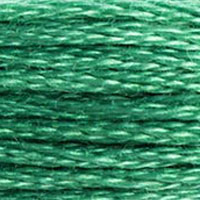
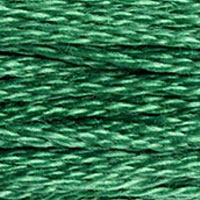
Step into a forest after rain and find a patch of ferns catching afternoon light — that's the color of DMC 912 Light Emerald Green. It's bright without being neon, saturated without being heavy, and carries the particular quality of green that suggests life in active growth: not shadow, not shade, but the sun-touched surface of healthy green vegetation. As the lightest of the four-step Emerald Green family, 912 handles the highlight and top-lit surface work that makes shaded foliage feel three-dimensional.
At #1B9D6B, this reads as a classic bright medium-green with excellent saturation. It's lighter than DMC 911 (Medium Emerald Green) by a meaningful step, creating a clear visual distinction that makes it effective as a highlight. In designs where only two emerald shades are used — a common simplification in smaller or faster projects — 912 paired with 909 or 910 provides enough contrast to create convincing foliage with a fraction of the thread range that full shading would require.
Highlight Color Behavior on Different Fabrics
Light, bright greens like 912 can behave quite differently depending on the fabric color and count they're stitched on. On white 14-count Aida, 912 reads as vivid and summery — the high-saturation green against white creates maximum chromatic contrast, and the color looks clean and energetic. This is great for designs that want a bright, modern feel.
On natural linen or antique white evenweave, the same thread picks up a slight warmth and reads as more naturalistic — closer to real vegetation, less graphic. Many stitchers working on realistic botanical subjects specifically choose linen over white Aida for this reason: the warm ground tone softens the contrast and makes bright colors like 912 read as sunlit rather than artificial.
On 18-count or 28-count over-two, the thread coverage is excellent. 912 is saturated enough that even fine fabric counts look solid without needing additional strands. For miniature pieces or ornaments where 28-count evenweave is common, 912 delivers clean, visible coverage.
Where Light Emerald Earns Its Place
The most common use for 912 is as the lightest value in a foliage shading sequence, but it also works effectively as a standalone color in simpler designs. Spring and garden-themed pieces often use 912 as their primary green, relying on its freshness rather than on a complex gradient. Easter designs, spring florals, and children's nature-themed embroidery frequently reach for 912 as their main leaf green because it reads as optimistic and alive.
Embroidered representations of specific plants where bright green is accurate — shamrocks, fresh herbs like parsley or basil, grass in a sunny meadow — use 912 as a primary fill rather than just a highlight. Paired with DMC 472 (Ultra Light Avocado Green) for maximum highlights and DMC 910 for shadowing, a three-stop light-to-dark scheme using 912 as the dominant fill color convincingly renders fresh summer foliage.
Stitchers working on food-themed embroidery — a popular genre that encompasses everything from vegetables to cocktails — find 912 useful for fresh herbs, edible greens, cucumber slices, and similar subjects where a bright, food-safe green is needed that doesn't tip into lime or neon territory. The color sits right in the sweet spot of appetizing, natural-looking green.
Anchor 209 carries an exact rating for DMC 912 and is a reliable substitute. It's the most commonly referenced alternative and performs well in both fill and accent roles. Note that Anchor's Emerald Green numbering system (230, 229, 205, 209) doesn't follow an obvious numerical sequence corresponding to the DMC family, so it's worth keeping the conversion list handy rather than guessing.
Madeira 1213 carries a close rather than exact rating — a slightly unusual situation since many nearby shades in the emerald range have exact Madeira matches. The difference is subtle but worth noting if you're building a complete Madeira-based gradient: you may need to test the 912 step to ensure the value step reads correctly. Cosmo 336 and Sullivans 45260 also carry close ratings with the same caveat.
The practical implication of the close-only ratings for Madeira and Cosmo is that DMC 912 is somewhat harder to substitute with confidence than some of its darker siblings. For large fill areas, testing is more important here than it would be for colors where exact matches exist in all brands.
Within DMC, if 912 is unavailable, DMC 913 (Medium Nile Green) offers a related but distinct alternative — it's similar in lightness but introduces a slightly softer, more muted quality. DMC 704 (Bright Chartreuse) covers similar brightness but with more yellow-green warmth. Neither is a precise replacement, but both maintain the "bright, fresh green" quality that 912 typically provides in designs.
Reference quality
How We Validate This Color Record
Use this page as a reference card for DMC 912: the structured data, quick conversions, and long-form copy are all tied back to the same stored color record.
- Methodology
- This page renders DMC 912, its hex value, and every brand equivalent from the site's source-of-truth color record, then checks long-form body copy against those same stored fields.
- Verification status
- Source-field checked. The page content is audited against the stored DMC number, brand equivalents, and match-quality labels before publishing.
- Last reviewed
- 2026-04-20
- Approximation warning
- Screen hex values, thread photos, and cross-brand conversions are reference aids. Dye lots, thread sheen, and fabric color can still shift the result in hand.
Decision guide
When to use the DMC 912 reference page
This page should help you decide faster between palette planning, brand substitution, and shade comparison without turning the color record into a thin lookup page.
Best for
- + Palette planning when you want the stored DMC 912 Light Emerald Green record, hex value #1B9D6B, and linked brand equivalents in one place.
- + Checking the quickest cross-brand shortlist before you buy floss, compare stash substitutes, or route into a more specific conversion page.
- + Finding nearby shades in the greens family before you commit to accents, shading, or background blends.
Watch for
- ! Screen previews are only reference aids. Light Emerald Green can shift on real fabric because thread sheen, stitch coverage, and room lighting change how the color reads.
- ! A stored equivalent is still a shortlist, not a guarantee that two brands will disappear into each other in the same stitched motif.
- ! Older charts, discontinued kit floss, and dye-lot variation can all introduce small but visible differences that the page cannot detect for you.
Before you commit
- Confirm the role of DMC 912 Light Emerald Green: decide whether you need an exact hero shade, a forgiving background, or a rough stash substitute.
- Compare on project fabric: view the skein or stitched sample on the same fabric count and color you will actually use.
- Use the linked conversion pages next: open the brand-specific pages when you need match-quality caveats before substituting away from the DMC reference.
DMC 912 FAQ
These questions appear on the page so the FAQ schema stays aligned with what visitors can actually read.
What is the Anchor equivalent of DMC 912?+
The closest Anchor equivalent to DMC 912 (Light Emerald Green) is Anchor 209. This is an exact match.
What color is DMC 912?+
DMC 912 is called "Light Emerald Green" and has a hex color value of #1B9D6B. It belongs to the greens color family.
What is the Madeira equivalent of DMC 912?+
The closest Madeira equivalent to DMC 912 (Light Emerald Green) is Madeira 1213. This is a close match.
How DMC 912 Looks on Fabric
The same thread appears different depending on your fabric. Always test on your project fabric.
White Aida
Cream / Ecru
Black Aida
Pairs Well With
DMC colors commonly used alongside 912 Light Emerald Green.
Suggested Palette
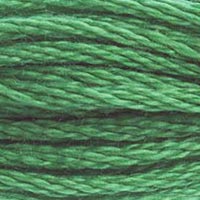
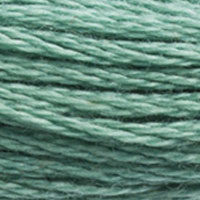
Shading Companions
Detailed Conversions
Where to Buy DMC 912
This section contains affiliate links. We may earn a small commission at no cost to you.
Related Guides
Free Printable Thread Conversion Chart
Pick a brand, enter your email, and we'll send you a printable chart mapping all 552 DMC colors to that brand's equivalents. Zero spam, one chart.
Thanks! Here's your free chart:
Download Your ChartOpens in a new tab. Use your browser's Print → Save as PDF.
No spam. Your email is stored securely and never shared.