
Quick Conversion Table
| Brand | Equivalent | Match |
|---|---|---|
| Anchor | 877 | exact |
| Madeira | 1703 | close |
| Cosmo ⚠ | 535 | close |
| Sullivans | 45111 | close |
| J&P Coats | 6876 | close |
| Dimensions | 6197 | close |
| Bucilla | 502 | close |
| Candamar | 6196 | close |
The Copper Patina Green That Stitchers Keep Reaching For
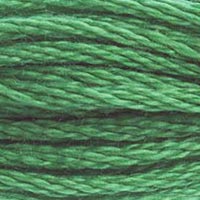
Stand on any European rooftop and look at the copper flashing, the domed cupolas, the weathered gutters — that verdigris green, the one that takes decades of rain and oxidation to develop, is remarkably close to DMC 502. This is architecture green, the color of surfaces that time has claimed and chemistry has transformed. It sits in the middle of the 501/502/503 blue-green family, neither as deep as 501 nor as airy as 503, occupying a sweet spot that pattern designers return to again and again when they need a green that feels established and refined rather than fresh or vivid.
What makes 502 distinctive within DMC's enormous green catalog is its restraint. This is a medium-value thread with enough blue to prevent it from reading as a standard leaf green, but not so much blue that it tips into teal territory. The effect is something cooler and more sophisticated than your typical green, with a slightly grey quality that prevents it from ever looking garish. If DMC 699 is a green that shouts across the room, 502 is the green that holds an interesting conversation at a dinner party.
Art Nouveau Designs and Stained Glass Effects
There's a reason 502 appears so frequently in art nouveau and arts-and-crafts-movement inspired designs. Those aesthetic traditions prized exactly this kind of muted, nature-derived color — greens that referenced plant life without being literally botanical, colors that sat comfortably alongside the warm golds and deep burgundies of William Morris textiles. If you're stitching a design influenced by that era, 502 is almost certainly in your thread list, and its role is usually structural: the vine borders, the leaf backgrounds, the flowing organic frames that give art nouveau its characteristic look.
For stained glass effect designs, 502 serves a dual purpose. It works as the glass color itself — that weathered green you see in medieval church windows where centuries of environmental exposure have softened and greyed the original pigment. But it also works beautifully as one of the mid-tone values in backstitched leading, where the typical choice of pure black (DMC 310) can look too harsh. Try backstitching your leading with one strand of 502 blended with one strand of DMC 844 (Ultra Dark Beaver Grey) for a more atmospheric, less graphic look.
Fabric and Lighting Considerations
At this medium value, DMC 502 sits in a range where fabric choice visibly affects the color relationship. On white Aida, 502 reads as clearly green — pleasant, balanced, and unambiguous. On cream or natural linen, the warm background coaxes out the blue undertone, and suddenly 502 leans cooler, almost sage-like. On hand-dyed fabrics with a warm brown or tea-stained base, 502 achieves its most interesting effect: the complementary warmth of the fabric makes the thread's cool undertone glow with unexpected clarity.
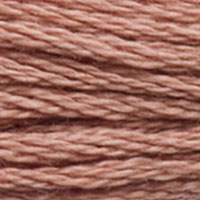
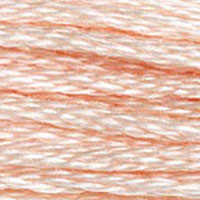
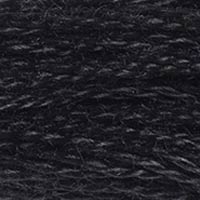
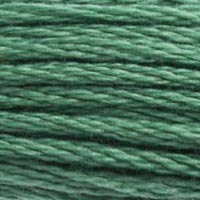
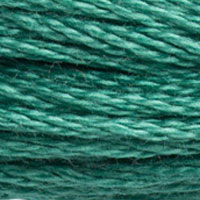
For companion threading, DMC 501 provides the shadow below and 503 the highlight above for a cohesive three-step gradient. Extend that range with DMC 504 (Very Light Blue Green) at the top and DMC 500 (Very Dark Blue Green) at the bottom for a five-value sweep that can handle everything from ocean depths to sunlit eucalyptus. For contrast pairings, DMC 356 (Medium Terra Cotta) is the classic complement — warm earth against cool verdigris, a combination that Mediterranean architecture has validated for centuries.
If you're parking threads in a large project and struggling to distinguish 502 from neighboring greens in low light, mark your needle with a small bit of washi tape. In dim conditions, the difference between 502 and DMC 3815 (Dark Celadon Green) can vanish entirely, and frogging two hours of work because you grabbed the wrong needle is an experience no one needs twice.
Anchor 877 is the go-to replacement here, and it delivers with minimal fuss — the hue, value, and undertone all align closely enough that you can stitch Anchor alongside DMC in a blended project without visible seaming. Madeira 1703 matches equally well, and its slightly different twist can actually help with coverage on higher-count fabrics where DMC sometimes feels like it's not quite filling the square.
Cosmo 535 is labeled a close match, and "close" is the right word — it captures the general territory but may lean slightly more purely green, losing a whisper of that blue-grey character that makes 502 special. In a design where 502 is one of many greens, this difference evaporates. In a design where the 501/502/503 family is doing the heavy lifting — carrying a border or defining a major motif — you'll want to test Cosmo 535 against its companion shades before committing.
Sullivans 45111 gets the value right but the undertone can drift depending on the batch. Always compare in natural daylight, not under your stitching lamp, which tends to flatten cool undertones and make everything look warmer than it is. Within DMC's range, DMC 3816 (Celadon Green) is sometimes suggested as an alternative, but it's noticeably lighter and more blue — not a swap, more of a neighboring shade that serves a different purpose in a palette.
Reference quality
How We Validate This Color Record
Use this page as a reference card for DMC 502: the structured data, quick conversions, and long-form copy are all tied back to the same stored color record.
- Methodology
- This page renders DMC 502, its hex value, and every brand equivalent from the site's source-of-truth color record, then checks long-form body copy against those same stored fields.
- Verification status
- Source-field checked. The page content is audited against the stored DMC number, brand equivalents, and match-quality labels before publishing.
- Last reviewed
- 2026-04-20
- Approximation warning
- Screen hex values, thread photos, and cross-brand conversions are reference aids. Dye lots, thread sheen, and fabric color can still shift the result in hand.
Decision guide
When to use the DMC 502 reference page
This page should help you decide faster between palette planning, brand substitution, and shade comparison without turning the color record into a thin lookup page.
Best for
- + Palette planning when you want the stored DMC 502 Blue Green record, hex value #5B9071, and linked brand equivalents in one place.
- + Checking the quickest cross-brand shortlist before you buy floss, compare stash substitutes, or route into a more specific conversion page.
- + Finding nearby shades in the greens family before you commit to accents, shading, or background blends.
Watch for
- ! Screen previews are only reference aids. Blue Green can shift on real fabric because thread sheen, stitch coverage, and room lighting change how the color reads.
- ! A stored equivalent is still a shortlist, not a guarantee that two brands will disappear into each other in the same stitched motif.
- ! Older charts, discontinued kit floss, and dye-lot variation can all introduce small but visible differences that the page cannot detect for you.
Before you commit
- Confirm the role of DMC 502 Blue Green: decide whether you need an exact hero shade, a forgiving background, or a rough stash substitute.
- Compare on project fabric: view the skein or stitched sample on the same fabric count and color you will actually use.
- Use the linked conversion pages next: open the brand-specific pages when you need match-quality caveats before substituting away from the DMC reference.
DMC 502 FAQ
These questions appear on the page so the FAQ schema stays aligned with what visitors can actually read.
What is the Anchor equivalent of DMC 502?+
The closest Anchor equivalent to DMC 502 (Blue Green) is Anchor 877. This is an exact match.
What color is DMC 502?+
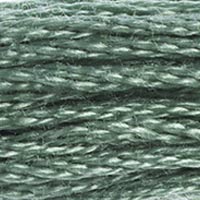
DMC 502 is called "Blue Green" and has a hex color value of #5B9071. It belongs to the greens color family.
What is the Madeira equivalent of DMC 502?+
The closest Madeira equivalent to DMC 502 (Blue Green) is Madeira 1703. This is a close match.
How DMC 502 Looks on Fabric
The same thread appears different depending on your fabric. Always test on your project fabric.
White Aida
Cream / Ecru
Black Aida
Pairs Well With
DMC colors commonly used alongside 502 Blue Green.
Suggested Palette
Shading Companions
Detailed Conversions
Where to Buy DMC 502
This section contains affiliate links. We may earn a small commission at no cost to you.
Related Guides
Free Printable Thread Conversion Chart
Pick a brand, enter your email, and we'll send you a printable chart mapping all 552 DMC colors to that brand's equivalents. Zero spam, one chart.
Thanks! Here's your free chart:
Download Your ChartOpens in a new tab. Use your browser's Print → Save as PDF.
No spam. Your email is stored securely and never shared.