
Quick Conversion Table
| Brand | Equivalent | Match |
|---|---|---|
| Anchor | 888 | close |
| Madeira | 2110 | close |
| Cosmo ⚠ | 774 | close |
| Sullivans | 45083 | close |
| J&P Coats | 2876 | close |
The Color of Dijon and Stone-Ground Grain
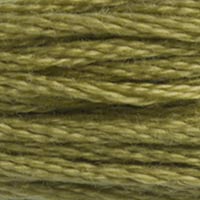
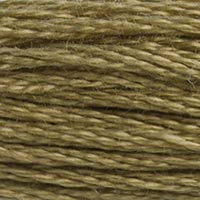
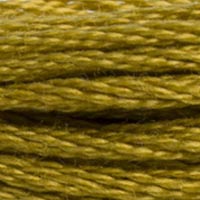
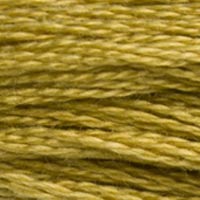
Pull a strand of DMC 370 Medium Mustard from the skein and hold it up. This isn't the bright, squeezy-bottle yellow mustard of American ballparks. This is the sophisticated, gritty, stone-ground mustard you find in a ceramic pot with a tiny wooden spoon — the kind with visible seeds and a complex, earthy bite. It's a yellow that has grown up and gotten serious, with enough brown and olive undertone to feel grounded and natural rather than sunny or cheerful.
At hex #B89D64, DMC 370 sits firmly in the darker end of the mustard family. It shares a shading group with DMC 371 (Mustard) and DMC 372 (Light Mustard), forming a three-step gradient that's invaluable for any project needing realistic golden-brown transitions. This trio works together for everything from autumn foliage details to the weathered gold of old picture frames, and 370 anchors the dark end — providing the shadow tones that give dimension to the lighter values above it.
Wheat Fields and Harvest Palettes
If you're stitching a harvest scene — sheaves of wheat, golden fields stretching to the horizon, a basket of fresh bread — DMC 370 is where the shadows live. The stalks catching full sun might be DMC 3821 (Straw) or DMC 3822 (Light Straw), but where those stalks overlap, where shadow falls between the sheaves, where the wheat bends and the color deepens, that's 370's territory. It provides the visual weight that keeps golden scenes from looking flat and washed out.
This thread is also a quiet star in wildlife designs. The darker tones of a lion's mane, the mottled back of a toad, the bark of certain trees, the dusky underside of a hawk's wing — anywhere you need a color that's identifiably warm and golden but subdued enough to read as shadow or secondary detail, 370 delivers.
Fabric and Coverage Considerations
One of the pleasant surprises with DMC 370 is its coverage. Being a darker, more saturated shade, it lays down much more cleanly than its paler yellow cousins. You won't fight the transparency issues that plague light yellows like DMC 745 or DMC 3078. Two strands on 14-count Aida gives you solid, opaque stitches with excellent definition.
The mustard family responds well to linen and evenweave fabrics. On natural linen, DMC 370 looks like it belongs — earthy, organic, and slightly rustic. It's a natural fit for country-themed samplers, folk art motifs, and prairie-style designs. Pair it with DMC 3371 (Black Brown) for outlining and DMC 3045 (Dark Yellow Beige) as a bridge tone, and you've got a palette that would make a farmhouse sampler look properly heritage.
For autumn projects, consider combining the full 370-371-372 gradient with DMC 918 (Dark Red Copper) and DMC 3011 (Dark Khaki Green) to create a palette that captures the specific warmth of October afternoons. These colors together have that quality of slanting golden light through turning leaves.
Alternatives to DMC 370 Medium Mustard
Medium mustard is a tricky shade to match because the balance between yellow, brown, and olive is very specific. A thread that's even slightly too warm reads as brown; too cool and it looks olive; too bright and it loses the mustard character entirely.
Anchor 888 is a close match, though some stitchers find Anchor's version leans slightly more olive than DMC's. This can work in your favor for nature-themed projects or be a problem if you need the warmer, more golden-brown character.
Madeira 2110 is close and tends to hold the warmth of the mustard tone well. Madeira's cotton has a slightly different twist that can affect how the color reads in large areas — the thread lays a bit differently, which changes how light interacts with the surface.
Cosmo 774 provides a close match with a tendency toward slightly more saturation. On a small sampler motif, the difference is negligible; on a large fill area, it's worth comparing in person.
Within the DMC range, don't confuse the mustard family (370-372) with the golden olive family (829-834) — they overlap in value but differ in undertone. The mustards are warmer and more brown-leaning; the golden olives carry more green. If your local shop is out of 370, DMC 831 (Medium Golden Olive) is the closest neighbor, but expect a slightly greener cast.
Sullivans 45083 is listed as close and serviceable for standalone projects, but avoid mixing it with DMC 370 mid-project — the undertone difference becomes visible in adjacent stitches.
Reference quality
How We Validate This Color Record
Use this page as a reference card for DMC 370: the structured data, quick conversions, and long-form copy are all tied back to the same stored color record.
- Methodology
- This page renders DMC 370, its hex value, and every brand equivalent from the site's source-of-truth color record, then checks long-form body copy against those same stored fields.
- Verification status
- Source-field checked. The page content is audited against the stored DMC number, brand equivalents, and match-quality labels before publishing.
- Last reviewed
- 2026-04-20
- Approximation warning
- Screen hex values, thread photos, and cross-brand conversions are reference aids. Dye lots, thread sheen, and fabric color can still shift the result in hand.
Decision guide
When to use the DMC 370 reference page
This page should help you decide faster between palette planning, brand substitution, and shade comparison without turning the color record into a thin lookup page.
Best for
- + Palette planning when you want the stored DMC 370 Medium Mustard record, hex value #B89D64, and linked brand equivalents in one place.
- + Checking the quickest cross-brand shortlist before you buy floss, compare stash substitutes, or route into a more specific conversion page.
- + Finding nearby shades in the yellows family before you commit to accents, shading, or background blends.
Watch for
- ! Screen previews are only reference aids. Medium Mustard can shift on real fabric because thread sheen, stitch coverage, and room lighting change how the color reads.
- ! A stored equivalent is still a shortlist, not a guarantee that two brands will disappear into each other in the same stitched motif.
- ! Older charts, discontinued kit floss, and dye-lot variation can all introduce small but visible differences that the page cannot detect for you.
Before you commit
- Confirm the role of DMC 370 Medium Mustard: decide whether you need an exact hero shade, a forgiving background, or a rough stash substitute.
- Compare on project fabric: view the skein or stitched sample on the same fabric count and color you will actually use.
- Use the linked conversion pages next: open the brand-specific pages when you need match-quality caveats before substituting away from the DMC reference.
DMC 370 FAQ
These questions appear on the page so the FAQ schema stays aligned with what visitors can actually read.
What is the Anchor equivalent of DMC 370?+
The closest Anchor equivalent to DMC 370 (Medium Mustard) is Anchor 888. This is a close match.
What color is DMC 370?+
DMC 370 is called "Medium Mustard" and has a hex color value of #B89D64. It belongs to the yellows color family.
What is the Madeira equivalent of DMC 370?+
The closest Madeira equivalent to DMC 370 (Medium Mustard) is Madeira 2110. This is a close match.
How DMC 370 Looks on Fabric
The same thread appears different depending on your fabric. Always test on your project fabric.
White Aida
Cream / Ecru
Black Aida
Pairs Well With
DMC colors commonly used alongside 370 Medium Mustard.
Suggested Palette
Shading Companions
Detailed Conversions
Where to Buy DMC 370
This section contains affiliate links. We may earn a small commission at no cost to you.
Related Guides
Free Printable Thread Conversion Chart
Pick a brand, enter your email, and we'll send you a printable chart mapping all 552 DMC colors to that brand's equivalents. Zero spam, one chart.
Thanks! Here's your free chart:
Download Your ChartOpens in a new tab. Use your browser's Print → Save as PDF.
No spam. Your email is stored securely and never shared.