
Quick Conversion Table
| Brand | Equivalent | Match |
|---|---|---|
| Anchor | 13 | close |
| Madeira | 0211 | close |
| Cosmo ⚠ | 346 | close |
| Sullivans | 45219 | close |
| J&P Coats | 2335 | close |
| Dimensions | 12335 | close |
| Bucilla | 119 | close |
The community debate over which red to use for outlining runs long and passionate on FlossTube, in SAL group chats, and across decades of needlework forum archives. DMC 310 (Black) is the default choice, but it can flatten designs that need warmth to breathe. DMC 3371 (Black Brown) softens the contrast without adding color. And then there's DMC 817 — Very Dark Coral Red — which solves the problem entirely differently by outlining in a deep, hot red that creates definition without abandoning the color family.
What Makes 817 Different From Other Dark Reds
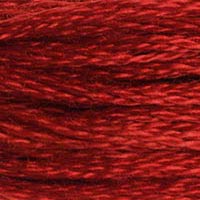
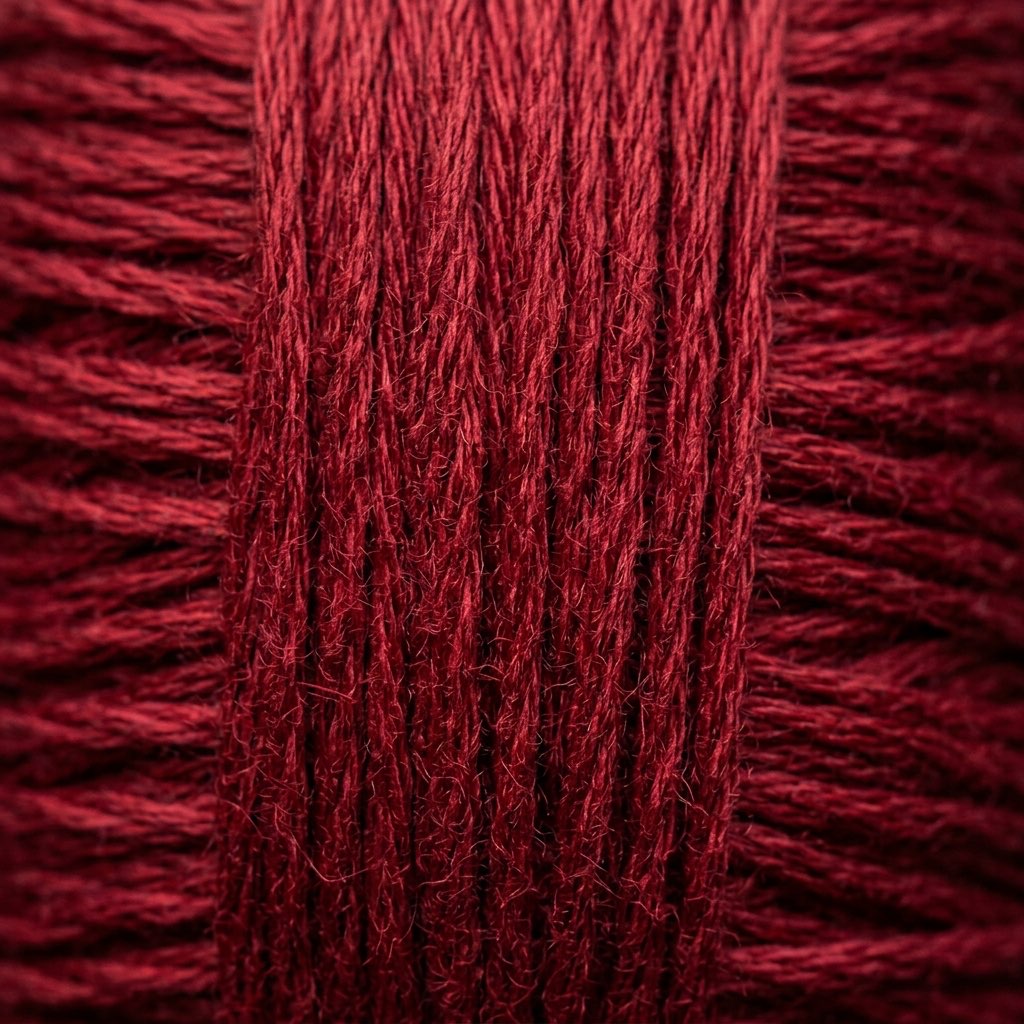
At hex #BB051F, this is a pure, saturated red without the blue undertones that push colors toward garnet or burgundy. It's coral-leaning — warmer in underlying temperature than DMC 816 (Garnet) or DMC 814 (Dark Garnet) — which means it reads as definitively, unambiguously red rather than as red-purple or red-wine. The "very dark" designation is accurate: this is a deep, commanding color that carries visual weight in any design.
That warmth makes 817 the natural shadow or outline choice for orange-red and true-red color families. If you're stitching a poppy, a tomato, a fire engine, or any design where the reds have warm coral or orange undertones, backstitching or outlining with 817 keeps everything within a consistent color temperature. Switching to a cool dark red or black would introduce a jarring undertone shift at the very edges of each element.
Where This Color Earns Its Keep
Seasonal designs call on 817 constantly. Christmas ornaments, holiday pillows, and winter-themed samplers all need a red that can handle both fill and definition duties. Designers who use 817 as the darkest shade in a red gradient — with DMC 349 (Dark Coral) and DMC 350 (Medium Coral) as mid-tones, and DMC 351 (Coral) as a highlight — get a natural-feeling warmth that reads as organic and floral rather than graphic and flat.
Autumn designs also benefit from 817's warmth. Paired with DMC 920 (Medium Copper) and DMC 433 (Medium Brown), 817 gives fall foliage its deepest, most saturated red tones. Maple leaves rendered in this palette have a genuinely photographic quality that cooler reds can't match.
Some stitchers use 817 as their go-to red for sampler alphabets and borders. The combination of depth and warmth means text stitched in 817 reads crisply at a distance while looking rich and warm up close — a useful property for pieces meant to be read across a room.
Thread Behavior and Technique Notes
Deep saturated reds like 817 can leave a faint color shadow on pale fabric if the thread is handled roughly during stitching — this is more about the dye family than any defect specific to 817, but it's worth knowing. On white or pale fabric, try to avoid dragging the thread across unstitched areas, and keep your hands clean and dry. The railroading technique helps here too: keeping strands parallel and smooth means less friction against the fabric weave.
On 28-count evenweave stitched over-two, 817 has excellent coverage — the saturation means you don't need to compensate for thin-looking stitches by adding an extra strand. On 14-count Aida, two strands give solid, rich coverage. Stitchers working on 18-count with one strand for fine details report that 817 reads well at that scale because its value is deep enough to maintain definition.
Madeira 0211 earns a rare exact match rating here, making it one of the more reliable cross-brand substitutions in the red family. If you're working in Madeira throughout and need this color, 0211 should behave essentially identically in finished pieces.
Anchor 13 is listed as close, and the difference is noticeable if you're mixing brands — Anchor's version reads slightly less warm, with a touch more blue in the undertone. In a piece where 817 stands alone or is surrounded by other warms, Anchor 13 works fine. Where the coral warmth is doing specific color-temperature work in a gradient alongside DMC 350 or 351, the Anchor equivalent may introduce a subtle inconsistency.
Within the DMC line, your nearest neighbors are DMC 321 (Christmas Red), which is slightly brighter and more blue-red than 817's warm coral cast, and DMC 349 (Dark Coral), which shares the warm undertone but sits at a slightly different value. Neither is a perfect drop-in substitute, but 349 is the closer emergency replacement if warmth matters to your design.
Cosmo 346 and Sullivans 45219 are both workable alternatives. As with most Cosmo reds, expect a slightly higher sheen than DMC's matte finish — this reads as slightly more vibrant in person, which may or may not serve your design. Sullivans tends to track closer to DMC in finish and tone.
One practical note: very dark reds from different dye lots can vary more than mid-tone colors. If you're buying multiple skeins of 817 for a large piece, check that dye lot numbers match, especially if you'll be working on the piece over months.
Reference quality
How We Validate This Color Record
Use this page as a reference card for DMC 817: the structured data, quick conversions, and long-form copy are all tied back to the same stored color record.
- Methodology
- This page renders DMC 817, its hex value, and every brand equivalent from the site's source-of-truth color record, then checks long-form body copy against those same stored fields.
- Verification status
- Source-field checked. The page content is audited against the stored DMC number, brand equivalents, and match-quality labels before publishing.
- Last reviewed
- 2026-04-20
- Approximation warning
- Screen hex values, thread photos, and cross-brand conversions are reference aids. Dye lots, thread sheen, and fabric color can still shift the result in hand.
Decision guide
When to use the DMC 817 reference page
This page should help you decide faster between palette planning, brand substitution, and shade comparison without turning the color record into a thin lookup page.
Best for
- + Palette planning when you want the stored DMC 817 Very Dark Coral Red record, hex value #BB051F, and linked brand equivalents in one place.
- + Checking the quickest cross-brand shortlist before you buy floss, compare stash substitutes, or route into a more specific conversion page.
- + Finding nearby shades in the reds family before you commit to accents, shading, or background blends.
Watch for
- ! Screen previews are only reference aids. Very Dark Coral Red can shift on real fabric because thread sheen, stitch coverage, and room lighting change how the color reads.
- ! A stored equivalent is still a shortlist, not a guarantee that two brands will disappear into each other in the same stitched motif.
- ! Older charts, discontinued kit floss, and dye-lot variation can all introduce small but visible differences that the page cannot detect for you.
Before you commit
- Confirm the role of DMC 817 Very Dark Coral Red: decide whether you need an exact hero shade, a forgiving background, or a rough stash substitute.
- Compare on project fabric: view the skein or stitched sample on the same fabric count and color you will actually use.
- Use the linked conversion pages next: open the brand-specific pages when you need match-quality caveats before substituting away from the DMC reference.
DMC 817 FAQ
These questions appear on the page so the FAQ schema stays aligned with what visitors can actually read.
What is the Anchor equivalent of DMC 817?+
The closest Anchor equivalent to DMC 817 (Very Dark Coral Red) is Anchor 13. This is a close match.
What color is DMC 817?+
DMC 817 is called "Very Dark Coral Red" and has a hex color value of #BB051F. It belongs to the reds color family.
What is the Madeira equivalent of DMC 817?+
The closest Madeira equivalent to DMC 817 (Very Dark Coral Red) is Madeira 0211. This is a close match.
How DMC 817 Looks on Fabric
The same thread appears different depending on your fabric. Always test on your project fabric.
White Aida
Cream / Ecru
Black Aida
Pairs Well With
DMC colors commonly used alongside 817 Very Dark Coral Red.
Suggested Palette
Shading Companions
Detailed Conversions
Where to Buy DMC 817
This section contains affiliate links. We may earn a small commission at no cost to you.
Related Guides
Free Printable Thread Conversion Chart
Pick a brand, enter your email, and we'll send you a printable chart mapping all 552 DMC colors to that brand's equivalents. Zero spam, one chart.
Thanks! Here's your free chart:
Download Your ChartOpens in a new tab. Use your browser's Print → Save as PDF.
No spam. Your email is stored securely and never shared.