
Quick Conversion Table
| Brand | Equivalent | Match |
|---|---|---|
| Anchor | 46 | close |
| Madeira | 0210 | close |
| Cosmo ⚠ | 2612 | close |
| Sullivans | 45120 | close |
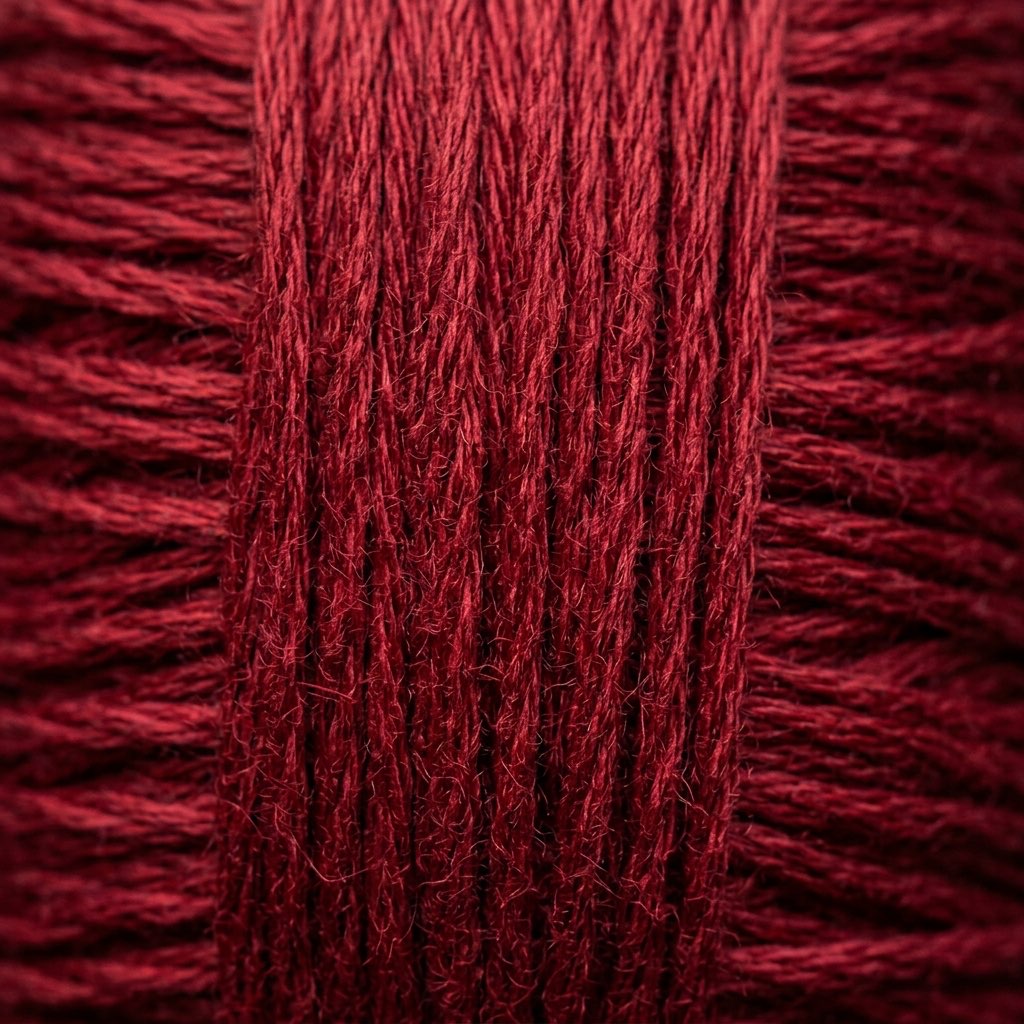
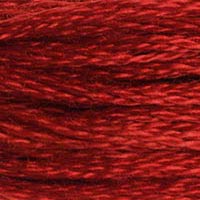
The challenge with naming a thread simply "Dark Red" is that it raises a question: which dark red? DMC's catalog contains dozens of reds ranging from blue-tinged to orange-influenced, from brick to wine, from true crimson to near-burgundy. DMC 485 answers the question by choosing the clearest, most direct version: a rich, warm, slightly cool dark red that neither leans strongly toward orange nor toward purple. It's red in its most definitive statement — the color of a stop sign in dim light, a ripe pomegranate split open, a cardinal's wing in shadow.
Color Character and Undertone Analysis
Understanding 485's undertones requires comparing it to its neighbors. DMC 304 (Medium Christmas Red) sits at a similar value but with slightly more warmth (orange pull). DMC 816 (Garnet) is deeper and more wine-influenced, with a clear purple component. DMC 3801 (Very Dark Melon) is redder and more orange. What 485 does is occupy the center of the red spectrum — the value and hue position that registers as simply, unambiguously dark red to most observers without triggering specific color associations like burgundy, crimson, or brick.
This neutrality within the red family is precisely what makes 485 useful. When a design needs dark red without the complications of burgundy's purple undertone or coral's orange warmth, 485 is the clear choice. It's particularly valuable in designs that use red as a near-neutral accent — the binding color in a geometric pattern, the dark value in a primarily neutral palette where a single warm accent appears.
Traditional and Heritage Design Applications
Dark, clear reds have a long history in textile design across many cultures. Norwegian and Swedish folk embroidery tradition uses exactly this quality of red — not a warm brick, not a cool burgundy, but a vivid dark red that photographs cleanly and reads powerfully against white or natural ground. Stitchers working Hardanger or traditional Scandinavian cross-stitch patterns will encounter this shade or its near-equivalents repeatedly. DMC 485 is an excellent match for these traditional palettes.
Similarly, traditional Eastern European folk embroidery — Hungarian, Romanian, Ukrainian — uses rich dark reds as primary accent colors on white or natural linen. These traditions predate the DMC numbering system by centuries, but the color itself is consistent: a clear, saturated dark red without excessive warmth or coolness. 485 fills this role well alongside DMC 321 (Red) for the lighter accents and DMC 815 (Medium Garnet) for deeper shadow tones in the same red family.
Christmas and Holiday Design
Christmas cross-stitch is probably where 485 gets the most use outside of heritage work. The deep red of a Christmas ornament in shadow, the darkest tone in a holly berry cluster, the rich background of a traditional Christmas sampler — all of these contexts suit 485 perfectly. Paired with DMC 3371 (Black Brown) for shadows and DMC 321 (Red) for brighter elements, it anchors the red family in a Christmas palette without needing burgundy's purple complications.
Anchor 46 is listed as a close rather than exact match — the two brands make slightly different choices in this dark red zone, with the Anchor version running perhaps a touch more warm (orange-influenced) than the DMC original. For most applications this is imperceptible, but for designs where the specific red quality of 485 is important — particularly traditional folk patterns where color accuracy to historical palettes matters — a side-by-side comparison before committing is worthwhile.
Madeira 0210 is a reliable substitute. Madeira's dark reds have good colorfastness, which is a real consideration for display pieces in rooms with natural light — dark saturated reds can be moderately prone to UV fading over long periods. Madeira's dye quality in this range is generally considered reliable for long-term display.
Cosmo 2612 performs well. Cosmo has invested in developing a comprehensive red family, and their dark reds are well-regarded. The 2612 number sits in the right zone for 485 applications — close enough in undertone that substitution in most design contexts should be seamless.
Sullivans 45120 is adequate for standard applications. The Sullivans dark red range is serviceable, though some stitchers report that very deep reds in the Sullivans lineup can occasionally have slight dye lot variation. Checking that multiple skeins come from the same lot is advisable for large projects.
Within DMC's range, DMC 814 (Dark Garnet) is one step darker and slightly more wine-influenced — a reasonable emergency substitute. DMC 304 (Medium Christmas Red) is slightly brighter and warmer, workable in contexts where 485's specific dark quality isn't essential.
Reference quality
How We Validate This Color Record
Use this page as a reference card for DMC 485: the structured data, quick conversions, and long-form copy are all tied back to the same stored color record.
- Methodology
- This page renders DMC 485, its hex value, and every brand equivalent from the site's source-of-truth color record, then checks long-form body copy against those same stored fields.
- Verification status
- Source-field checked. The page content is audited against the stored DMC number, brand equivalents, and match-quality labels before publishing.
- Last reviewed
- 2026-04-20
- Approximation warning
- Screen hex values, thread photos, and cross-brand conversions are reference aids. Dye lots, thread sheen, and fabric color can still shift the result in hand.
Decision guide
When to use the DMC 485 reference page
This page should help you decide faster between palette planning, brand substitution, and shade comparison without turning the color record into a thin lookup page.
Best for
- + Palette planning when you want the stored DMC 485 Dark Red record, hex value #B01020, and linked brand equivalents in one place.
- + Checking the quickest cross-brand shortlist before you buy floss, compare stash substitutes, or route into a more specific conversion page.
- + Finding nearby shades in the reds family before you commit to accents, shading, or background blends.
Watch for
- ! Screen previews are only reference aids. Dark Red can shift on real fabric because thread sheen, stitch coverage, and room lighting change how the color reads.
- ! A stored equivalent is still a shortlist, not a guarantee that two brands will disappear into each other in the same stitched motif.
- ! Older charts, discontinued kit floss, and dye-lot variation can all introduce small but visible differences that the page cannot detect for you.
Before you commit
- Confirm the role of DMC 485 Dark Red: decide whether you need an exact hero shade, a forgiving background, or a rough stash substitute.
- Compare on project fabric: view the skein or stitched sample on the same fabric count and color you will actually use.
- Use the linked conversion pages next: open the brand-specific pages when you need match-quality caveats before substituting away from the DMC reference.
DMC 485 FAQ
These questions appear on the page so the FAQ schema stays aligned with what visitors can actually read.
What is the Anchor equivalent of DMC 485?+
The closest Anchor equivalent to DMC 485 (Dark Red) is Anchor 46. This is a close match.
What color is DMC 485?+
DMC 485 is called "Dark Red" and has a hex color value of #B01020. It belongs to the reds color family.
What is the Madeira equivalent of DMC 485?+
The closest Madeira equivalent to DMC 485 (Dark Red) is Madeira 0210. This is a close match.
How DMC 485 Looks on Fabric
The same thread appears different depending on your fabric. Always test on your project fabric.
White Aida
Cream / Ecru
Black Aida
Pairs Well With
DMC colors commonly used alongside 485 Dark Red.
Suggested Palette
Shading Companions
Detailed Conversions
Where to Buy DMC 485
This section contains affiliate links. We may earn a small commission at no cost to you.
Related Guides
Free Printable Thread Conversion Chart
Pick a brand, enter your email, and we'll send you a printable chart mapping all 552 DMC colors to that brand's equivalents. Zero spam, one chart.
Thanks! Here's your free chart:
Download Your ChartOpens in a new tab. Use your browser's Print → Save as PDF.
No spam. Your email is stored securely and never shared.