
Quick Conversion Table
| Brand | Equivalent | Match |
|---|---|---|
| Anchor | 19 | exact |
| Madeira | 0508 | close |
| Cosmo ⚠ | 241 | close |
| Sullivans | 45050 | close |
| J&P Coats | 3019 | close |
| Dimensions | 13019 | close |
| Bucilla | 304 | close |
Recovery decision for DMC 304
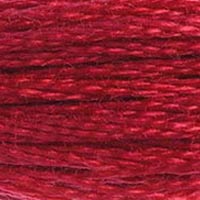
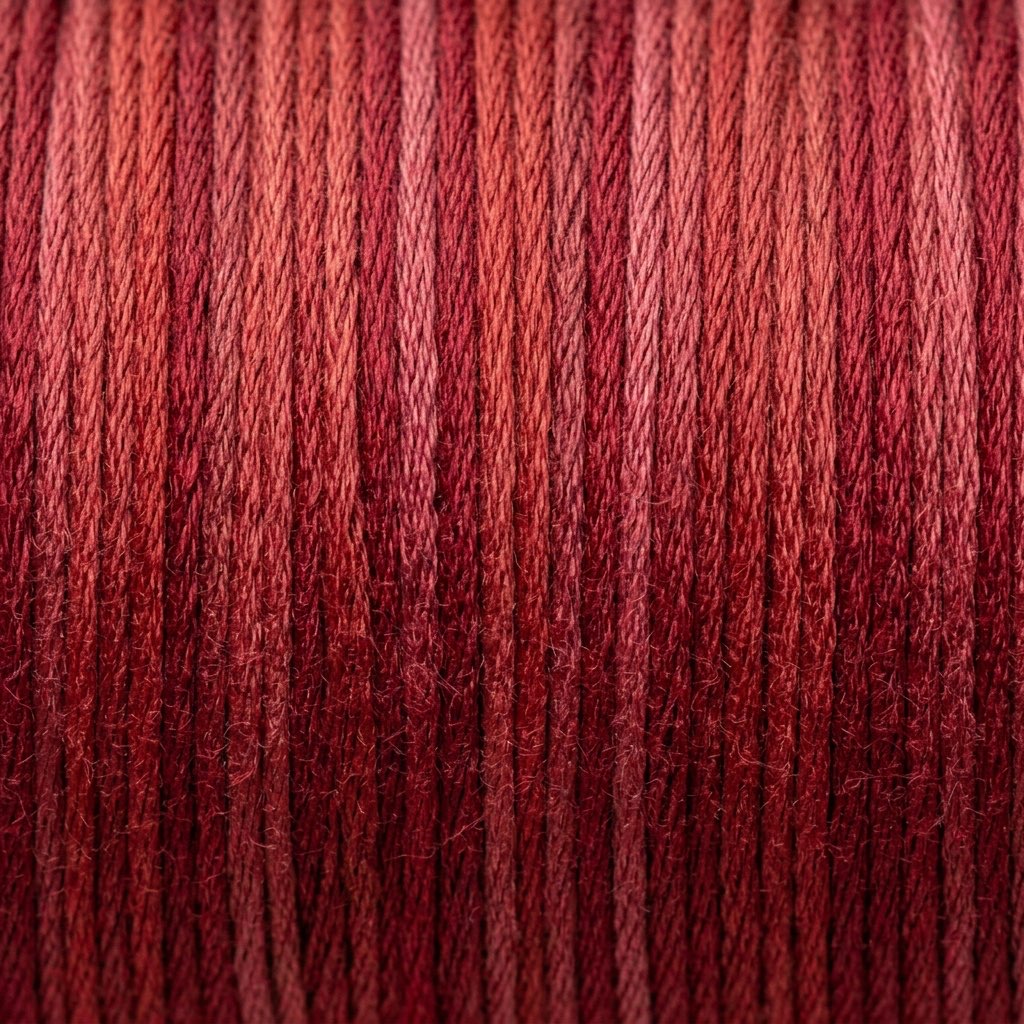
DMC 304 Medium Red is a deep, slightly cool red used for classic samplers, holiday motifs, florals, and folk-art designs. It sits between the brighter DMC 666 and the darker DMC 498, so any substitute needs to land in that mid-tone range. Always stitch a small test patch on your actual fabric before committing to a full project.
Where this shade fails first: The biggest risk is shifting too warm or too dark: warmer reds read orange against greens, while darker reds flatten shading in florals and faces. Dye-lot variation in deep reds is also common, so confirm bolt and batch numbers when buying multiple skeins.
Lay the candidate skein directly across a strand of DMC 304 on your chosen fabric, then view under both daylight and indoor lighting. Stitch a small block of each side by side, wash or steam it, and confirm the hue, value, and sheen still match before committing to the full design.
Christmas Red's Quieter Sibling
Every stitcher knows DMC 321 Christmas Red. It shows up in every holiday sampler, every Santa suit, every poinsettia petal. What fewer stitchers realize is that DMC 304 Medium Red is often the better choice — slightly deeper, slightly cooler, and with a sophistication that 321's cheerful brightness cannot match. If 321 is the red of a brand-new fire truck, 304 is the red of a leather-bound book in a library with mahogany shelves. Same family, different personality entirely.
The hex value (#B71F33) reveals the distinction. That slight blue bias in the red channel pulls 304 away from the warm, orange-leaning reds and toward the cool, blue-leaning reds. In color theory terms, 304 sits closer to crimson than to scarlet. This matters enormously in practice, because cool reds recede slightly while warm reds advance, which means 304 creates a different spatial effect in a design than 321 or 666 (Bright Red) would. Where those warmer reds jump forward and demand attention, 304 integrates more smoothly into complex compositions.
That receding quality makes 304 invaluable for shadow work within red subjects. Stitching a rose? DMC 321 or 666 catches the light on the outermost petals, but 304 fills the inner petals where shadows gather. The cool undertone reads as depth without looking brown or muddy, which is the constant challenge when darkening reds — go too warm and you get rust, go too dark and you get maroon. 304 threads the needle, so to speak, between those pitfalls.
The Warm Red vs. Cool Red Spectrum
Understanding where 304 sits on the warm-to-cool red axis helps you deploy it intentionally. Here is the practical spectrum as it applies to DMC reds:
- Warm reds (orange undertone): DMC 666 (Bright Red), DMC 817 (Very Dark Coral Red), DMC 350 (Medium Coral)
- Neutral reds (balanced): DMC 321 (Red), DMC 347 (Very Dark Salmon)
- Cool reds (blue undertone): DMC 304 (Medium Red), DMC 326 (Very Dark Rose), DMC 816 (Garnet)
This distinction matters when you are selecting reds for specific subjects. Warm reds read as energetic, festive, and attention-grabbing — they are the reds of holiday decorations, lipstick, and stop signs. Cool reds read as elegant, historical, and refined — they are the reds of velvet curtains, aged wine, and medieval heraldry. Choosing 304 over 321 for a Victorian sampler or a coat of arms is not just a matter of personal preference; it is a matter of historical color accuracy.
For patriotic designs, the choice between warm and cool reds depends on which flag you are stitching. The American flag's "Old Glory Red" is specified as a warm red — DMC 321 or 666 are better matches. The British Union Jack uses a cooler, more crimson red that 304 approximates well. French tricolore, Turkish crescent, Canadian maple leaf — each flag's red has a specific character, and reaching for the right DMC shade makes the difference between a flag that reads correctly and one that looks slightly off without the viewer being able to articulate why.
Practical Stitching and Coverage
Coverage with 304 is excellent. Two strands on 14-count Aida produce complete, opaque coverage with a consistent color that does not show fabric through the stitches. The thread separates cleanly from the skein and does not exhibit the pilling or fuzzing that some stitchers report with certain red dyes. Tension is predictable, and the thread does not stretch or distort during stitching.
On darker fabrics — black Aida, navy evenweave — 304 still reads clearly as red, though it loses some of its subtlety. The cool undertone that distinguishes it from warmer reds becomes less apparent against a dark background, where all medium-value reds tend to converge visually. If the cool quality of 304 is specifically why you chose it, consider using it on white, cream, or natural linen where the undertone has room to express itself.
Pairing 304 with metallics can be striking. A design stitched primarily in 304 with gold metallic accents (DMC Light Effects E3821 or Kreinik 002) evokes medieval manuscript illumination — that specific combination of deep crimson and gold leaf that defines the visual language of old European books and religious art. Adding DMC 310 (Black) for outlining completes the palette in a way that feels intentionally historical rather than generically festive.
For blended needle work, combining one strand of 304 with one strand of DMC 902 (Very Dark Garnet) creates a rich, dark crimson that reads as the deepest shadow in a rose or the darkest fold in a red velvet curtain. The two threads share enough color DNA to blend naturally rather than looking like two obviously different colors twisted together.
Cross-Brand Matching for DMC 304
Both major substitution paths here are rated exact, which is good news. Anchor 19 captures the cool-leaning crimson of 304 faithfully, and the thread weight is close enough that coverage on standard fabric counts is equivalent. If your local shop stocks Anchor more readily than DMC — common in the UK and parts of Europe — Anchor 19 is a reliable grab without needing to second-guess the match.
Madeira 0508 is also an exact match and delivers 304's crimson tone with Madeira's characteristically smoother finish. Some stitchers find that Madeira's slight sheen enhances the richness of deep reds, making them look slightly more saturated in finished pieces. Whether that enhancement is desirable depends on your project — for a Victorian sampler where richness is a virtue, Madeira's version may actually be preferable. For a contemporary geometric design where flat, matte color is the goal, stick with DMC.
Cosmo 241 is listed as a close match, and it is worth noting that this same Cosmo number appears as a match for DMC 350 (Medium Coral) as well. Cosmo's 241 sits between the two DMC shades — warmer than 304 but cooler than 350. If your project relies on the cool, crimson character that separates 304 from warmer reds, Cosmo 241 may read as slightly too warm. Test before committing, especially if 304 appears alongside other reds in your design where the cool undertone needs to contrast.
Sullivans 45050 is rated close and leans into the warm side of the match. Coverage may run slightly lighter than DMC at the same strand count, which can amplify the perceived warmth — lighter coverage lets more fabric show through, and on white Aida, that diluting effect pushes the visible color toward pink-red rather than crimson. If you choose Sullivans, consider whether your coverage is truly solid before stitching large areas.
Within DMC, the nearest alternatives are 321 (Red, warmer and brighter), 816 (Garnet, darker and more blue), and 498 (Dark Red, deeper but similarly cool). None is a true substitute because each occupies its own distinct position on the red spectrum, but if 304 is unavailable, DMC 498 is the closest in mood and undertone.
Reference quality
How We Validate This Color Record
Use this page as a reference card for DMC 304: the structured data, quick conversions, and long-form copy are all tied back to the same stored color record.
- Methodology
- This page renders DMC 304, its hex value, and every brand equivalent from the site's source-of-truth color record, then checks long-form body copy against those same stored fields.
- Verification status
- Source-field checked. The page content is audited against the stored DMC number, brand equivalents, and match-quality labels before publishing.
- Last reviewed
- 2026-04-20
- Approximation warning
- Screen hex values, thread photos, and cross-brand conversions are reference aids. Dye lots, thread sheen, and fabric color can still shift the result in hand.
Decision guide
When to use the DMC 304 reference page
This page should help you decide faster between palette planning, brand substitution, and shade comparison without turning the color record into a thin lookup page.
Best for
- + Traditional samplers where 304 anchors borders, alphabets, and central motifs
- + Holiday ornaments, stockings, and poinsettia designs needing a classic deep red
- + Folk-art and redwork pieces relying on a single saturated mid-red
- + Rose petals and tulip shading paired with darker reds like 498
- + Palette planning when you want the stored DMC 304 Medium Red record, hex value #B71F33, and linked brand equivalents in one place.
- + Checking the quickest cross-brand shortlist before you buy floss, compare stash substitutes, or route into a more specific conversion page.
- + Finding nearby shades in the reds family before you commit to accents, shading, or background blends.
Watch for
- ! The biggest risk is shifting too warm or too dark: warmer reds read orange against greens, while darker reds flatten shading in florals and faces. Dye-lot variation in deep reds is also common, so confirm bolt and batch numbers when buying multiple skeins.
- ! Substitutes that lean orange will clash with cool greens and blues
- ! Darker replacements collapse shading between 304 and neighboring 498
- ! Dye-lot shifts in deep reds show clearly across large blocks
- ! Cheaper polyester floss can bleed red dye when washed or blocked
- ! Screen previews are only reference aids. Medium Red can shift on real fabric because thread sheen, stitch coverage, and room lighting change how the color reads.
- ! A stored equivalent is still a shortlist, not a guarantee that two brands will disappear into each other in the same stitched motif.
- ! Older charts, discontinued kit floss, and dye-lot variation can all introduce small but visible differences that the page cannot detect for you.
Before you commit
- Stitch a 10 by 10 test block on your project fabric first
- Compare the substitute beside 304 under daylight and lamp light
- Check colorfastness by dampening a snippet on white scrap fabric
- Buy all skeins from the same dye lot when possible
- Confirm the role of DMC 304 Medium Red: decide whether you need an exact hero shade, a forgiving background, or a rough stash substitute.
- Compare on project fabric: view the skein or stitched sample on the same fabric count and color you will actually use.
- Use the linked conversion pages next: open the brand-specific pages when you need match-quality caveats before substituting away from the DMC reference.
DMC 304 FAQ
These questions appear on the page so the FAQ schema stays aligned with what visitors can actually read.
What is the Anchor equivalent of DMC 304?+
The closest Anchor equivalent to DMC 304 (Medium Red) is Anchor 19. This is an exact match.
What color is DMC 304?+
DMC 304 is called "Medium Red" and has a hex color value of #B71F33. It belongs to the reds color family.
What is the Madeira equivalent of DMC 304?+
The closest Madeira equivalent to DMC 304 (Medium Red) is Madeira 0508. This is a close match.
How DMC 304 Looks on Fabric
The same thread appears different depending on your fabric. Always test on your project fabric.
White Aida
Cream / Ecru
Black Aida
Pairs Well With
DMC colors commonly used alongside 304 Medium Red.
Suggested Palette
Shading Companions
Detailed Conversions
Where to Buy DMC 304
This section contains affiliate links. We may earn a small commission at no cost to you.
Related Guides
Free Printable Thread Conversion Chart
Pick a brand, enter your email, and we'll send you a printable chart mapping all 552 DMC colors to that brand's equivalents. Zero spam, one chart.
Thanks! Here's your free chart:
Download Your ChartOpens in a new tab. Use your browser's Print → Save as PDF.
No spam. Your email is stored securely and never shared.