
Quick Conversion Table
| Brand | Equivalent | Match |
|---|---|---|
| Anchor | 122 | exact |
| Madeira | 2702 | close |
| Cosmo ⚠ | 2664 | close |
| Sullivans | 45404 | close |
| J&P Coats | 7150 | close |
The cornflower — Centaurea cyanus — was one of the most beloved wildflowers of European fields before intensive agriculture largely pushed it out. The Prussians called it the national flower. Kaiser Wilhelm was said to have hidden from his pursuers in cornflower fields as a boy. The color itself became associated with simplicity, loyalty, and the lost rural landscape. When DMC named this thread Cornflower Blue, they weren't just reaching for a flower association — cornflower blue has a specific cultural weight in European textile tradition that makes it appropriate in historical, folk, and botanical cross-stitch contexts in particular ways.
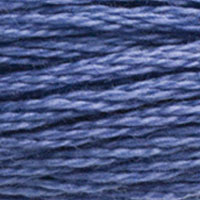
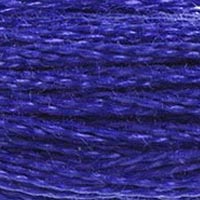
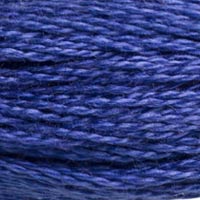
At hex #60678C, DMC 3807 is a medium-dark blue-violet: not as dark as a true navy, not as bright or red as a pure periwinkle, not as gray as slate blue. It sits in the middle-deep zone of the blue-violet range with enough saturation to read as clearly blue while its violet undertone prevents it from being simply a utility blue. This is a color with character — not a background color, not a detail color, but a design element in its own right.
Floral Subjects
The obvious application — cornflower botanical designs — uses 3807 as the primary petal color. The thread's specific blue-violet quality matches the flower's actual color range remarkably well. Combined with DMC 3746 (Dark Blue Violet) for shadow positions and DMC 341 (Light Blue Violet) for highlight petals, you can build a convincing cornflower cluster.
Beyond cornflowers, this blue-violet occupies useful territory in other floral subjects. Borage flowers — another intense blue wildflower — use a similar color range. Delphinium in its blue rather than purple form, love-in-a-mist (Nigella), and certain iris species all occupy this blue-violet territory where 3807 can function as a primary or shadow color.
Textile and Folk Art Traditions
Traditional European folk embroidery — particularly Central European styles from Hungary, Slovakia, and Poland — uses blue-violet in this range extensively. Cross-stitch interpretations of these traditions, including the proliferating Scandinavian and Eastern European folk patterns in modern SALs, reach for 3807 as their characteristic mid-depth blue. Paired with DMC 321 (Christmas Red), DMC 3347 (Medium Yellow Green), and DMC 3774 (Very Light Desert Sand), it creates the palette you'd recognize from traditional Hungarian embroidery.
Blue-and-white ware — Delft, Chinese export porcelain, Meissen blue onion pattern — uses blue in this approximate value range as its primary color. Cross-stitch designs inspired by these traditions find 3807 provides the right depth and character. Pair it with DMC 3761 (Light Sky Blue) for highlights and DMC 336 (Navy Blue) for the deepest shadow areas in the blue motifs.
One technique consideration: 3807's blue-violet quality makes it sensitive to warm versus cool lighting. Under warm incandescent light, it reads bluer. Under daylight or cool fluorescent light, the violet component comes forward. This can create a frustrating 'what color is this thread' experience while stitching in changing light conditions — a real issue for stitchers who work in multiple light environments. When in doubt, assess the color in the lighting where the finished piece will be displayed.
Anchor 122 and Madeira 2702 are both exact matches for DMC 3807 — good support for a color that's used as a primary in folk and floral designs where accurate hue matters. Anchor 122 in particular is a reliable equivalent that cross-brand stitchers can trust for cornflower work.
Cosmo 2664 is rated close. It typically sits slightly more blue and slightly less violet in some dye lots — still clearly in the cornflower blue territory but without quite as much of the violet character. In botanical cornflower work where you want the characteristic blue-violet of the actual flower, this distinction can matter. In designs using 3807 as a general mid-dark blue, the Cosmo equivalent works fine.
Sullivans 45404 is rated close and acceptable in most uses.
Within the DMC range, if 3807 is unavailable, the closest alternatives require understanding what quality you need from it. For the blue component: DMC 333 (Very Dark Blue Violet) goes darker. DMC 340 (Medium Blue Violet) goes lighter and more toward violet. For a more straightforwardly blue alternative: DMC 158 (Medium Very Dark Cornflower Blue) provides a related but distinctly different blue without the violet character. DMC 792 (Dark Cornflower Blue) and DMC 793 (Medium Cornflower Blue) are in the adjacent range — 792 going slightly darker and more navy, 793 slightly lighter. All three are worth considering depending on your design's specific needs.
Reference quality
How We Validate This Color Record
Use this page as a reference card for DMC 3807: the structured data, quick conversions, and long-form copy are all tied back to the same stored color record.
- Methodology
- This page renders DMC 3807, its hex value, and every brand equivalent from the site's source-of-truth color record, then checks long-form body copy against those same stored fields.
- Verification status
- Source-field checked. The page content is audited against the stored DMC number, brand equivalents, and match-quality labels before publishing.
- Last reviewed
- 2026-04-20
- Approximation warning
- Screen hex values, thread photos, and cross-brand conversions are reference aids. Dye lots, thread sheen, and fabric color can still shift the result in hand.
Decision guide
When to use the DMC 3807 reference page
This page should help you decide faster between palette planning, brand substitution, and shade comparison without turning the color record into a thin lookup page.
Best for
- + Palette planning when you want the stored DMC 3807 Cornflower Blue record, hex value #60678C, and linked brand equivalents in one place.
- + Checking the quickest cross-brand shortlist before you buy floss, compare stash substitutes, or route into a more specific conversion page.
- + Finding nearby shades in the blues family before you commit to accents, shading, or background blends.
Watch for
- ! Screen previews are only reference aids. Cornflower Blue can shift on real fabric because thread sheen, stitch coverage, and room lighting change how the color reads.
- ! A stored equivalent is still a shortlist, not a guarantee that two brands will disappear into each other in the same stitched motif.
- ! Older charts, discontinued kit floss, and dye-lot variation can all introduce small but visible differences that the page cannot detect for you.
Before you commit
- Confirm the role of DMC 3807 Cornflower Blue: decide whether you need an exact hero shade, a forgiving background, or a rough stash substitute.
- Compare on project fabric: view the skein or stitched sample on the same fabric count and color you will actually use.
- Use the linked conversion pages next: open the brand-specific pages when you need match-quality caveats before substituting away from the DMC reference.
DMC 3807 FAQ
These questions appear on the page so the FAQ schema stays aligned with what visitors can actually read.
What is the Anchor equivalent of DMC 3807?+
The closest Anchor equivalent to DMC 3807 (Cornflower Blue) is Anchor 122. This is an exact match.
What color is DMC 3807?+
DMC 3807 is called "Cornflower Blue" and has a hex color value of #60678C. It belongs to the blues color family.
What is the Madeira equivalent of DMC 3807?+
The closest Madeira equivalent to DMC 3807 (Cornflower Blue) is Madeira 2702. This is a close match.
How DMC 3807 Looks on Fabric
The same thread appears different depending on your fabric. Always test on your project fabric.
White Aida
Cream / Ecru
Black Aida
Pairs Well With
DMC colors commonly used alongside 3807 Cornflower Blue.
Suggested Palette

Detailed Conversions
Where to Buy DMC 3807
This section contains affiliate links. We may earn a small commission at no cost to you.
Related Guides
Free Printable Thread Conversion Chart
Pick a brand, enter your email, and we'll send you a printable chart mapping all 552 DMC colors to that brand's equivalents. Zero spam, one chart.
Thanks! Here's your free chart:
Download Your ChartOpens in a new tab. Use your browser's Print → Save as PDF.
No spam. Your email is stored securely and never shared.