
Quick Conversion Table
| Brand | Equivalent | Match |
|---|---|---|
| Anchor | 175 | exact |
| Madeira | 0907 | close |
| Cosmo ⚠ | 662 | close |
| Sullivans | 45205 | close |
| J&P Coats | 7005 | close |
| Dimensions | 6017 | close |
| Bucilla | 3794 | close |
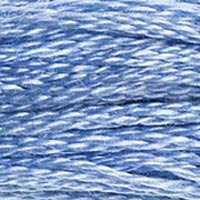
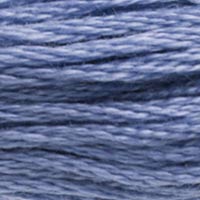
Picture the inside of a cornflower petal near its edge, where the blue is bright and light and the flower's characteristic purple warmth is still present — that's the visual territory of DMC 794 Light Cornflower Blue. It's the cornflower in its most luminous form, the color of something seen in good light rather than in shadow, and it carries that quality of brightness and clarity that makes it useful as a highlight and as a standalone soft-but-clear blue.
Soft Blue Without Coolness
The challenge with pale blues in cross-stitch is that they tend to read as cold. Baby blues like DMC 747 (Very Light Sky Blue) or DMC 3756 (Ultra Very Light Baby Blue) are undeniably pale and undeniably cool — useful for nursery themes, cold sky backgrounds, and ice effects, but limited in their warmth range. DMC 794 Light Cornflower Blue sidesteps this coldness problem with its purple undertone. Even lightened to this degree, the slight warmth from the purple component keeps 794 from reading as a cold blue. It's a soft, somewhat warm blue that feels more lavender-adjacent than steel-blue-adjacent.
This warmth makes 794 more versatile than cooler pale blues in mixed-palette designs. Placed next to pinks, mauves, and dusty purples, it harmonizes rather than clashes. In designs with a warm, vintage, or romantic palette register, 794 provides blue presence without the chilliness that would disrupt the palette's warmth.
Highlight Position in the Cornflower Gradient
As the lightest member of the DMC cornflower family, 794 serves as the highlight value in multi-shade shading sequences. The gradient from DMC 791 (Very Dark) through 792 and 793 to 794 (Light) provides four complete values, and 794 marks the most illuminated, lightest areas in that range — the petal tips of a cornflower catching direct sun, the edge of an iris petal where it curves toward the light, the lightest area of a light blue butterfly wing.
In folk art designs that use the cornflower family for decorative flower motifs, 794 often appears as the main flower fill color with 793 or 792 as the outline or shadow — a common simplified approach in geometric and traditional designs where you want clear, clean color without complex multi-shade shading.
Blue-Lavender Applications
At this light value with its purple undertone, 794 starts functioning as a light lavender-blue. This makes it useful in lavender field designs (where the flowers in bright sunlight look nearly blue rather than purple), in forget-me-not designs (where the tiny flowers have exactly this kind of soft, slightly warm pale blue), and in hydrangea designs where some flower heads appear in this range depending on their soil pH and the light conditions.
Bluebell designs — particularly for the English bluebell (Hyacinthoides non-scripta) that appears in woodland cross-stitch — use 794 for the lighter bell areas, with 793 or 792 for the deeper bell sections. The result captures the specific blue-purple quality of bluebells that distinguishes them from generic blue flowers.
Sky and Distance Effects
In landscape cross-stitch, atmospheric perspective makes distant objects appear lighter and slightly bluer. DMC 794 works as a sky or distant-object color in this context, reading as the light blue of a clear afternoon sky or the hazy blue of mountains seen at distance. It's light enough not to dominate a landscape composition but warm enough not to read as cold winter sky.
Anchor 175 is exact-rated for DMC 794. Madeira 0907 is close-rated rather than exact — worth noting when Madeira is your substitute brand of choice, as the difference between a close and exact match becomes more visible at lighter values where subtle hue differences are easier to detect. Cosmo 662 and Sullivans 45205 are both close-rated.
The light cornflower blue range is one where brand differences can be more noticeable than in deeper shades. Pale blues with purple undertones are particularly sensitive to variation — a substitute that reads slightly more purple or slightly more blue-gray can shift the character perceptibly in designs where the specific pale blue-lavender quality is important. Testing close-rated substitutes against your other palette colors in natural light is especially advisable for 794.
Within DMC, DMC 793 (Medium Cornflower Blue) is the natural step deeper if you need 794 to read with more presence and color saturation. For a lighter substitute that stays in the general blue zone, DMC 341 (Light Blue Violet) offers similar light value with a slightly different hue character. DMC 3747 (Very Light Blue Violet) is another neighbor in the pale blue-lavender range — close enough in character to 794 that it can substitute in designs where the specific cornflower identification isn't critical.
Reference quality
How We Validate This Color Record
Use this page as a reference card for DMC 794: the structured data, quick conversions, and long-form copy are all tied back to the same stored color record.
- Methodology
- This page renders DMC 794, its hex value, and every brand equivalent from the site's source-of-truth color record, then checks long-form body copy against those same stored fields.
- Verification status
- Source-field checked. The page content is audited against the stored DMC number, brand equivalents, and match-quality labels before publishing.
- Last reviewed
- 2026-04-20
- Approximation warning
- Screen hex values, thread photos, and cross-brand conversions are reference aids. Dye lots, thread sheen, and fabric color can still shift the result in hand.
Decision guide
When to use the DMC 794 reference page
This page should help you decide faster between palette planning, brand substitution, and shade comparison without turning the color record into a thin lookup page.
Best for
- + Palette planning when you want the stored DMC 794 Light Cornflower Blue record, hex value #8F9CC1, and linked brand equivalents in one place.
- + Checking the quickest cross-brand shortlist before you buy floss, compare stash substitutes, or route into a more specific conversion page.
- + Finding nearby shades in the blues family before you commit to accents, shading, or background blends.
Watch for
- ! Screen previews are only reference aids. Light Cornflower Blue can shift on real fabric because thread sheen, stitch coverage, and room lighting change how the color reads.
- ! A stored equivalent is still a shortlist, not a guarantee that two brands will disappear into each other in the same stitched motif.
- ! Older charts, discontinued kit floss, and dye-lot variation can all introduce small but visible differences that the page cannot detect for you.
Before you commit
- Confirm the role of DMC 794 Light Cornflower Blue: decide whether you need an exact hero shade, a forgiving background, or a rough stash substitute.
- Compare on project fabric: view the skein or stitched sample on the same fabric count and color you will actually use.
- Use the linked conversion pages next: open the brand-specific pages when you need match-quality caveats before substituting away from the DMC reference.
DMC 794 FAQ
These questions appear on the page so the FAQ schema stays aligned with what visitors can actually read.
What is the Anchor equivalent of DMC 794?+
The closest Anchor equivalent to DMC 794 (Light Cornflower Blue) is Anchor 175. This is an exact match.
What color is DMC 794?+
DMC 794 is called "Light Cornflower Blue" and has a hex color value of #8F9CC1. It belongs to the blues color family.
What is the Madeira equivalent of DMC 794?+
The closest Madeira equivalent to DMC 794 (Light Cornflower Blue) is Madeira 0907. This is a close match.
How DMC 794 Looks on Fabric
The same thread appears different depending on your fabric. Always test on your project fabric.
White Aida
Cream / Ecru
Black Aida
Pairs Well With
DMC colors commonly used alongside 794 Light Cornflower Blue.
Suggested Palette
Shading Companions
Detailed Conversions
Where to Buy DMC 794
This section contains affiliate links. We may earn a small commission at no cost to you.
Related Guides
Free Printable Thread Conversion Chart
Pick a brand, enter your email, and we'll send you a printable chart mapping all 552 DMC colors to that brand's equivalents. Zero spam, one chart.
Thanks! Here's your free chart:
Download Your ChartOpens in a new tab. Use your browser's Print → Save as PDF.
No spam. Your email is stored securely and never shared.