DMC vs Anchor Embroidery Floss: Which Should You Choose?
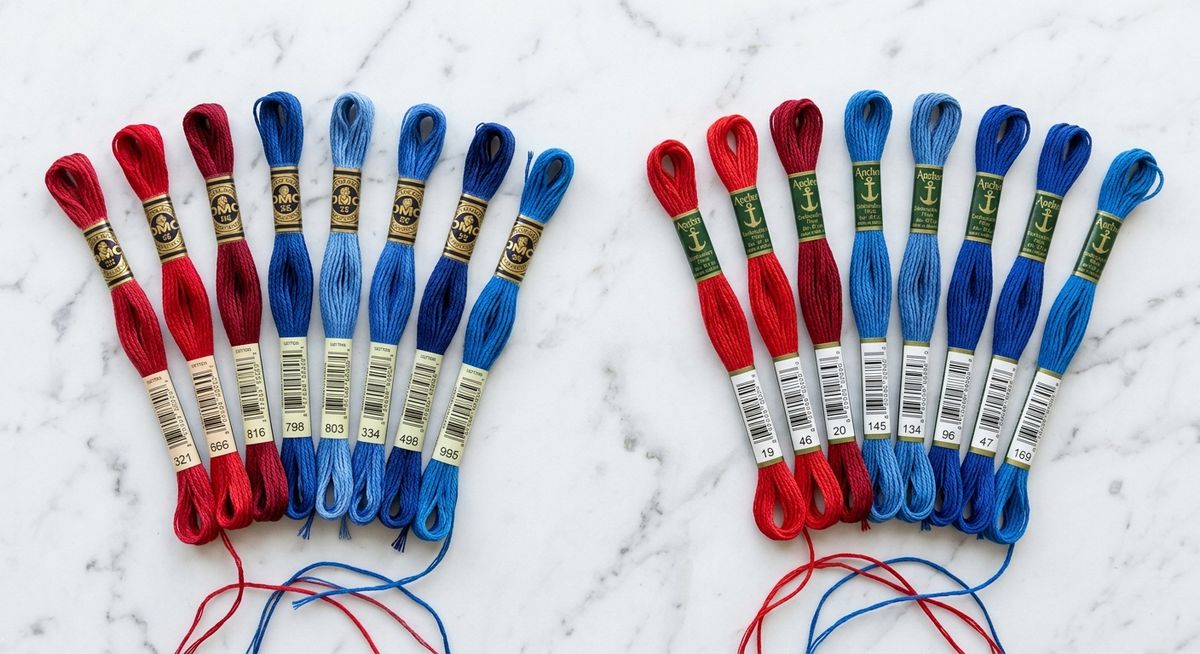
DMC and Anchor are the two brands that dominate cross-stitch and embroidery. Walk into any well-stocked craft store, look at any popular pattern, and you’ll find one or both of them listed. They’re direct competitors selling nearly identical products — six-strand cotton floss — to largely the same audience.
So which one should you use?
The honest answer: both are excellent, and neither is objectively better. But they’re not the same, and the differences matter depending on how you stitch, where you shop, and what you’re making. Here’s a thorough, opinionated comparison.
If you’re choosing between brands because a project started from mixed sources — a digital palette, an inherited stash, and an older pattern — do the reference work in that order. Start from the exact DMC record when you know the color (for example DMC 3051 Dark Green Gray), use a direct brand conversion when the pattern already specifies DMC (like DMC 310 to Anchor), and fall back to a digital lookup such as hex ACACAC or hex E890A8 only when the project gives you a screen color instead of a thread number. Keep the physical stash organized as you test substitutions with the DMC floss organization guide, and use the Stitchies methodology when you need to understand what exact, close, and approximate mean. Muted antique shades are where the decision matters most, so compare a route like DMC 3740 Dark Antique Violet before you assume the nearest brand equivalent will preserve the same mood.
Quick Comparison
| Feature | DMC | Anchor |
|---|---|---|
| Total colors available | ~500 | ~445 |
| Thread feel | Slightly smoother, silkier | Slightly more matte, textured |
| Colorfastness | Excellent | Excellent |
| Coverage per strand | Good | Slightly denser |
| Availability (US) | Very widely available | Less common; often online-only |
| Availability (UK/EU) | Widely available | Widely available |
| Price per skein | ~$0.50–$0.90 | ~$0.50–$0.90 |
| Numbering system | Numeric (e.g., DMC 310) | Numeric (e.g., Anchor 403) |
| Numbers match between brands | No — completely different | No — completely different |
DMC: The Overview
DMC (Dollfus-Mieg et Compagnie) is a French company that’s been making thread since 1746. In the US, DMC is the default brand. If a pattern is sold in an American craft store, the color codes are almost certainly DMC. If someone says “I need a dark navy,” they’re probably reaching for a DMC skein.
What DMC does well
Availability. This is DMC’s biggest practical advantage in North America. Michaels, Joann, Walmart, and most independent craft shops stock DMC. If you run out of a color mid-project on a Sunday afternoon, there’s a reasonable chance you can get it locally. For online buyers, DMC is everywhere.
Color range. With roughly 500 colors, DMC’s palette is one of the largest of any embroidery floss brand. They cover subtle gradations — the blues alone span two dozen shades from pale sky to near-black navy like DMC 336 Navy Blue.
Pattern compatibility. The overwhelming majority of English-language cross-stitch patterns are written in DMC codes. Following a pattern in DMC means zero conversion work.
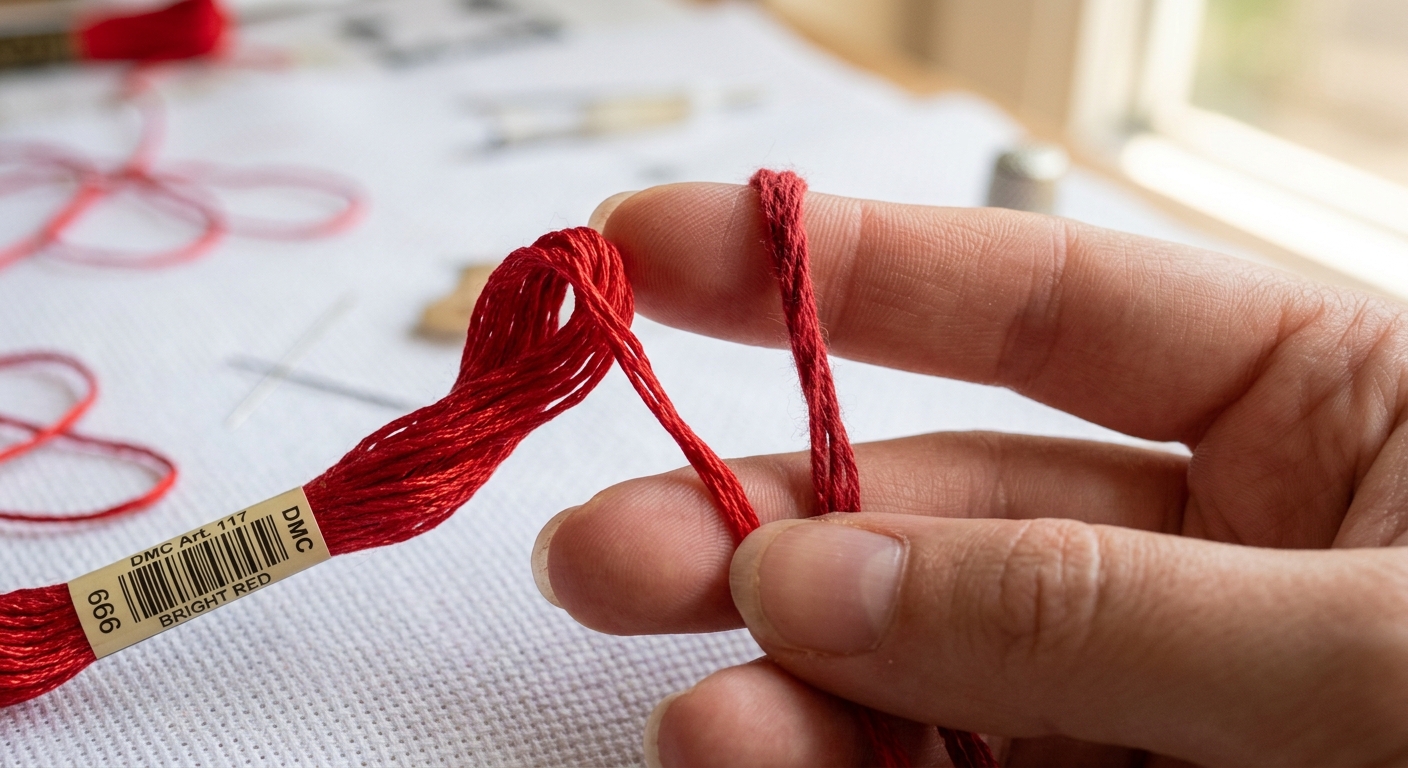
Thread feel. DMC has a slightly silkier, smoother texture that many stitchers prefer for detailed work. It separates cleanly into individual strands, which matters a lot when you’re working with one or two strands on evenweave.
Variegated and specialty lines. DMC offers Light Effects (metallic), Color Variations (hand-dyed style gradients), and Coloris (slow-changing variegated). If you want to expand beyond solid floss, DMC’s specialty lines are more developed.
Where DMC falls short
No brand is perfect. DMC has some colors that are notoriously inconsistent between dye lots — notably some of the pinks and teals. For large projects where you’ll need to buy multiple skeins of the same color, buy them all at once from the same lot if possible. DMC also discontinued several colors over the years, which can make matching older patterns frustrating.
Anchor: The Overview
Anchor is a UK-based brand (now owned by Coats) with a particularly strong following in the UK, Europe, Australia, and parts of Asia. It’s the thread that older British patterns were written for, and it’s the brand many European stitchers grew up with.
What Anchor does well
Thread texture for canvas work. Anchor’s slightly more textured, matte finish gives it excellent coverage on higher-count fabric, and many stitchers feel it fills in better on Aida. This is subjective, but it comes up consistently in stitcher communities.
Color depth in certain ranges. Anchor’s reds, pinks, and warm earth tones are widely regarded as particularly rich and well-saturated. If a project leans heavily on warm colors, Anchor’s palette can feel more vibrant in those ranges.
Price and value. In markets where Anchor is sold locally — particularly the UK and Australia — pricing tends to be comparable to or slightly better than DMC. The quality-per-dollar is strong.
Established quality. Anchor has been producing embroidery floss for over 100 years. Colorfastness is good, the thread is consistent, and it behaves predictably.
Where Anchor falls short
Availability in the US. This is the big one. Finding Anchor in an American craft store is hit or miss. Many US stitchers have to order it online and plan ahead, which makes it impractical for in-progress restocking. If you’re in the US and you want to walk into a store and grab a missing color, Anchor is rarely an option.
Pattern compatibility. If you’re following any modern US-published pattern, it’s in DMC. Using Anchor means converting every single color code — which is doable (we’ll cover that below) but adds friction.
Slightly smaller color range. With around 445 colors versus DMC’s ~500, Anchor has fewer options in some color families. For most projects this doesn’t matter, but if you’re trying to match an extremely specific shade, DMC’s larger palette gives you more choices.
Head-to-Head: The Key Comparisons
Color Range
DMC wins on raw numbers. About 500 colors versus Anchor’s roughly 445. In practice, the difference is less dramatic — both brands cover the full spectrum and include plenty of subtle variations within each color family. Where you’ll feel the gap is in specialty shades and neutrals.
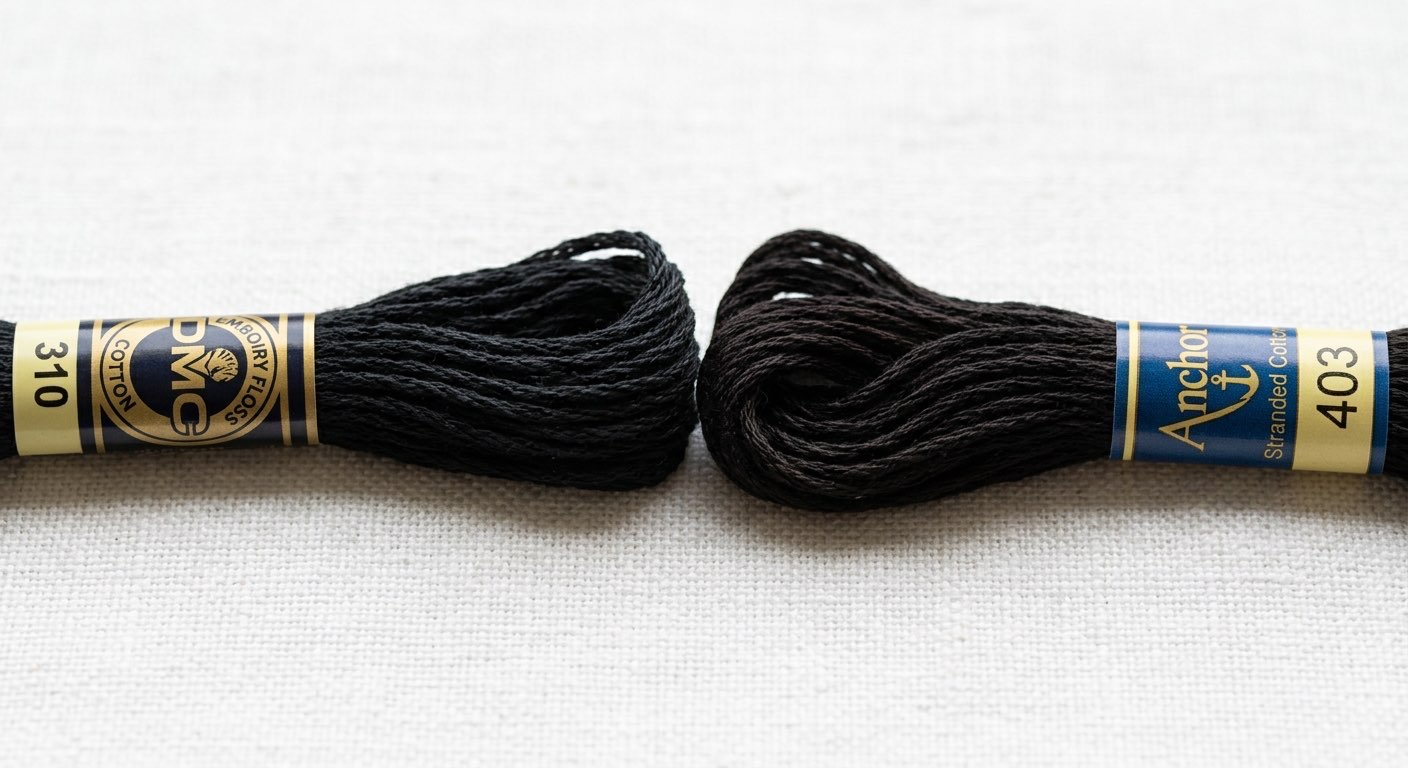
Neither brand’s numbering tells you anything useful about the color — DMC 310 is black, but DMC 311 is a medium navy. You have to look them up. That’s true of both brands. For reference, DMC 310 Black is one of the most commonly used colors in the hobby, and its Anchor equivalent (403) is a near-identical match.
Thread Feel and Quality
Both brands use mercerized cotton and produce consistent, colourfast thread. The differences in feel are real but subtle. DMC tends to be slightly silkier and smoother; Anchor has a bit more texture and grip. Neither is objectively better — it’s preference, and it depends partly on the fabric you’re stitching on.
On high-count fabrics (28-count and above) where you’re working with one strand, DMC’s smoother separation can be easier to work with. On standard 14-count Aida with two strands, many stitchers find Anchor covers just as well or slightly better due to its denser texture.
Availability
In North America: DMC by a wide margin. In the UK and Europe: Anchor is more commonly available, though DMC is also sold everywhere. Online: Both are readily available through Amazon and specialty retailers.
If you’re in the US and building a stash, DMC makes your life easier. If you’re in the UK, either works and you can often find Anchor locally for less.
Price
Retail prices are similar — both brands run roughly $0.50–$0.90 per skein depending on retailer and whether there’s a sale. DMC floss on Amazon and Anchor floss on Amazon are both priced competitively, and buying in bulk sets can reduce the per-skein cost significantly.
Over the course of a large project, price is unlikely to be a deciding factor. The real cost difference comes from buying a full starter kit: DMC’s 500-color starter sets tend to be more widely discounted due to higher competition among retailers.
Numbering System
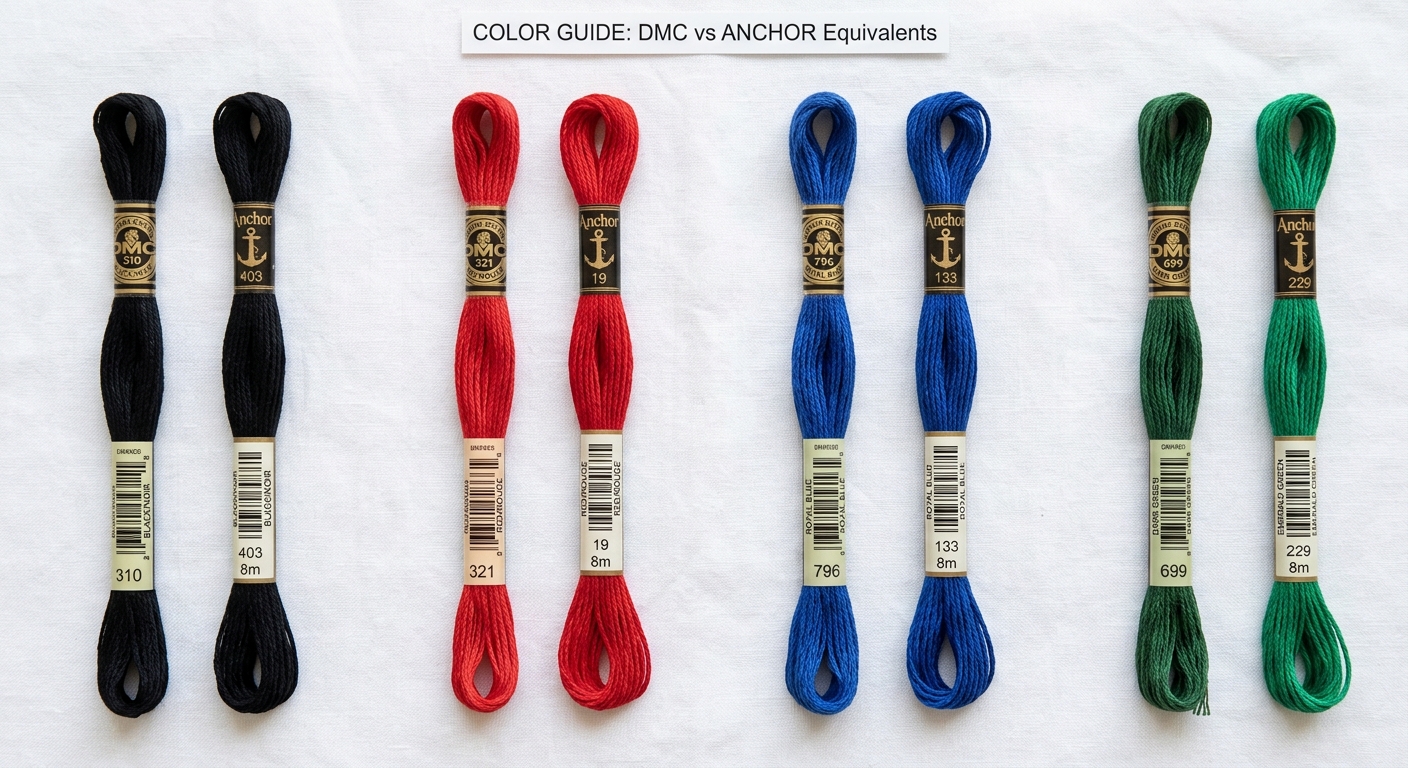
Both brands use numeric codes, but the numbers are completely different. DMC 310 is black. Anchor 403 is also black — same color, entirely different number. There is no pattern to the difference, no formula to convert between them. You need a reference chart.
This is where things can get confusing. If you inherit a stash with unlabeled threads, or you find a pattern that lists Anchor codes when you only have DMC, you’re looking up every single color individually. Conversions are also approximate in some cases — brands don’t always have exact color matches for each other, so the “equivalent” is the closest available, not a guaranteed identical shade.
When to Choose DMC
Choose DMC if:
- You’re based in the US and want to be able to restock locally
- You’re following modern patterns (almost all are written in DMC)
- You’re new to cross-stitch and don’t want to deal with conversions
- You want access to specialty threads (Light Effects, Color Variations)
- You’re building a stash from scratch and want maximum flexibility
When to Choose Anchor
Choose Anchor if:
- You’re in the UK, Europe, or Australia where Anchor is locally available
- You’re working from older British or European patterns written in Anchor codes
- You prefer a slightly denser, more matte thread feel
- You already have an Anchor stash and want to stay consistent
- Someone gave you a pile of Anchor thread and you want to use it
Can You Mix DMC and Anchor in the Same Project?
Yes — but test first.
The threads are physically compatible. They’re both six-strand mercerized cotton and work on the same fabrics with the same needles. There’s no reason you can’t use DMC for most of a project and Anchor for a color that’s only available in one brand.
The practical concern is color matching. If a pattern calls for DMC 500 (a dark green), and you’re substituting Anchor 879, the Anchor equivalent is a very close match — but it may not be identical. Side by side in good light, you might see a subtle difference. In a finished piece viewed at normal distance, you probably won’t.
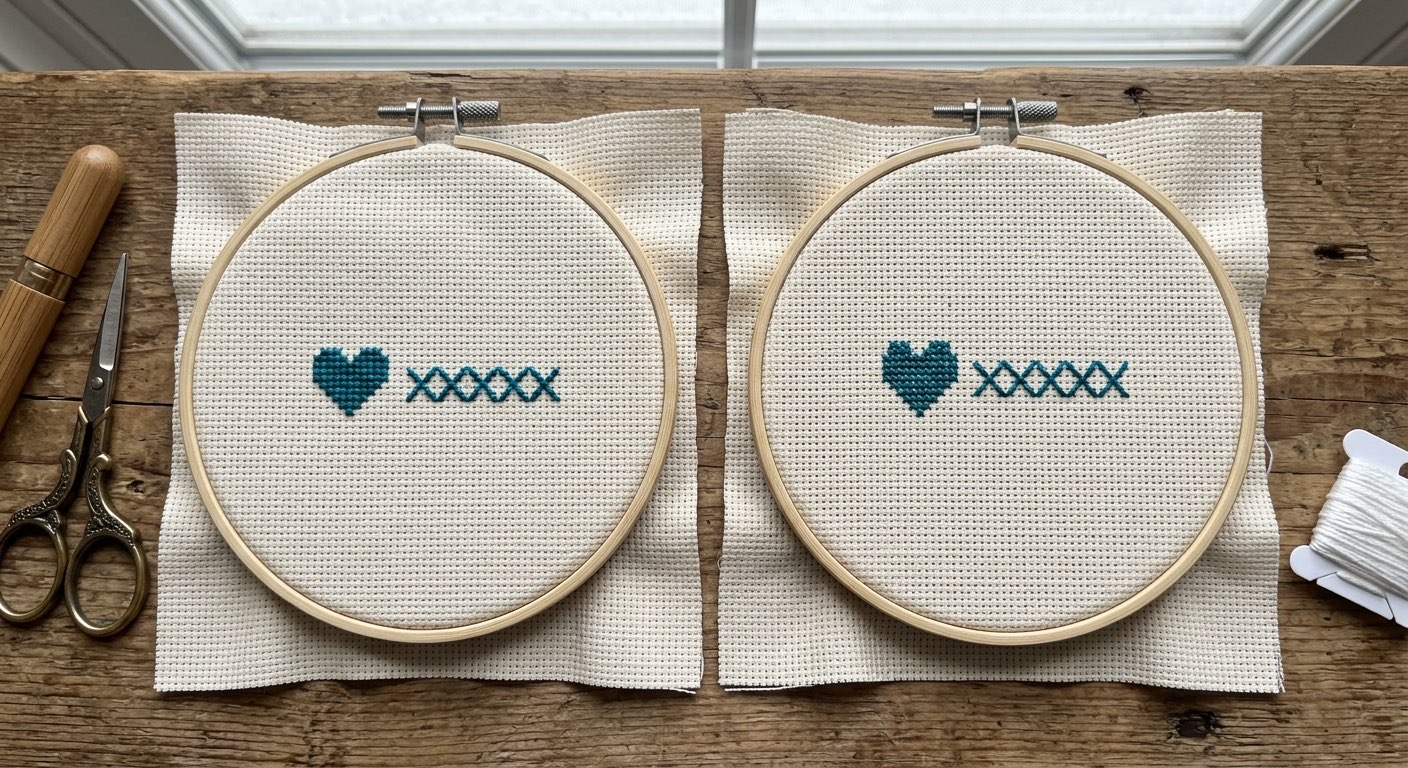
The second concern is sheen. Because DMC and Anchor have slightly different finishes, mixing them in areas of solid color that sit adjacent to each other could create a subtle texture difference. Again, usually not visible in a finished piece, but worth knowing.
Practical rule: If you’re substituting one color or a few colors, you’ll be fine. If you’re trying to mix brands randomly throughout a project, do a test stitch on a scrap of fabric first and look at it in different lighting before committing.
Converting Between DMC and Anchor
This is where getstitchies.com comes in.
Every DMC color has a dedicated conversion page that shows the closest Anchor equivalent, along with Madeira, Cosmo, and Sullivans matches. The conversions note the match quality — whether it’s an exact match, a very close equivalent, or just the nearest available color. Conversions are approximate; no two brands are guaranteed to be identical.
Some examples:
- DMC 310 Black → Anchor conversion — one of the few near-exact matches between brands
- DMC 321 Christmas Red → Anchor conversion — a popular red with a close Anchor equivalent
- DMC 796 Dark Royal Blue → Anchor conversion — compare how the blues translate
- Browse all color families to find colors you’re working with and check their cross-brand equivalents
If you’re converting an entire pattern from DMC to Anchor (or vice versa), the most reliable approach is to look up each color individually rather than using a generic chart — match quality varies significantly by color family, and some shades simply don’t have a close equivalent in the other brand.
For a broader look at what’s available, the color categories page organizes colors by family so you can compare options across brands within a hue range.
The Verdict
For most stitchers — especially those in the US following modern patterns — start with DMC. The availability, pattern compatibility, and color range make it the path of least resistance. You’ll spend less time converting codes and more time stitching.
If you’re in the UK, Australia, or Europe: either brand is a solid choice, and you may find Anchor more accessible locally. Anchor’s texture suits some stitchers better, and if the patterns you love are written for Anchor, there’s no good reason to convert everything to DMC.
If you already have a stash of one brand and someone hands you a pattern in the other: convert and keep stitching. The conversion tools exist precisely for this situation, and a close match is almost always available. Try looking up a few common colors like DMC 699 Christmas Green or DMC 930 Dark Antique Blue to see how the conversions work in practice.
Both brands have been around for generations. Both make high-quality thread. The best choice is usually whichever one is easiest to get your hands on, and that answer depends almost entirely on where you live.
Disclosure: This post contains affiliate links. We may earn a small commission at no cost to you when you purchase through these links. This helps support the site and allows us to continue creating free content.