
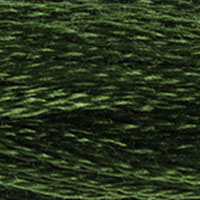
DMC 895 — Very Dark Hunter Green
Greens family · Hex #1B5300
Quick Conversion Table
| Brand | Equivalent | Match |
|---|---|---|
| Anchor | 1044 | exact |
| Madeira | 1314 | close |
| Cosmo ⚠ | 121 | close |
| Sullivans | 45248 | close |
| J&P Coats | 6021 | close |
| Bucilla | 895 | close |
| Candamar | 6065 | close |
Hunter green has a specific origin in outdoor and hunting culture — the dark, natural greens of forest and field that provided camouflage and blended with the environment were the practical colors of hunting dress in eighteenth- and nineteenth-century Europe. The name stuck to a category of deep, cool-leaning forest greens that read as serious, substantial, and fundamentally connected to the natural world. DMC 895, Very Dark Hunter Green at hex #1B5300, is one of the darkest and most definitively "hunter" greens in the DMC line: deep enough to function as shadow or outline, green enough to be unambiguous about its nature.
Hunter Green Versus Pistachio Green at This Value
DMC 890 (Ultra Dark Pistachio Green) is the other very-dark-green option in the DMC line, and understanding how 895 differs helps clarify where each belongs. 890's pistachio character gives it a slightly warmer, more yellow-green undertone at its dark value. 895's hunter character is cooler and slightly more blue-green, which reads as more formal, more forest-like, and more naturally connected to evergreen foliage. For holiday and evergreen work specifically, many stitchers prefer 895 over 890 for exactly this reason — the cooler, more serious dark green quality.
In practice, using both in the same piece is possible but requires care: the undertone difference between them is visible when adjacent, so mixing them within a single design element would look inconsistent. Using 895 for one design element (say, pine boughs) and 890 for another (say, an adjacent holly spray) can work if the design has enough separation between them.
The Essential Christmas Green
Christmas cross-stitch design is one of the most active categories in the community, and 895 appears in it constantly. Holiday wreaths, garlands, Christmas trees, pine boughs, holly — anything involving dark evergreen color in holiday work will likely include 895. Paired with DMC 890 (Ultra Dark Pistachio Green) for an even deeper shadow or with DMC 3345 (Dark Hunter Green) for the next lighter value, 895 anchors the dark end of the Christmas green range.
The classic Christmas color pairing of red and green reaches its most traditional expression when the green is dark — hunter green, not lime or medium green. 895 paired with DMC 816 (Garnet) or DMC 321 (Christmas Red) gives you a Christmas palette that reads as authentically traditional, the colors of Victorian Christmas cards and traditional holiday textile design rather than modern commercial holiday branding.
Forest and Nature Applications
Conifer trees, ferns, moss, and other deeply shadowed woodland vegetation all reach for 895 in their darkest tones. A forest scene where light falls through a canopy onto lower foliage needs 895 for the deeply shadowed areas — the green that exists in the forest interior where almost no direct light reaches. Without this depth, forest scenes read as evenly lit and flat; with it, the eye reads depth, distance, and the quality of diffuse light filtering through layered canopy.
Ivy and climbing plant designs use 895 for the shadow underside of leaves and the deeply shaded interior of dense ivy growth. The architectural quality of ivy-covered walls and garden structures depends on convincing shadow depth, and 895 provides it in the green family more naturally than any competing color.
Anchor 1044 and Madeira 1314 both earn exact match ratings, giving 895 reliable alternatives across the major brands. For such an important and widely-used dark green, these confirmed exact matches are particularly valuable — stitchers who work in Anchor or Madeira can source their equivalent with confidence that the resulting color will be correctly calibrated for holiday and nature designs.
Cosmo 121 and Sullivans 45248 are close matches. The hunter green family's cooler undertone is one of the more distinctive characteristics in this section of the green spectrum, and whether these alternatives match it precisely is worth testing before committing to large areas. For holiday work specifically, where the specific quality of the dark green is important to the design's traditional character, testing is especially recommended.
Within DMC, the direct alternatives in the hunter green family are DMC 3345 (Dark Hunter Green), which is lighter but in the same hue family, and DMC 890 (Ultra Dark Pistachio Green), which is at a similar depth but with warmer undertone. For designs where 895 functions as the darkest shadow green in a hunter green gradient, 890 can substitute if the slightly warmer undertone doesn't affect your design context adversely. For designs where 895 functions as the primary dark green and 890 wasn't specified, any dark forest green in the DMC line can potentially work — 3345, 890, or even DMC 500 (Very Dark Blue Green) if the blue-green quality would suit the design.
During holiday season, 895 can be harder to find in local stores because it's in high demand for Christmas projects. If you stitch a lot of holiday designs, keeping 895 stocked year-round rather than trying to source it in November or December is practical advice that FlossTube veterans frequently share.
Reference quality
How We Validate This Color Record
Use this page as a reference card for DMC 895: the structured data, quick conversions, and long-form copy are all tied back to the same stored color record.
- Methodology
- This page renders DMC 895, its hex value, and every brand equivalent from the site's source-of-truth color record, then checks long-form body copy against those same stored fields.
- Verification status
- Source-field checked. The page content is audited against the stored DMC number, brand equivalents, and match-quality labels before publishing.
- Last reviewed
- 2026-04-20
- Approximation warning
- Screen hex values, thread photos, and cross-brand conversions are reference aids. Dye lots, thread sheen, and fabric color can still shift the result in hand.
Decision guide
When to use the DMC 895 reference page
This page should help you decide faster between palette planning, brand substitution, and shade comparison without turning the color record into a thin lookup page.
Best for
- + Palette planning when you want the stored DMC 895 Very Dark Hunter Green record, hex value #1B5300, and linked brand equivalents in one place.
- + Checking the quickest cross-brand shortlist before you buy floss, compare stash substitutes, or route into a more specific conversion page.
- + Finding nearby shades in the greens family before you commit to accents, shading, or background blends.
Watch for
- ! Screen previews are only reference aids. Very Dark Hunter Green can shift on real fabric because thread sheen, stitch coverage, and room lighting change how the color reads.
- ! A stored equivalent is still a shortlist, not a guarantee that two brands will disappear into each other in the same stitched motif.
- ! Older charts, discontinued kit floss, and dye-lot variation can all introduce small but visible differences that the page cannot detect for you.
Before you commit
- Confirm the role of DMC 895 Very Dark Hunter Green: decide whether you need an exact hero shade, a forgiving background, or a rough stash substitute.
- Compare on project fabric: view the skein or stitched sample on the same fabric count and color you will actually use.
- Use the linked conversion pages next: open the brand-specific pages when you need match-quality caveats before substituting away from the DMC reference.
DMC 895 FAQ
These questions appear on the page so the FAQ schema stays aligned with what visitors can actually read.
What is the Anchor equivalent of DMC 895?+
The closest Anchor equivalent to DMC 895 (Very Dark Hunter Green) is Anchor 1044. This is an exact match.
What color is DMC 895?+
DMC 895 is called "Very Dark Hunter Green" and has a hex color value of #1B5300. It belongs to the greens color family.
What is the Madeira equivalent of DMC 895?+
The closest Madeira equivalent to DMC 895 (Very Dark Hunter Green) is Madeira 1314. This is a close match.
Year-round holiday SALs often use 895 as the primary dark green for any evergreen elements in monthly ornament exchanges. The standard single-ornament sized WIP that appears in December SAL groups typically uses 895 as one of two or three greens, making it one of the more regularly exhausted colors in a holiday-stitching stash.
Large-scale Christmas scenes — village scenes, nativity designs, fully decorated tree motifs — may use 895 in significant quantity for tree and garland coverage. If you're undertaking a major holiday project, buying two or three skeins of 895 at the outset prevents the frustrating mid-project discovery that you've run out. Dye lot consistency matters more in large areas of coverage, so buying all needed skeins from the same batch is worth the upfront expense.
How DMC 895 Looks on Fabric
The same thread appears different depending on your fabric. Always test on your project fabric.
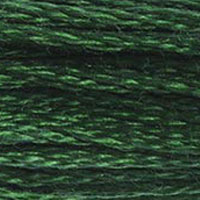
White Aida
Cream / Ecru
Black Aida
Pairs Well With
DMC colors commonly used alongside 895 Very Dark Hunter Green.
Suggested Palette
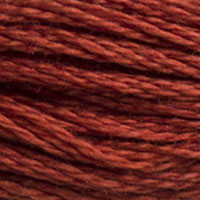
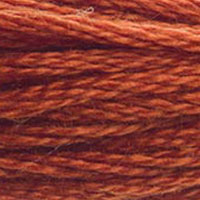
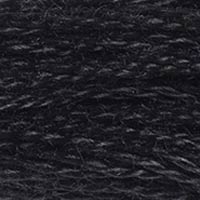
Shading Companions
Detailed Conversions
Where to Buy DMC 895
This section contains affiliate links. We may earn a small commission at no cost to you.
Related Guides
Free Printable Thread Conversion Chart
Pick a brand, enter your email, and we'll send you a printable chart mapping all 552 DMC colors to that brand's equivalents. Zero spam, one chart.
Thanks! Here's your free chart:
Download Your ChartOpens in a new tab. Use your browser's Print → Save as PDF.
No spam. Your email is stored securely and never shared.