
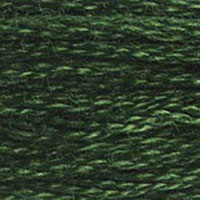
DMC 890 — Ultra Dark Pistachio Green
Greens family · Hex #184923
Quick Conversion Table
| Brand | Equivalent | Match |
|---|---|---|
| Anchor | 218 | exact |
| Madeira | 1314 | close |
| Cosmo ⚠ | 320 | close |
| Sullivans | 45243 | close |
| J&P Coats | 6021 | close |
| Dimensions | 6048 | close |
| Candamar | 6047 | close |
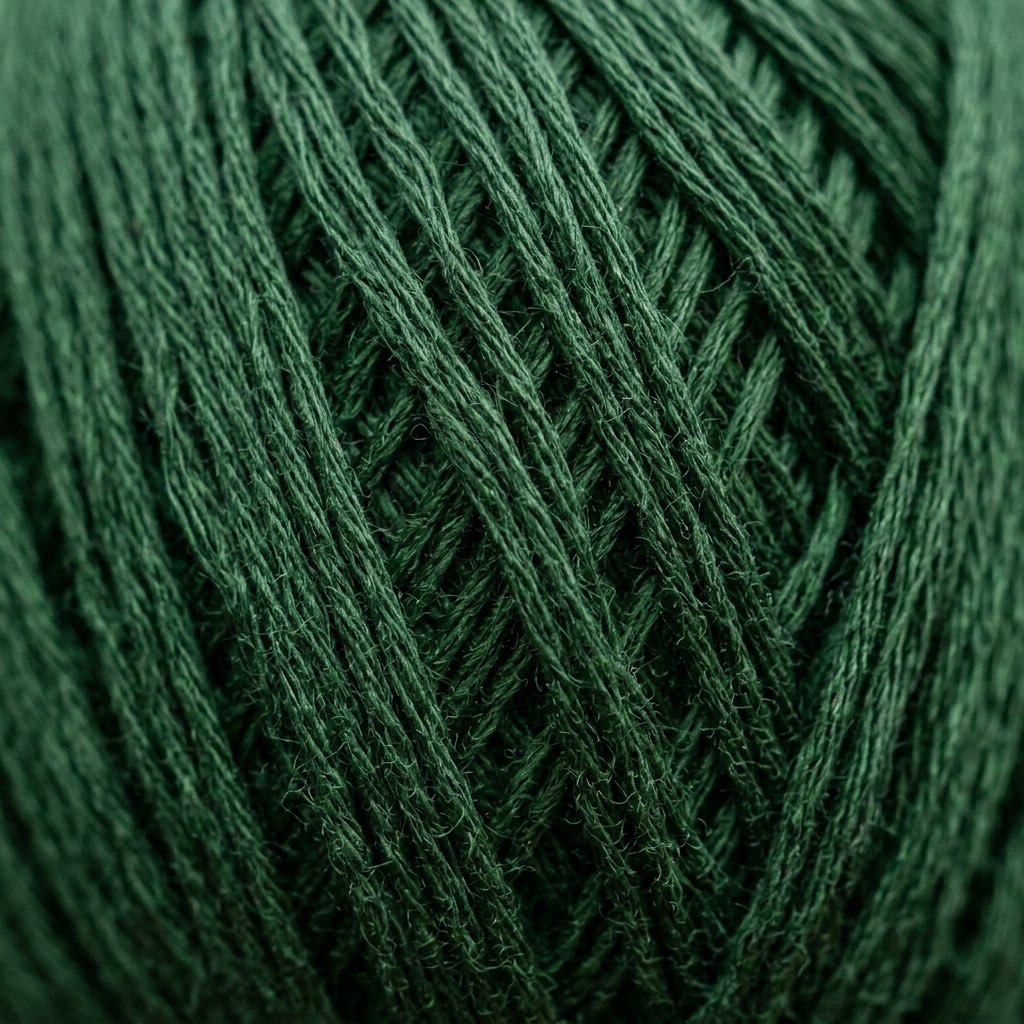
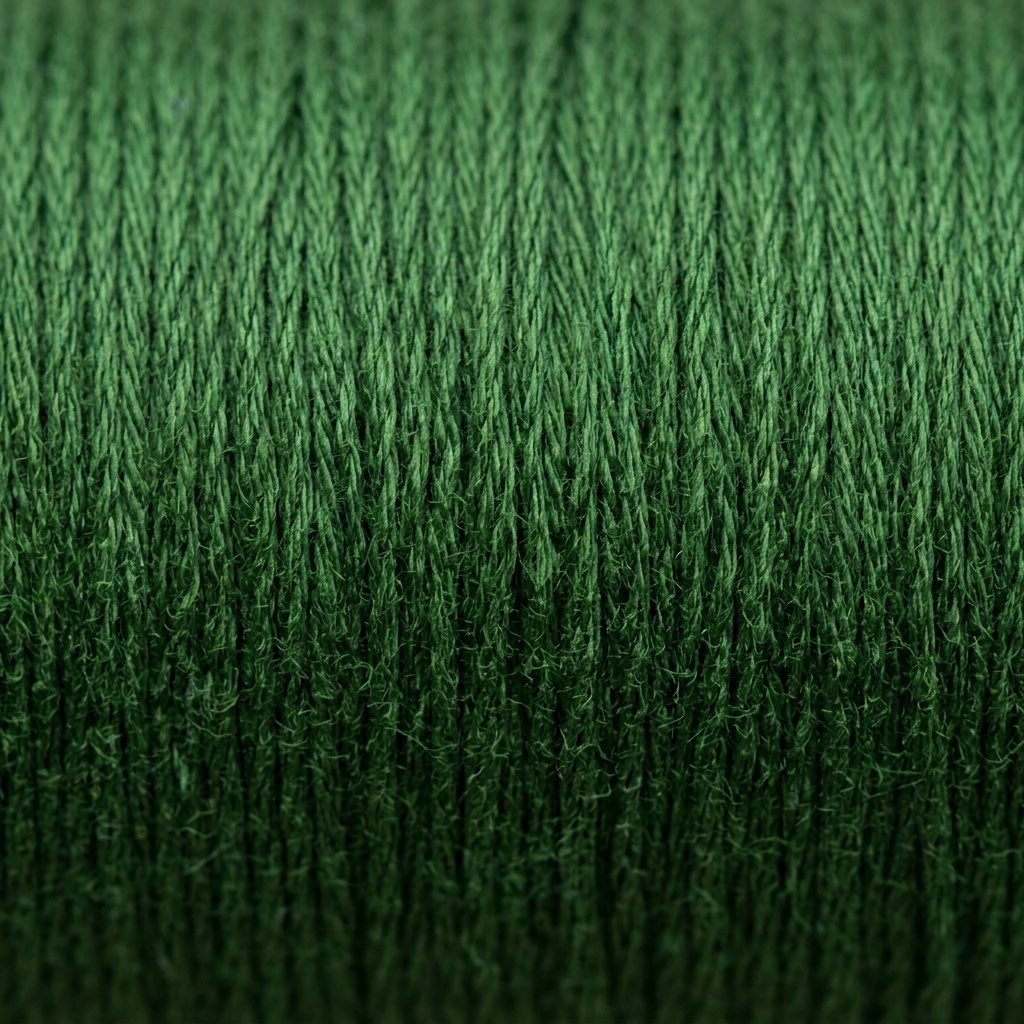
There's a problem that shows up in a specific type of Christmas or nature cross-stitch: you want a green that's dark enough to function as both shadow and outline — deep enough to visually anchor the piece — but that still reads as unmistakably, deeply green rather than drifting toward black or olive. DMC 890 solves this problem. Ultra Dark Pistachio Green at hex #184923 is one of the darkest greens in the DMC standard line, but it maintains a clear, forest-green identity that pure black or near-black could never provide.
The Darkest Green That Still Reads as Green
At this value, the question of whether a color reads as dark green or as near-black is determined by its saturation relative to its darkness. 890's pistachio-green undertone — which sounds lighter than the color actually is — provides enough green character that even at this deep value, the eye recognizes it as forest green rather than neutral dark. This property makes 890 uniquely useful as an outlining color for green-family designs, where using true black for backstitch would introduce a jarring neutral edge around warm green forms.
The pistachio green family (890 through 369) runs from this ultra-dark anchor all the way to very light pistachio — a substantial value range. 890 at the extreme dark end means the family has genuine depth to work with, which enables the kind of dramatic dark-to-light gradient that creates three-dimensional, luminous green rendering.
Christmas and Evergreen Designs
Evergreen trees, holly, pine boughs, and winter wreaths are natural subjects for 890. The deep shadow areas between pine needles, inside a dense wreath, or in the recesses of a thick holly branch correspond to 890's depth. Paired with DMC 895 (Very Dark Hunter Green) for the second-darkest tier, DMC 3345 (Dark Hunter Green) for the primary body green, and lighter pistachio values for highlights, 890 gives evergreen subjects the convincing depth that makes them read as three-dimensional and dense rather than flat.
A Christmas wreath in cross-stitch is only as convincing as its darkest greens. Without 890 (or something equally deep) tucked into the recesses, the wreath looks like it's made of equally-lit stems with no sense of depth or density. The dark green shadow that 890 provides is what creates the illusion of a real, thick wreath with interior depth.
Forest and Woodland Scenes
Deep forest cross-stitch — the dappled light of deciduous woodland, the dense interior of conifer forest, the mysterious green depth of a rain forest floor — relies on ultra-dark greens for visual credibility. 890 handles the deepest shadow green zones: the areas between tree trunks, the shadow beneath dense canopy, the deep recesses of layered foliage. Without this depth, forest scenes read as evenly lit rather than atmospherically deep.
Fern and moss designs, popular in botanical and woodland-themed cross-stitch, use 890 for the deepest shadow areas of overlapping fronds and the dark zone of fern undersides. The combination of this depth with 895 (Very Dark Hunter Green) and the lighter hunter green family members creates fern rendering of convincing naturalism.
Heraldic and Decorative Green
Heraldic designs that specify "vert" (heraldic green) in their dark shadow areas often use 890 for the shadow zone of the green quarters or fields. The color reads as authoritative and rich enough for formal heraldic use while remaining clearly green rather than drifting toward the olive or gray-green territory that would misrepresent the heraldic color.
Both Anchor 218 and Madeira 1314 earn exact match ratings, making 890 well-supported across the major brands. For such a deep, specific green, this cross-brand consistency is particularly useful — the exact pistachio-green character at this dark value is what makes 890 distinctive, and knowing that both Anchor and Madeira have calibrated to match it accurately gives stitchers flexibility in sourcing.
Cosmo 320 and Sullivans 45243 are close matches. At 890's extreme dark value, close matches can work adequately in most design contexts — the depth makes minor undertone differences less visible. However, in designs where 890 is outlining or adjacent to lighter pistachio green family members, any shift in the green character could disrupt the family coherence. Testing alongside your lighter pistachio greens before substituting is worthwhile.
Within DMC, the nearest neighbors are DMC 895 (Very Dark Hunter Green), which is in a different green family but at a similar dark value, and the next-lightest pistachio value. For designs where 890 functions specifically as the darkest pistachio green in a family gradient, 895 is not an ideal substitute — it reads as hunter green rather than pistachio, which changes the undertone of the gradient. For designs where 890 functions simply as the darkest available dark green for shadow or outlining, 895 is a more defensible alternative.
DMC 3345 (Dark Hunter Green) is another dark green option at a lighter value than 890, useful if 890 reads as too dark for your specific design. The jump from 3345 to 890 is significant — 890 is substantially darker — so using 3345 where 890 was specified means accepting a noticeable reduction in depth at the dark end of your green gradient.
Reference quality
How We Validate This Color Record
Use this page as a reference card for DMC 890: the structured data, quick conversions, and long-form copy are all tied back to the same stored color record.
- Methodology
- This page renders DMC 890, its hex value, and every brand equivalent from the site's source-of-truth color record, then checks long-form body copy against those same stored fields.
- Verification status
- Source-field checked. The page content is audited against the stored DMC number, brand equivalents, and match-quality labels before publishing.
- Last reviewed
- 2026-04-20
- Approximation warning
- Screen hex values, thread photos, and cross-brand conversions are reference aids. Dye lots, thread sheen, and fabric color can still shift the result in hand.
Decision guide
When to use the DMC 890 reference page
This page should help you decide faster between palette planning, brand substitution, and shade comparison without turning the color record into a thin lookup page.
Best for
- + Palette planning when you want the stored DMC 890 Ultra Dark Pistachio Green record, hex value #184923, and linked brand equivalents in one place.
- + Checking the quickest cross-brand shortlist before you buy floss, compare stash substitutes, or route into a more specific conversion page.
- + Finding nearby shades in the greens family before you commit to accents, shading, or background blends.
Watch for
- ! Screen previews are only reference aids. Ultra Dark Pistachio Green can shift on real fabric because thread sheen, stitch coverage, and room lighting change how the color reads.
- ! A stored equivalent is still a shortlist, not a guarantee that two brands will disappear into each other in the same stitched motif.
- ! Older charts, discontinued kit floss, and dye-lot variation can all introduce small but visible differences that the page cannot detect for you.
Before you commit
- Confirm the role of DMC 890 Ultra Dark Pistachio Green: decide whether you need an exact hero shade, a forgiving background, or a rough stash substitute.
- Compare on project fabric: view the skein or stitched sample on the same fabric count and color you will actually use.
- Use the linked conversion pages next: open the brand-specific pages when you need match-quality caveats before substituting away from the DMC reference.
DMC 890 FAQ
These questions appear on the page so the FAQ schema stays aligned with what visitors can actually read.
What is the Anchor equivalent of DMC 890?+
The closest Anchor equivalent to DMC 890 (Ultra Dark Pistachio Green) is Anchor 218. This is an exact match.
What color is DMC 890?+
DMC 890 is called "Ultra Dark Pistachio Green" and has a hex color value of #184923. It belongs to the greens color family.
What is the Madeira equivalent of DMC 890?+
The closest Madeira equivalent to DMC 890 (Ultra Dark Pistachio Green) is Madeira 1314. This is a close match.
How DMC 890 Looks on Fabric
The same thread appears different depending on your fabric. Always test on your project fabric.
White Aida
Cream / Ecru
Black Aida
Pairs Well With
DMC colors commonly used alongside 890 Ultra Dark Pistachio Green.
Suggested Palette
Shading Companions
Detailed Conversions
Where to Buy DMC 890
This section contains affiliate links. We may earn a small commission at no cost to you.
Related Guides
Free Printable Thread Conversion Chart
Pick a brand, enter your email, and we'll send you a printable chart mapping all 552 DMC colors to that brand's equivalents. Zero spam, one chart.
Thanks! Here's your free chart:
Download Your ChartOpens in a new tab. Use your browser's Print → Save as PDF.
No spam. Your email is stored securely and never shared.