
Quick Conversion Table
| Brand | Equivalent | Match |
|---|---|---|
| Anchor | 1022 | exact |
| Madeira | 0405 | close |
| Cosmo ⚠ | 853 | close |
| Sullivans | 45191 | close |
| J&P Coats | 3069 | close |
| Dimensions | 6760 | close |
| Bucilla | 6760 | close |
| Candamar | 6172 | close |
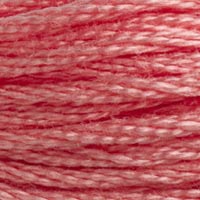
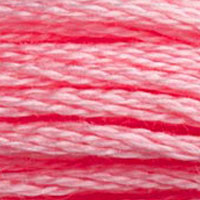
Salmon as a color sits at the fascinating intersection of pink, orange, and coral — a tripoint where minor shifts in any direction take you somewhere completely different. DMC 760 Salmon holds its position at this intersection with confidence. It's not so pink that it reads as a pure pink thread, not so orange that it becomes coral, not so muted that it reads as dusty rose. It's genuinely salmon — the color of the fish's flesh, of a certain evening sky, of a rose variety that gardeners sometimes call "salmon pink."
The Gradient Architecture of the Salmon Range
Understanding where DMC 760 sits in relation to its neighbors helps clarify its best uses. DMC 761 (Light Salmon) is one step lighter — softer, paler, and more pinkish. DMC 3328 (Dark Salmon) deepens into a more saturated, slightly more orange-toned salmon. DMC 347 (Very Dark Salmon) moves into a clear, rich coral-red. Together, this family covers the pink-orange middle ground that's so useful for skin tones, florals, and warm-palette designs.
In shading work, 760 serves as the mid-value: darker than the highlights (761, DMC 948), lighter than the shadows (3328, 347). For a coral or salmon-colored peony — the kind of soft, peachy-pink variety that shows up constantly in garden cross-stitch — the progression from 761 through 760 to 3328 produces a convincing sense of petal depth that single-color fills simply can't achieve.
Skin Tone Applications: The Blush Family
Salmon threads appear in skin tone palettes for two related reasons: as the actual skin tone for medium-warm complexions, and as the blush or flush color that appears on cheeks, the tip of the nose, and ear lobes in portrait work. DMC 760's particular warmth makes it useful for both purposes. For complexions in the medium-warm to medium-olive range, 760 can function as the shadow or contour color paired with lighter peach highlights.
As a blush color applied to lighter skin tones, 760 sometimes appears in patterns using a blended needle technique: one strand of DMC 754 (Light Peach) and one strand of 760 gives you a warm blush mid-tone that can be targeted to specific facial areas without a sharp color transition. This blending approach is common in realistic portrait styles and produces more naturalistic-looking facial color than a flat stitch area of either color alone.
Floral Design: Roses, Poppies, and Beyond
In the rose family of cross-stitch designs, salmon coloring is a distinct and popular variant — think coral garden roses, the David Austin rose varieties in warm pink-orange, or the Japanese varieties called "salmon pink." DMC 760 anchors the mid-tones in these designs. It also appears in poppy designs where a softer, more orange-leaning pink is called for, in tulip designs in the orange-pink range, and in peony patterns that want warmth without the deeper fuchsia tones of true pinks.
For spring floral SALs and large botanical panel WIPs, 760 tends to be a high-use color — it's versatile enough across the pink-orange range to appear in multiple different flower types within a single design.
Seasonal Context
Salmon occupies interesting seasonal territory: it's strongly associated with spring and summer — warm enough for summer garden themes, soft enough for spring florals — but also appears in beach and coastal designs where the color of sea glass, shells, and certain marine life naturally falls in the salmon range. Starfish, conch shells, certain coral formations, and sea anemones all have salmon tones that 760 represents accurately. If you're building a coastal or beach-themed piece, 760 alongside DMC 945 (Tawny) and DMC 3827 (Pale Golden Brown) creates the kind of warm, sun-bleached coastal palette that's genuinely evocative.
Anchor 1022 and Madeira 0405 are both exact-rated for DMC 760 and are reliable substitutions. The salmon family is one of the more consistently matched ranges across brands, so these conversions can be used with reasonable confidence in most design contexts.
Cosmo 853 and Sullivans 45191 are close-rated. Cosmo 853 reportedly sits slightly more coral-orange in some batches, which can work well in designs where the warm side of salmon is preferable. Sullivans 45191 is generally a good mid-range salmon equivalent.
Within DMC, DMC 761 (Light Salmon) is the most natural lighter substitute and is frequently specified in the same patterns as 760 — if you've run short and haven't started the shadow areas yet, you can sometimes shift the whole palette one step lighter using 761 without the change being obvious in context. DMC 3328 (Dark Salmon) substitutes in shadow areas where a touch more depth is acceptable. If you need to substitute 760 with something from outside the salmon family, DMC 353 (Peach) is in the general neighborhood but reads more peachy and less pink-orange — it can work in non-critical areas but will shift the color perceptibly in close comparison.
Reference quality
How We Validate This Color Record
Use this page as a reference card for DMC 760: the structured data, quick conversions, and long-form copy are all tied back to the same stored color record.
- Methodology
- This page renders DMC 760, its hex value, and every brand equivalent from the site's source-of-truth color record, then checks long-form body copy against those same stored fields.
- Verification status
- Source-field checked. The page content is audited against the stored DMC number, brand equivalents, and match-quality labels before publishing.
- Last reviewed
- 2026-04-20
- Approximation warning
- Screen hex values, thread photos, and cross-brand conversions are reference aids. Dye lots, thread sheen, and fabric color can still shift the result in hand.
Decision guide
When to use the DMC 760 reference page
This page should help you decide faster between palette planning, brand substitution, and shade comparison without turning the color record into a thin lookup page.
Best for
- + Palette planning when you want the stored DMC 760 Salmon record, hex value #F5ADAD, and linked brand equivalents in one place.
- + Checking the quickest cross-brand shortlist before you buy floss, compare stash substitutes, or route into a more specific conversion page.
- + Finding nearby shades in the pinks family before you commit to accents, shading, or background blends.
Watch for
- ! Screen previews are only reference aids. Salmon can shift on real fabric because thread sheen, stitch coverage, and room lighting change how the color reads.
- ! A stored equivalent is still a shortlist, not a guarantee that two brands will disappear into each other in the same stitched motif.
- ! Older charts, discontinued kit floss, and dye-lot variation can all introduce small but visible differences that the page cannot detect for you.
Before you commit
- Confirm the role of DMC 760 Salmon: decide whether you need an exact hero shade, a forgiving background, or a rough stash substitute.
- Compare on project fabric: view the skein or stitched sample on the same fabric count and color you will actually use.
- Use the linked conversion pages next: open the brand-specific pages when you need match-quality caveats before substituting away from the DMC reference.
DMC 760 FAQ
These questions appear on the page so the FAQ schema stays aligned with what visitors can actually read.
What is the Anchor equivalent of DMC 760?+
The closest Anchor equivalent to DMC 760 (Salmon) is Anchor 1022. This is an exact match.
What color is DMC 760?+
DMC 760 is called "Salmon" and has a hex color value of #F5ADAD. It belongs to the pinks color family.
What is the Madeira equivalent of DMC 760?+
The closest Madeira equivalent to DMC 760 (Salmon) is Madeira 0405. This is a close match.
How DMC 760 Looks on Fabric
The same thread appears different depending on your fabric. Always test on your project fabric.
White Aida
Cream / Ecru
Black Aida
Pairs Well With
DMC colors commonly used alongside 760 Salmon.
Suggested Palette
Shading Companions
Detailed Conversions
Where to Buy DMC 760
This section contains affiliate links. We may earn a small commission at no cost to you.
Related Guides
Free Printable Thread Conversion Chart
Pick a brand, enter your email, and we'll send you a printable chart mapping all 552 DMC colors to that brand's equivalents. Zero spam, one chart.
Thanks! Here's your free chart:
Download Your ChartOpens in a new tab. Use your browser's Print → Save as PDF.
No spam. Your email is stored securely and never shared.